Advertisements
Advertisements
Question
Describe fully one experiment with potted green plant to show that starch is not produced in the leaves when carbon dioxide is not available (diagrams essential)
Advertisements
Solution
Experiment to show that starch is not produced in the leaves when carbon dioxide is not available:
a. A potted plant is kept in the dark for two days to destarch the leaves.
b. Take a wide mouth bottle and fill 1/ 3'd of it with caustic potash solution.
c. Insert half part of the leaf of potted plant in the bottle and do not let the leaf to
touch the solution in the bottle.
d. The apparatus is kept in sunlight for few hours.
e. The leaf is plucked and tested for starch.
f. Only the portion of the leaf which is outside the bottle turns blue and the part of
the leaf inside the bottle remains colourless because it did not get C0 2 for
photosynthesis. All the C02 present in the bottle was absorbed by caustic
solution.

APPEARS IN
RELATED QUESTIONS
Fill in the blank:
Land plants obtain their carbon dioxide from the ______.
How would you demonstrate that green plants release oxygen when exposed to light?
Photosynthesis in green plants is directly and indirectly dependent on so many plant structures.
Explain briefly the role of the following structures in this process is Xylem tissue in the leaf veins
Given below is a schematic diagram to illustrate some aspects of photosynthesis.
- Fill up the gaps, in blank spaces (1-4), by writing the names of the correct items.
- What phenomenon do the thick arrows A and B indicate?

Given below is the representation of a certain phenomenon in nature. With four organisms 1-4.
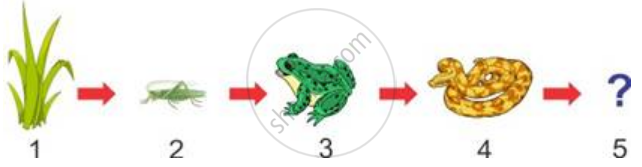
Name any one organism that could be shown at No .5
Given alongside is the diagram of an experimental set-up:
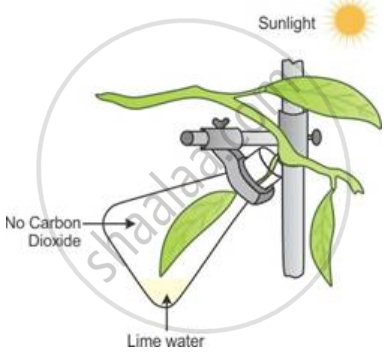
Will it work satisfactorily? Given reason.
Chlorophyll is necessary for photosynthesis.
Choose the Odd One Out
Match the terms given in column A with column B:
| Column A | Column B | ||
| (a) | Chlorophyll | (i) | Removes/absorbs CO2 |
| (b) | Methylated spirit | (ii) | Tests presence of starch |
| (c) | Potassium hydroxide | (iii) | Traps solar energy |
| (d) | Iodine solution | (iv) | Produces oxygen |
| (e) | Water | (v) | Bleaches chlorophyll |
