Advertisements
Advertisements
Question
How would you demonstrate that green plants release oxygen when exposed to light?
Advertisements
Solution
- Place some water plants (Elodea or Hydrilla) in a beaker containing pond water and cover them by a short-stemmed funnel.
- Invert a test tube full of water over the stem of the funnel. (Ensure that the level of water in the beaker is above the level of the stem of the inverted funnel.)
- Place the apparatus in the sun for a few hours (in Fig). Bubbles of the gas will collect in the test tube.
- Test the gas in the test tube. A glowing splinter bursts into flame, which shows the presence of oxygen.

RELATED QUESTIONS
Fill in the blank:
Land plants obtain their carbon dioxide from the ______.
How do non-green plants such as fungi and bacteria obtain their nourishment?
Given below is a schematic diagram to illustrate some aspects of photosynthesis.
- Fill up the gaps, in blank spaces (1-4), by writing the names of the correct items.
- What phenomenon do the thick arrows A and B indicate?

Given below is the representation of a certain phenomenon in nature. With four organisms 1-4.

Name the biological process which was the starting point of the whole chain.
Given alongside is the diagram of an experimental set-up:
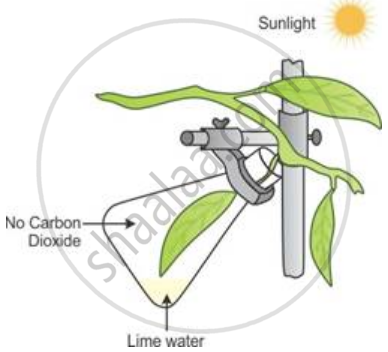
Would you take any step before starting the experiment? Describe this step and explain its necessity.
A potted plant was taken in order to prove a factor necessary for photosynthesis. The potted plant was kept in the dark for 24 hours. One of the leaves was covered with black paper in the centre. The potted plant was then placed in sunlight for a few hours.
During the starch test, why was the leaf
(1) boiled in water
(2) boiled in methylated spirit
A potted plant was taken in order to prove a factor necessary for photosynthesis. The potted plant was kept in the dark for 24 hours. One of the leaves was covered with black paper in the centre. The potted plant was then placed in sunlight for a few hours.
Write a balanced chemical equation to represent the process of photosynthesis.
Choose the Odd One Out
Write the overall chemical equation for photosynthesis.
Name two plants having variegated leaves.
