Advertisements
Advertisements
Question
Given below is a schematic diagram to illustrate some aspects of photosynthesis.
- Fill up the gaps, in blank spaces (1-4), by writing the names of the correct items.
- What phenomenon do the thick arrows A and B indicate?

Advertisements
Solution
-
- Sunlight
- Oxygen
- Glucose
- Water
-
- Transpiration
- Ascent of sap
APPEARS IN
RELATED QUESTIONS
Name the following:
The source of carbon dioxide for aquatic plants.
Given below is the representation of a certain phenomenon in nature. With four organisms 1-4.

Name the biological process which was the starting point of the whole chain.
Given alongside is the diagram of an experimental set-up:
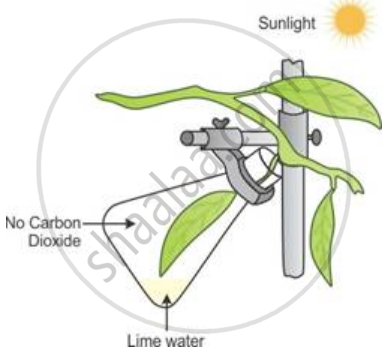
Will it work satisfactorily? Given reason.
A potted plant was taken in order to prove a factor necessary for photosynthesis. The potted plant was kept in the dark for 24 hours. One of the leaves was covered with black paper in the centre. The potted plant was then placed in sunlight for a few hours.
What aspect of photosynthesis was being tested?
The diagram below shows two test-tubes A and B. Test-tube A contains a green water plant. Test-tube B contains both a green water plant and a snail. Both test-tubes are kept in sunlight. Answer the questions that follow:

(a) Name the physiological process that releases the bubbles of oxygen.
(b) Explain the physiological process as mentioned above in (a).
(c) What is the purpose of keeping a snail in test-tube B?
(d) Why does test-tube B have more bubbles of oxygen?
(e) Give an example of a water plant that can be used in the above experiment.
(f) Write the overall chemical equation for the above process.
Chloroplasts are called energy converters.
Name the following:
Light in which the maximum rate of photosynthesis takes place.
Choose the Odd One Out
Write the overall chemical equation for photosynthesis.
