Advertisements
Advertisements
Question
Advertisements
Solution
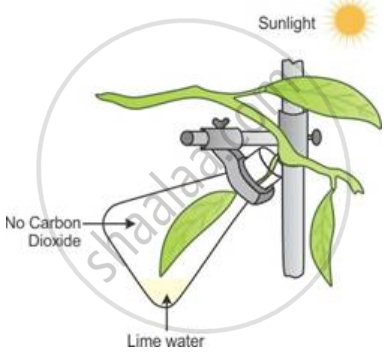
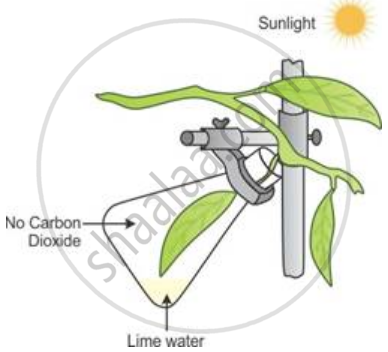
The amount of carbon dioxide in the atmosphere is increasing due to increased human activities like burning of fossil fuels, deforestation, etc. which cause the rise in global temperatures. This global warming result in melting of polar ice caps, floods in coastal areas, disturbance in hydrogenic cycle etc. Thus "Human activities are harmful to the balance of nature".
APPEARS IN
RELATED QUESTIONS
The diagram is set up to demonstrate an experiment. Pond weed was placed in five water-filled tubes. The experiment was set up as shown in the diagram. The tubes were then left for 24 hours. Write the correct answer out of the five available choices:
(i) In which tube would you except to find the plant with the least amount of starch?
(a ) 1 (b) 2 (c) 3 (d) 4 (e ) 5
(ii) The tube in which most oxygen would be found is
(a ) 1 (b) 2 (c) 3 (d) 4 (e ) 5
(iii) The tube in which least carbon dioxide would be found is
(a ) 1 (b) 2 (c) 3 (d) 4 (e ) 5
(iv) The tube in which the plant would survive for the shortest length of time is
(a ) 1 (b) 2 (c) 3 (d) 4 (e) 5

Complete the following by filling the blanks 1 to 5 with appropriate words/terms/phrases:
To test the leaf for starch, the leaf is boiled in water to ______ (1). It is next boiled in methylated spirit to ______ (2). The leaf is placed in warm water to soften it. It is then placed in a dish and ______ (3) solution is added. The region which contains starch, turns ______ (4) and the region which does not contain starch, turns ______ (5)
A potted plant was taken in order to prove a factor necessary for photosynthesis. The potted plant was kept in the dark for 24 hours. One of the leaves was covered with black paper in the centre. The potted plant was then placed in sunlight for a few hours.
What aspect of photosynthesis was being tested?
The diagram below shows two test-tubes A and B. Test-tube A contains a green water plant. Test-tube B contains both a green water plant and a snail. Both test-tubes are kept in sunlight. Answer the questions that follow:

(a) Name the physiological process that releases the bubbles of oxygen.
(b) Explain the physiological process as mentioned above in (a).
(c) What is the purpose of keeping a snail in test-tube B?
(d) Why does test-tube B have more bubbles of oxygen?
(e) Give an example of a water plant that can be used in the above experiment.
(f) Write the overall chemical equation for the above process.
Name the following:
The site of light reaction in the cell of a leaf.
Give technical term:
Name only one plant, you are familiar with which has no chlorophyll.
Choose the Correct Answer:
The main difference between chlorophyll ‘a’ and ‘b’ is:
Name two aquatic plants which can be used for the experiment of photosynthesis.
Given below is the figure of an experimental set-up, showing a physiological act of the plants. Study and answer the following questions:

- What is the objective of this experiment?
- Name and define the process shown here.
- Why do we destarch the leaves before performing the experiment?
- How do we destarch the leaves?
- What will be the observation when we pour iodine solution over the bleached experimental leaf?
- Write a well-balanced equation for the above process.