Advertisements
Advertisements
Question
Given alongside is the diagram of an experimental set-up:
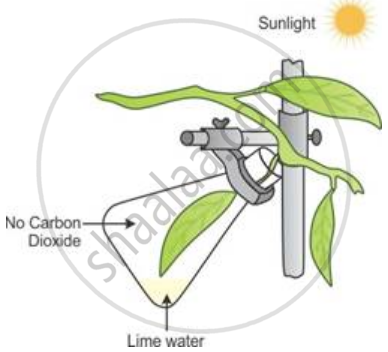
Would you take any step before starting the experiment? Describe this step and explain its necessity.
Advertisements
Solution
Before starting the experiment, it is necessary to destarch the leaves of the plant by keeping the plant in complete darkness for 48 hours. This is because if the plant is not destarched, then the experiment will give false results because starch stored previously may be detected in the leaf placed in the beaker even if no starch is produced during the experiment.
RELATED QUESTIONS
Name the following:
The source of carbon dioxide for aquatic plants.
A potted plant was taken in order to prove a factor necessary for photosynthesis. The potted plant was kept in the dark for 24 hours. One of the leaves was covered with black paper in the centre. The potted plant was then placed in sunlight for a few hours.
Why was the plant placed in the dark before beginning the experiment?
A potted plant was taken in order to prove a factor necessary for photosynthesis. The potted plant was kept in the dark for 24 hours. One of the leaves was covered with black paper in the centre. The potted plant was then placed in sunlight for a few hours.
Draw a neat diagram of a chloroplast and label its parts.
Where are the chlorophyll pigments present in a cell?
Chlorophyll is necessary for photosynthesis.
Chloroplasts are called energy converters.
Name the following:
Light in which the maximum rate of photosynthesis takes place.
Choose the Correct Answer:
The main difference between chlorophyll ‘a’ and ‘b’ is:
Match the terms given in column A with column B:
| Column A | Column B | ||
| (a) | Chlorophyll | (i) | Removes/absorbs CO2 |
| (b) | Methylated spirit | (ii) | Tests presence of starch |
| (c) | Potassium hydroxide | (iii) | Traps solar energy |
| (d) | Iodine solution | (iv) | Produces oxygen |
| (e) | Water | (v) | Bleaches chlorophyll |
