Advertisements
Advertisements
Question
Match the terms given in column A with column B:
| Column A | Column B | ||
| (a) | Chlorophyll | (i) | Removes/absorbs CO2 |
| (b) | Methylated spirit | (ii) | Tests presence of starch |
| (c) | Potassium hydroxide | (iii) | Traps solar energy |
| (d) | Iodine solution | (iv) | Produces oxygen |
| (e) | Water | (v) | Bleaches chlorophyll |
Advertisements
Solution
| Column A | Column B | ||
| (a) | Chlorophyll | (iii) | Traps solar energy |
| (b) | Methylated spirit | (v) | Bleaches chlorophyll |
| (c) | Potassium hydroxide | (i) | Removes/absorbs CO2 |
| (d) | Iodine solution | (ii) | Tests presence of starch |
| (e) | Water | (iv) | Produces oxygen |
APPEARS IN
RELATED QUESTIONS
Describe fully one experiment with potted green plant to show that starch is not produced in the leaves when carbon dioxide is not available (diagrams essential)
Name the following:
The main mineral constituent of chlorophyll.
Photosynthesis in green plants is directly and indirectly dependent on so many plant structures.
Explain briefly the role of the following structures in this process is Xylem tissue in the leaf veins
Given alongside is the diagram of an experimental set-up:
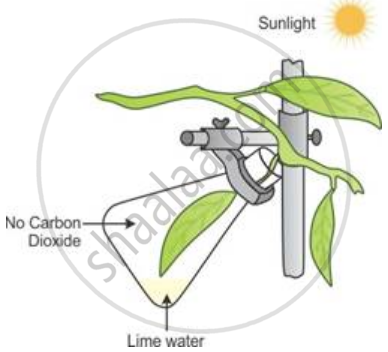
What alteration (s) will you make in it for obtaining expected result?
A potted plant was taken in order to prove a factor necessary for photosynthesis. The potted plant was kept in the dark for 24 hours. One of the leaves was covered with black paper in the centre. The potted plant was then placed in sunlight for a few hours.
During the starch test, why was the leaf
(1) boiled in water
(2) boiled in methylated spirit
Name the following:
The site of light reaction in the cell of a leaf.
Name the following:
Light in which the maximum rate of photosynthesis takes place.
Choose the Odd One Out
Write the overall chemical equation for photosynthesis.
Given below is the figure of an experimental set-up, showing a physiological act of the plants. Study and answer the following questions:

- What is the objective of this experiment?
- Name and define the process shown here.
- Why do we destarch the leaves before performing the experiment?
- How do we destarch the leaves?
- What will be the observation when we pour iodine solution over the bleached experimental leaf?
- Write a well-balanced equation for the above process.
