Advertisements
Advertisements
प्रश्न
Match the terms given in column A with column B:
| Column A | Column B | ||
| (a) | Chlorophyll | (i) | Removes/absorbs CO2 |
| (b) | Methylated spirit | (ii) | Tests presence of starch |
| (c) | Potassium hydroxide | (iii) | Traps solar energy |
| (d) | Iodine solution | (iv) | Produces oxygen |
| (e) | Water | (v) | Bleaches chlorophyll |
Advertisements
उत्तर
| Column A | Column B | ||
| (a) | Chlorophyll | (iii) | Traps solar energy |
| (b) | Methylated spirit | (v) | Bleaches chlorophyll |
| (c) | Potassium hydroxide | (i) | Removes/absorbs CO2 |
| (d) | Iodine solution | (ii) | Tests presence of starch |
| (e) | Water | (iv) | Produces oxygen |
APPEARS IN
संबंधित प्रश्न
An experiment was set up as shown in the figure given below . The twig in the diagram was intact on the plant and it was as such in sunlight for a few hours .
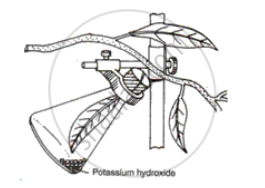
(i) What is the aim of the above experiment ?
(ii) Why was potassium hydroxide placed inside the conical flask ?
(iii) What test would you perform on the leaf inside the flask?
(iv) What is the expected result of the above test ?
(v) Is it necessary to similarly test on outer leaf also ? Giva a reason .
How do non-green plants such as fungi and bacteria obtain their nourishment?
Photosynthesis in green plants is directly and indirectly dependent on so many plant structures.
Explain briefly the role of the following structures in this process Guard cells.
Given alongside is the diagram of an experimental set-up:
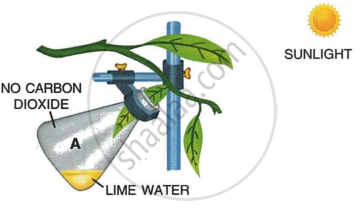
- What is the objective of this experiment?
- Will it work satisfactorily? Give reason.
- What alteration(s) will you make in it for obtaining expected result?
- Would you take any steps before starting the experiment? Describe this step and explain its necessity.
Given alongside is the diagram of an experimental set-up:
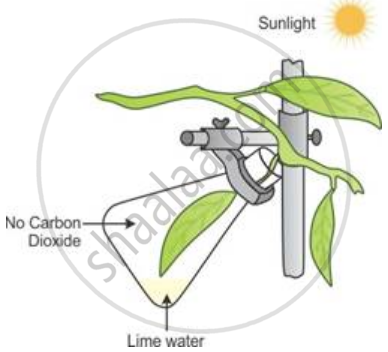
What alteration (s) will you make in it for obtaining expected result?
Where are the chlorophyll pigments present in a cell?
Why Is Photosynthesis Important in Nature?
Choose the Correct Answer:
The main difference between chlorophyll ‘a’ and ‘b’ is:
Given below is the diagram of an experimental set-up (final stage). Study the same and answer the following questions:

- What is the main aim of the experiment?
- Oxygen gas shown in the experiment is released from which of the raw materials?
- How would you confirm the presence of oxygen gas?
- Name the chemical substance which can be added in water to enhance the process/rate of release of oxygen gas.
- Draw a neat and labelled diagram of the same experiment for its initial stage.
