Advertisements
Advertisements
Question
The diagram below shows two test-tubes A and B. Test-tube A contains a green water plant. Test-tube B contains both a green water plant and a snail. Both test-tubes are kept in sunlight. Answer the questions that follow:

(a) Name the physiological process that releases the bubbles of oxygen.
(b) Explain the physiological process as mentioned above in (a).
(c) What is the purpose of keeping a snail in test-tube B?
(d) Why does test-tube B have more bubbles of oxygen?
(e) Give an example of a water plant that can be used in the above experiment.
(f) Write the overall chemical equation for the above process.
Advertisements
Solution
(a) Photosynthesis releases bubbles of oxygen.
(b) Photosynthesis is a physiological process by which plant cells containing chlorophyll produce food in the form of carbohydrates by using carbon dioxide, water and light energy. Oxygen is released as a by-product.
(c) Carbon dioxide released by the snail during respiration is used by the plant for photosynthesis. This increases the rate of photosynthesis in the plant placed in test tube B. This also suggests that both respiration and photosynthesis are complementary processes to maintain the concentration of oxygen and carbon dioxide in the atmosphere.
(d) A plant and a snail are kept in test tube B. The plant in test tube B has more concentration of CO2 available because the snail releases CO2 during respiration. This increases the rate of photosynthesis in the plant placed in test tube B which leads to the release of more amount of oxygen.
(e) Hydrilla
(f) Chemical equation for photosynthesis:
\[\ce {6CO_2 + 12H_2O ->[Light energy][Chlorophyll] C_6H_12O_6 + 6H_2O + 6O_2 ↑ }\]
APPEARS IN
RELATED QUESTIONS
The diagram is set up to demonstrate an experiment. Pond weed was placed in five water-filled tubes. The experiment was set up as shown in the diagram. The tubes were then left for 24 hours. Write the correct answer out of the five available choices:
(i) In which tube would you except to find the plant with the least amount of starch?
(a ) 1 (b) 2 (c) 3 (d) 4 (e ) 5
(ii) The tube in which most oxygen would be found is
(a ) 1 (b) 2 (c) 3 (d) 4 (e ) 5
(iii) The tube in which least carbon dioxide would be found is
(a ) 1 (b) 2 (c) 3 (d) 4 (e ) 5
(iv) The tube in which the plant would survive for the shortest length of time is
(a ) 1 (b) 2 (c) 3 (d) 4 (e) 5

Mention one difference between the following on the basis of what is given in bracket.
Chlorophyll and chloroplast (part of plant cell)
Given alongside is the diagram of an experimental set-up:
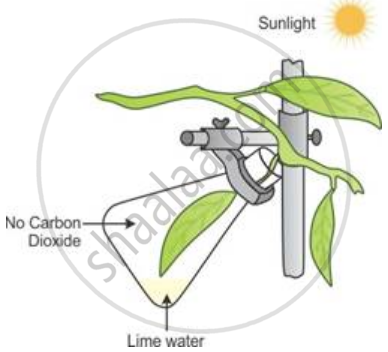
What alteration (s) will you make in it for obtaining expected result?
Given alongside is the diagram of an experimental set-up:
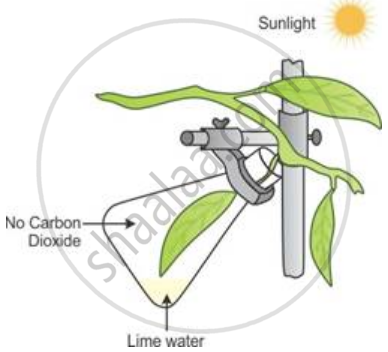
Would you take any step before starting the experiment? Describe this step and explain its necessity.
Where are the chlorophyll pigments present in a cell?
Complete the following sentence with appropriate word:
________ are regarded as complete photosynthetic units of plants.
Choose the Odd One Out
Choose the correct answer:
Chlorophyll is present
