Advertisements
Advertisements
Question
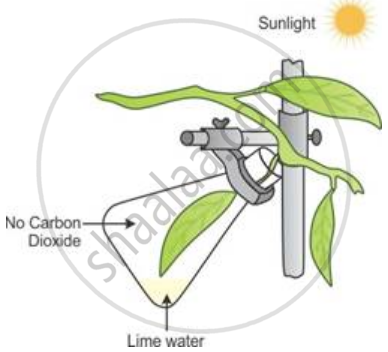
A potted plant was taken in order to prove a factor necessary for photosynthesis. The potted plant was kept in the dark for 24 hours. One of the leaves was covered with black paper in the centre. The potted plant was then placed in sunlight for a few hours.
Write a balanced chemical equation to represent the process of photosynthesis.
Advertisements
Solution
Chemical equation for the process of photosynthesis:
\[\ce {6CO_2 + 12H_2O ->[Light energy][chlorophyll] C_6H_12O_6 + 6H_2O + 6O_2}\]
APPEARS IN
RELATED QUESTIONS
An experiment was set up as shown in the figure given below . The twig in the diagram was intact on the plant and it was as such in sunlight for a few hours .

(i) What is the aim of the above experiment ?
(ii) Why was potassium hydroxide placed inside the conical flask ?
(iii) What test would you perform on the leaf inside the flask?
(iv) What is the expected result of the above test ?
(v) Is it necessary to similarly test on outer leaf also ? Giva a reason .
The diagram alongside refers to an experiment in which the apparatus was set up with the light source 10 cm away from the plant. After 15 minutes the number of bubbles evolved per minute from the cut stem was recorded. The light source was moved to 20 cm away from the plant, left for 15 minutes and the number of bubbles evolved per minute was again recorded. The experiment was repeated with the light source at distances of 40, 60, 80 and 100 cm away from the plant. Plot a graph for the results obtained and answer the following questions.

(i) From the graph it seems likely that the rate of bubbling per minute at 50 cm would have been
(a) 2.0 (b) 2.5 (c) 3.0 (d) 3.5
(ii) The gas produced by the plant during the experiment was
(a) air (b) oxygen (c) carbon dioxide (d) nitrogen (e) hydrogen
(iii) The gas collected comes due to the breakdown of
(a) glucose (b) starch (c) water (d) air (e) ATP
(iv) If ice cubes were added to the water, the rate of bubble formation would
(a) Stay the same.
(b) Increase because more water is added.
(c) Decrease because the temperature drops.
(d) Decrease because water freezes.
(e) Cannot tell from the information given.
(v) If some sodium bicarbonate is added to the water the rate of bubble formation
(a) Increases because more respiration occurs.
(b) Increases because more photosynthesis occurs.
(c) Increases because the gas becomes less soluble.
(d) Decreases because carbon dioxide acts as a limiting factor.
(e) Decreases because respiration decreases.
Name the following:
The source of carbon dioxide for aquatic plants.
Mention one difference between the following on the basis of what is given in bracket.
Chlorophyll and chloroplast (part of plant cell)
Why is it not possible to demonstrate respiration in a green plant kept in sunlight?
The diagram below shows two test-tubes A and B. Test-tube A contains a green water plant. Test-tube B contains both a green water plant and a snail. Both test-tubes are kept in sunlight. Answer the questions that follow:

(a) Name the physiological process that releases the bubbles of oxygen.
(b) Explain the physiological process as mentioned above in (a).
(c) What is the purpose of keeping a snail in test-tube B?
(d) Why does test-tube B have more bubbles of oxygen?
(e) Give an example of a water plant that can be used in the above experiment.
(f) Write the overall chemical equation for the above process.
Give technical term:
Name only one plant, you are familiar with which has no chlorophyll.
Complete the following sentence with appropriate word:
________ are regarded as complete photosynthetic units of plants.
Which of the following is used to remove chlorophyll from the leaves?
Name two plants having variegated leaves.