Advertisements
Advertisements
प्रश्न
A potted plant was taken in order to prove a factor necessary for photosynthesis. The potted plant was kept in the dark for 24 hours. One of the leaves was covered with black paper in the centre. The potted plant was then placed in sunlight for a few hours.
Write a balanced chemical equation to represent the process of photosynthesis.
Advertisements
उत्तर
Chemical equation for the process of photosynthesis:
\[\ce {6CO_2 + 12H_2O ->[Light energy][chlorophyll] C_6H_12O_6 + 6H_2O + 6O_2}\]
APPEARS IN
संबंधित प्रश्न
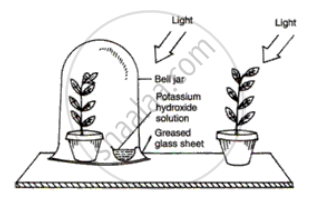
Two healthy green plants were placed in the dark for 24 hours. They were then set up, as shown in the figure, for 4 hours. Then a leaf was taken from each plant and
the chlorophyll was removed from the leaves:
( i) What is the next and final step in this experiment?
( ii ) What would be the results of the final step?
( iii ) Why was it necessary to grease the glass sheet?
( iv ) What hypothesis is being tested in this experiment?
Fill in the blank:
Land plants obtain their carbon dioxide from the ______.
Given below is the representation of a certain phenomenon in nature. With four organisms 1-4.

Name the biological process which was the starting point of the whole chain.
A potted plant was taken in order to prove a factor necessary for photosynthesis. The potted plant was kept in the dark for 24 hours. One of the leaves was covered with black paper in the centre. The potted plant was then placed in sunlight for a few hours.
What aspect of photosynthesis was being tested?
A potted plant was taken in order to prove a factor necessary for photosynthesis. The potted plant was kept in the dark for 24 hours. One of the leaves was covered with black paper in the centre. The potted plant was then placed in sunlight for a few hours.
Draw a neat diagram of a chloroplast and label its parts.
Differentiate Between:
Light reaction and Dark reaction.
Give technical term:
Name only one plant, you are familiar with which has no chlorophyll.
Complete the following sentence with appropriate word:
Carbon dioxide enters the leaf through _______.
Give reasons/explain:
During the starch test, the leaf is boiled in methylated spirit.
