Advertisements
Advertisements
प्रश्न
Given alongside is the diagram of an experimental set-up:
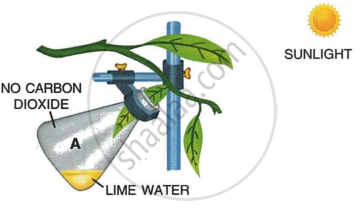
- What is the objective of this experiment?
- Will it work satisfactorily? Give reason.
- What alteration(s) will you make in it for obtaining expected result?
- Would you take any steps before starting the experiment? Describe this step and explain its necessity.
Advertisements
उत्तर
- To demonstrate the importance of carbon dioxide in photosynthesis.
- No, the experiment will not work satisfactorily, as the beaker contains lime water and not potassium hydroxide to absorb CO2.
- Place potassium hydroxide in the beaker instead of lime water.
- The plant must be kept in complete darkness for 48 hours in order to destarch its foliage prior to commencing the experiment. The reason for this is that the experiment will yield false results if the plant is not destarched, as the leaf deposited in the beaker may contain starch that was previously stored, even if no starch is produced during the experiment.
APPEARS IN
संबंधित प्रश्न
A healthy oat seeding in a pot is transferred from light to any airy but completely dark room. How would it differ from its original condition in appearance after about a week? Explain the difference.
Mention one difference between the following on the basis of what is given in bracket.
Chlorophyll and chloroplast (part of plant cell)
The chemical substance used to test the presence of starch in the cell of a leaf is ______.
How do non-green plants such as fungi and bacteria obtain their nourishment?
All life owes its existence to chlorophyll. Give reason.
Photosynthesis in green plants is directly and indirectly dependent on so many plant structures.
Explain briefly the role of the following structures in this process is Xylem tissue in the leaf veins
Name the following:
The green colouring matter of the plants.
Complete the following sentence with appropriate word:
A light-induced reaction which leads to the splitting of water is _____ of water.
Given below is the figure of an experimental set-up, showing a physiological act of the plants. Study and answer the following questions:

- What is the objective of this experiment?
- Name and define the process shown here.
- Why do we destarch the leaves before performing the experiment?
- How do we destarch the leaves?
- What will be the observation when we pour iodine solution over the bleached experimental leaf?
- Write a well-balanced equation for the above process.
Given below is the diagram of an experimental set-up (final stage). Study the same and answer the following questions:

- What is the main aim of the experiment?
- Oxygen gas shown in the experiment is released from which of the raw materials?
- How would you confirm the presence of oxygen gas?
- Name the chemical substance which can be added in water to enhance the process/rate of release of oxygen gas.
- Draw a neat and labelled diagram of the same experiment for its initial stage.
