Advertisements
Online Mock Tests
Chapters
1: Cell: The structural and functional unit of life
2: Structure of chromosome, cell cycle and cell division
3: Genetics: Some Basic Fundamentals
Unit-2 : Plant Physiology
4: Absorption by roots: The Processes Involved
5: Transpiration
▶ 6: Photosynthesis
7: Chemical Coordination in Plants
Unit-3 : Human Anatomy and Physiology
8: The Circulatory System
9: The Excretory System
10: The Nervous System
11: Sense Organs
12: The Endocrine System
13: The Reproductive System
Unit-4 : Human Evolution
14: Human Evolution
Unit-5 : Population
15: Population: The increasing numbers and rising problems
Unit-6 : Pollution
16: Pollution: A Rising Environmental Problem

Advertisements
Solutions for Chapter 6: Photosynthesis
Below listed, you can find solutions for Chapter 6 of CISCE Selina for कन्साइस बायोलॉजी [अंग्रेजी] कक्षा १० आईसीएसई.
Selina solutions for कन्साइस बायोलॉजी [अंग्रेजी] कक्षा १० आईसीएसई 6 Photosynthesis Progress Check [Page 74]
Answer the following in “Yes” or “No”
All parts of a green plant carry out photosynthesis
Answer the following in “Yes” or “No”
All green parts of a plant carry out photosynthesis.
Answer the following in “Yes” or “No”
Photosynthesis is the only biological process that releases oxygen into the air.
Answer the following in “Yes” or “No”
Out of nine types of chlorophylls, chlorophyll a and b are the most abundant.
Answer the following in “Yes” or “No”
Too much light destroys chlorophyll.
Answer the following in “Yes” or “No”
No transpiration occurs during photosynthesis.
Answer the following in “Yes” or “No”
During sunlight, the guard cells turn flaccid to open the stomata.
Selina solutions for कन्साइस बायोलॉजी [अंग्रेजी] कक्षा १० आईसीएसई 6 Photosynthesis Progress Check [Page 76]
- Write the overall summary of the chemical equation of photosynthesis.
- Which single substance in the above equation is repeated in raw material as well as reproduced as an end product?
What is the source of oxygen released in photosynthesis - CO2 or H2O?
What happens in photolysis?
Dark reaction involves utilisation of CO2 in producing C6H12O6 (glucose). Why is this phase called dark reaction?
Glucose produced during photosynthesis is soon polymerised into starch. What does polymerisation mean?
Why is it better to call the dark phase of photosynthesis as “light-independent phase”?
Selina solutions for कन्साइस बायोलॉजी [अंग्रेजी] कक्षा १० आईसीएसई 6 Photosynthesis Progress Check [Page 78]
How do the following favour increased photosynthesis?
Large surface area of the leaf.
How do the following favour increased photosynthesis?
Thinness of the leaf.
How do the following favour increased photosynthesis?
More numerous stomata.
Name the three end-products of photosynthesis and mention the fate of each of them in the plant.
If we keep on increasing CO2 concentration in the air, will the rate of photõsynthesis also keep on increasing in direct proportion?
Yes/No. Explain.
Selina solutions for कन्साइस बायोलॉजी [अंग्रेजी] कक्षा १० आईसीएसई 6 Photosynthesis Progress Check [Page 81]
Why is it necessary to destarch the leaves of a plant before performing an experiment on photosynthesis?
Why do we perform the iodine test?
What chemical do you use to remove CO2 from inside a flask in certain experiments on photosynthesis?
All food chains start with a plant. Why is this so?
The honey bee produces honey. In terms of the food chain, is the honey bee a producer or a consumer?
Selina solutions for कन्साइस बायोलॉजी [अंग्रेजी] कक्षा १० आईसीएसई 6 Photosynthesis Review Questions [Pages 82 - 85]
MULTIPLE CHOICE TYPE (Select the most appropriate option in each case)
Chlorophyll is located in ______.
Stroma
Thylakoid
Stoma
Fret
Which of the following is not applicable to the process of photosynthesis?
Oxygen is evolved
Carbon dioxide is absorbed
Carbon dioxide is evolved
Water is utilised
The colour of VIBGYOR spectrum, which is reflected by chlorophyll, is ______.
Blue
Green
Green
Yellow
The basic functional unit of solar energy which is absorbed by the pigment chlorophyll is ______.
Proton
Phytochrome
Phyton
Photon
The molecules of water split during ______.
Photorespiration
Phosphorylation
Photolysis
Photophosphorylation
The granum is a pile of many ______.
Frets
Stoma
Strama
Thylakoids
Which of the following is used to remove chlorophyll from the leaves?
Iodine solution
Methylated spirit
Potassium hydroxide
Soda lime
The raw material which is reduced during photosynthesis is ______.
Carbon dioxide
Glucose
Water
Oxygen
The optimum temperature for the process of photosynthesis is ______.
53°C
45°C
25°C
35°C
The conversion of several glucose molecules into starch is termed as ______.
Photolysis
Phosphorylation
Polymerisation
Photorespiration
The following questions are Assertion-Reason based questions. Choose the answer based on the options given below.
Assertion (A): Photosynthesis occurs in all parts of a green plant.
Reason (R): Chlorophyll is the green pigment which traps solar energy during daytime.
A is True and R is False.
A is False and R is True.
Both A and R are True.
Both A and R are False.
Assertion (A): Guard cells regulate the opening and closing of the stomatal aperture.
Reason (R): Guard cells contain chloroplasts and are mostly located on the lower surface of the leaves. Other cells of the lower epidermis do not contain chloroplasts.
A is True and R is False
A is False and R is True
Both A and R are True
Both A and R are False
Assertion (A): Palisade cells of mesophyll are loosely arranged towards the lower epidermis of a dorsiventral leaf.
Reason (R): Palisade cells contain the maximum amount of chlorophyll, trap solar energy and help in the process of photosynthesis.
A is True and R is False.
A is False and R is True.
Both A and R are True.
Both A and R are False.
Assertion (A): Phosphorylation occurs in all organisms only during the process of respiration.
Reason (R): Photophosphorylation is the process during which ADP combines with inorganic phosphate (iP) and produces ATP.
A is True and R is False.
A is False and R is True.
Both A and R are True.
Both A and R are False.
Assertion (A): A plant should be placed in dark for 24 to 48 hours before using it for experiments on photosynthesis.
Reason (R): During this period, all the starch from the leaves, is either utilized in the process of respiration or stored in the storage organs.
A is True and R is False.
A is False and R is True.
Both A and R are True.
Both A and R are False.
VERY SHORT ANSWER TYPE
Name the following:
The category of organisms that prepare their own food from basic raw materials.
Name the following:
The kind of plastids found in the mesophyll cells of the leaf.
Name the following:
The compound which stores energy in the cells.
Name the following:
The first form of food substance produced during photosynthesis.
Name the following:
The source of carbon dioxide for aquatic plants.
Name the following:
The part of chloroplast where the dark reaction of photosynthesis takes place.
Given below are groups of terms. The first pair indicates the relationship between the two terms. Complete the second pair accordingly.
Chlorophyll : Magnesium : : Haemoglobin : ______
Given below are groups of terms. The first pair indicates the relationship between the two terms. Complete the second pair accordingly.
Light reaction : Gran um : : Dark reaction : ______
Given below are groups of terms. The first pair indicates the relationship between the two terms. Complete the second pair accordingly.
Producers : Autotrophs : : Consumers : ______
Given below are groups of terms. The first pair indicates the relationship between the two terms. Complete the second pair accordingly.
Respiration: Carbon dioxide : : Photosynthesis : ______
Given below are groups of terms. The first pair indicates the relationship between the two terms. Complete the second pair accordingly.
Water and minerals : Xylem : : Prepared food : ______
SHORT ANSWER TYPE
Identify the false statement and rewrite it correctly by changing the first or last word only.
Dark reaction of photosynthesis occurs during night time.
True
False
Identify the false statement and rewrite it correctly by changing the first or last word only.
Photosynthesis requires enzymes.
True
False
Identify the false statement and rewrite it correctly by changing the first or last word only.
Green plants are consumers.
True
False
Identify the false statement and rewrite it correctly by changing the first or last word only.
Photosynthesis results in the loss of dry weight of the plants.
True
False
Identify the false statement and rewrite it correctly by changing the first or last word only.
Photosynthesis stops at a temperature of about 35°C.
True
False
Identify the false statement and rewrite it correctly by changing the first or last word only.
Photosynthesis occurs only in cells containing chloroplasts.
True
False
Identify the false statement and rewrite it correctly by changing the first or last word only.
Green plants perform photosynthesis.
True
False
Identify the false statements and rewrite them correctly by changing the first or last word only.
Algae are autotrophs.
True
False
Fill in the blanks with the appropriate answer from the choices given in the options.
The site of light reaction in the cells of a leaf is ______.
cytoplasm
stroma
grana
The chemical substance used to test the presence of starch in the cell of a leaf is ______.
CaCl2
iodine solution
Benedict solution
Stroma is ground substance in ______.
cytoplasm
chloroplast
ribosomes
The dark reaction of photosynthesis is known as ______.
Hill reaction
cyclic phosphorylation
Calvin cycle
In the flowering plants, food is transported in the form of ______.
sucrose
glucose
starch
Are the following statement true or false? Give a reason in support of your answer.
The rate of photosynthesis continues to rise as long as the intensity of light rises.
True
False
Are the following statement true or false? Give a reason in support of your answer.
The outside atmospheric temperature has no effect on the rate of photosynthesis.
True
False
Are the following statement true or false? Give a reason in support of your answer.
If you immerse a leaf intact on the plant in ice cold water, it will continue to photosynthesise in bright sunshine.
True
False
Are the following statement true or false? Give a reason in support of your answer.
Destarching of the leaves of a potted plant can occur only at night.
True
False
Are the following statement true or false? Give a reason in support of your answer.
If a plant is kept in bright light all the 24 hours for a few days, the dark reaction (biosynthetic phase) will fail to occur.
True
False
Are the following statement true or false? Give a reason in support of your answer.
Photosynthesis is considered as a process supporting all life on earth.
True
False
Given below are five terms. Rewrite the terms in the correct order so as to be in logical sequence with regard to photosynthesis:
(i) water molecules, (ii) oxygen, (iii) grana, (iv) hydrogen and hydroxyl ions, (v) photons.
State any four differences between photosynthesis and respiration.
Complete the following food chains by writing the names of appropriate organisms in the blanks:
Grass → ______ → Snake → ______
Complete the following food chains by writing the names of appropriate organisms in the blanks:
______ → Mouse ______ → Peacock
Name two aquatic plants which can be used for the experiment of photosynthesis.
Name two plants having variegated leaves.
Name two raw materials for photosynthesis.
Name four essentials for photosynthesis.
Name the two main phases of photosynthesis.
Match the terms given in column A with column B:
| Column A | Column B | ||
| (a) | Chlorophyll | (i) | Removes/absorbs CO2 |
| (b) | Methylated spirit | (ii) | Tests presence of starch |
| (c) | Potassium hydroxide | (iii) | Traps solar energy |
| (d) | Iodine solution | (iv) | Produces oxygen |
| (e) | Water | (v) | Bleaches chlorophyll |
Complete the following by filling the blanks 1 to 5 with appropriate words/terms/phrases:
To test the leaf for starch, the leaf is boiled in water to ______ (1). It is next boiled in methylated spirit to ______ (2). The leaf is placed in warm water to soften it. It is then placed in a dish and ______ (3) solution is added. The region which contains starch, turns ______ (4) and the region which does not contain starch, turns ______ (5)
State the location:
Chlorophyll
Write the exact location of chloroplasts in the parts of a plant.
State the location:
Stroma
Write the exact location of guard cells.
Write the exact location of palisade cells.
DESCRIPTIVE TYPE
Define Photosynthesis.
Define the following term:
Thylakoids
Define the following term:
Chloroplast
Define the following term:
Photolysis of water
Define the following term:
Polymerisation
Given below is the figure of an experimental set-up, showing a physiological act of the plants. Study and answer the following questions:

- What is the objective of this experiment?
- Name and define the process shown here.
- Why do we destarch the leaves before performing the experiment?
- How do we destarch the leaves?
- What will be the observation when we pour iodine solution over the bleached experimental leaf?
- Write a well-balanced equation for the above process.
Why is it necessary to place a plant in the dark before starting an experiment on photosynthesis? Explain.
Why is it not possible to demonstrate respiration in a green plant kept in sunlight?
Most leaves have the upper surface more green and shiny than the lower one. Why?
Give reasons/explain:
During the starch test, the leaf is boiled in water.
Give reasons/explain:
During the starch test, the leaf is boiled in methylated spirit.
Distinguish between the following pairs on the basis of the word indicated in the bracket ( ).
Light reaction and Dark reaction (end products)
Distinguish between the following pairs on the basis of the word indicated in the bracket ( ).
Producers and Consumers (organisms)
Mention one difference between the following on the basis of what is given in bracket.
Grass and grasshopper (mode of nutrition)
Distinguish between the following pairs on the basis of the word indicated in the bracket ( ).
Stoma and Stroma (structure)
STRUCTURED/APPLICATION/SKILL TYPE
Given below is a schematic diagram to illustrate some aspects of photosynthesis.
- Fill up the gaps, in blank spaces (1-4), by writing the names of the correct items.
- What phenomenon do the thick arrows A and B indicate?

Given below is the representation of a certain phenomenon in nature. With four organisms 1-4.

- Name the phenomenon represented.
- Name any one organism that could be shown at No. 5.
- Name the biological process which was the starting point of the whole chain.
- Name one natural element which all the organisms 2-4 and even 5 are getting from No. 1 for their survival.
A potted plant with variegated leaves was taken in order to prove a factor necessary for photosynthesis. The potted plant was kept in the dark for 24 hours and then placed in bright sunlight for a few hours. Observe the diagrams and answer the questions:

- What aspect of photosynthesis is being tested in the above diagram?
- Represent the process of photosynthesis in the form of a balanced equation.
- Why was the plant kept in the dark before beginning the experiment?
- What will be the result of the starch test performed on Leaf ‘A’ shown in the diagram? Give an example of a plant with variegated leaves
- Draw a neat labelled diagram of a chloroplast.
Given alongside is the diagram of an experimental set-up:
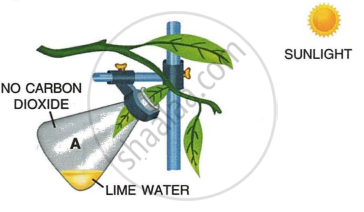
- What is the objective of this experiment?
- Will it work satisfactorily? Give reason.
- What alteration(s) will you make in it for obtaining expected result?
- Would you take any steps before starting the experiment? Describe this step and explain its necessity.
Draw a neat diagram of the stomatal apparatus found in the epidermis of leaves and label the Stoma, Guard cells, Chloroplast, Epidermal cells, Cell wall and Nucleus.
Given below is the diagram of an experimental set-up (final stage). Study the same and answer the following questions:

- What is the main aim of the experiment?
- Oxygen gas shown in the experiment is released from which of the raw materials?
- How would you confirm the presence of oxygen gas?
- Name the chemical substance which can be added in water to enhance the process/rate of release of oxygen gas.
- Draw a neat and labelled diagram of the same experiment for its initial stage.
Given below are figures (A) and (B) showing open and closed stomatal apertures respectively.
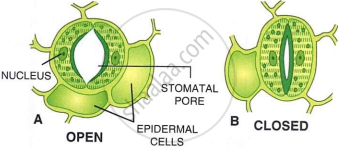
Answer the questions that follow:
- When do these stomata open (day/night)?
- What is the condition of the guard cells when the stomata are open (turgid/flaccid)?
- Name the gas taken in and released out through these pores during photosynthesis.
- Name the cells of the lower epidermis that contain chloroplasts.
- Write two characteristic features of both the inner and outer walls of the guard cells.
Solutions for 6: Photosynthesis
Selina solutions for कन्साइस बायोलॉजी [अंग्रेजी] कक्षा १० आईसीएसई chapter 6 - Photosynthesis
Shaalaa.com has the CISCE Mathematics कन्साइस बायोलॉजी [अंग्रेजी] कक्षा १० आईसीएसई CISCE solutions in a manner that help students grasp basic concepts better and faster. The detailed, step-by-step solutions will help you understand the concepts better and clarify any confusion. Selina solutions for Mathematics कन्साइस बायोलॉजी [अंग्रेजी] कक्षा १० आईसीएसई CISCE 6 (Photosynthesis) include all questions with answers and detailed explanations. This will clear students' doubts about questions and improve their application skills while preparing for board exams.
Further, we at Shaalaa.com provide such solutions so students can prepare for written exams. Selina textbook solutions can be a core help for self-study and provide excellent self-help guidance for students.
Concepts covered in कन्साइस बायोलॉजी [अंग्रेजी] कक्षा १० आईसीएसई chapter 6 Photosynthesis are Carbon Cycle, Regulation of Stomatal Opening for Carbon Dioxide Intake, Experiments on Photosynthesis, Adaptations in Leaves to Perform Photosynthesis, Process of Photosynthesis, Factors Affecting Photosynthesis, Products of Photosynthesis, Opening and Closing of Stomata, Light Reaction, Light-Independent Phase of Photosynthesis, Significance of Photosynthesis, Concept of Photosynthesis, Chlorophyll: The Vital Plant Pigment, Carbon Cycle, Regulation of Stomatal Opening for Carbon Dioxide Intake, Experiments on Photosynthesis, Adaptations in Leaves to Perform Photosynthesis, Process of Photosynthesis, Factors Affecting Photosynthesis, Products of Photosynthesis, Opening and Closing of Stomata, Light Reaction, Light-Independent Phase of Photosynthesis, Significance of Photosynthesis, Concept of Photosynthesis, Chlorophyll: The Vital Plant Pigment, Carbon Cycle, Regulation of Stomatal Opening for Carbon Dioxide Intake, Experiments on Photosynthesis, Adaptations in Leaves to Perform Photosynthesis, Process of Photosynthesis, Factors Affecting Photosynthesis, Products of Photosynthesis, Opening and Closing of Stomata, Light Reaction, Light-Independent Phase of Photosynthesis, Significance of Photosynthesis, Concept of Photosynthesis, Chlorophyll: The Vital Plant Pigment.
Using Selina कन्साइस बायोलॉजी [अंग्रेजी] कक्षा १० आईसीएसई solutions Photosynthesis exercise by students is an easy way to prepare for the exams, as they involve solutions arranged chapter-wise and also page-wise. The questions involved in Selina Solutions are essential questions that can be asked in the final exam. Maximum CISCE कन्साइस बायोलॉजी [अंग्रेजी] कक्षा १० आईसीएसई students prefer Selina Textbook Solutions to score more in exams.
Get the free view of Chapter 6, Photosynthesis कन्साइस बायोलॉजी [अंग्रेजी] कक्षा १० आईसीएसई additional questions for Mathematics कन्साइस बायोलॉजी [अंग्रेजी] कक्षा १० आईसीएसई CISCE, and you can use Shaalaa.com to keep it handy for your exam preparation.
