Advertisements
Advertisements
प्रश्न
Given below is the figure of an experimental set-up, showing a physiological act of the plants. Study and answer the following questions:

- What is the objective of this experiment?
- Name and define the process shown here.
- Why do we destarch the leaves before performing the experiment?
- How do we destarch the leaves?
- What will be the observation when we pour iodine solution over the bleached experimental leaf?
- Write a well-balanced equation for the above process.
Advertisements
उत्तर
- To demonstrate the need for sunlight for photosynthesis.
- Photosynthesis. Photosynthesis is the process by which plants produce glucose using water, carbon dioxide, sunshine, and chlorophyll pigment in their leaves. Photosynthesis produces glucose and oxygen as its end products. Plants use glucose to power their cells, while other species require oxygen for respiration.
- We remove starch from a plant to facilitate photosynthesis in the presence of sunlight. If starch is already present in the leaves, photosynthesis does not take place.
- By keeping the leaves in a dark room for 24 to 48 hours, we can destarch them. This is because darkness inhibits photosynthesis and enables the plant to use up any stored starch.
- If starch is present, the bleached experimental leaf will turn blue-black when iodine solution is applied. The leaf is said to be starch-free if there is no colour change and it stays brown.
- \[\ce{6CO2 + 6H2O ->[Sunlight][Chlorophyll] C6H12O6 + 6O2}\]
APPEARS IN
संबंधित प्रश्न
Fill in the blank:
Land plants obtain their carbon dioxide from the ______.
The diagram is set up to demonstrate an experiment. Pond weed was placed in five water-filled tubes. The experiment was set up as shown in the diagram. The tubes were then left for 24 hours. Write the correct answer out of the five available choices:
(i) In which tube would you except to find the plant with the least amount of starch?
(a ) 1 (b) 2 (c) 3 (d) 4 (e ) 5
(ii) The tube in which most oxygen would be found is
(a ) 1 (b) 2 (c) 3 (d) 4 (e ) 5
(iii) The tube in which least carbon dioxide would be found is
(a ) 1 (b) 2 (c) 3 (d) 4 (e ) 5
(iv) The tube in which the plant would survive for the shortest length of time is
(a ) 1 (b) 2 (c) 3 (d) 4 (e) 5

Photosynthesis in green plants is directly and indirectly dependent on so many plant structures.
Explain briefly the role of the following structures in this process Guard cells.
Photosynthesis in green plants is directly and indirectly dependent on so many plant structures.
Explain briefly the role of the following structures in this process is Xylem tissue in the leaf veins
Given below is the representation of a certain phenomenon in nature. With four organisms 1-4.
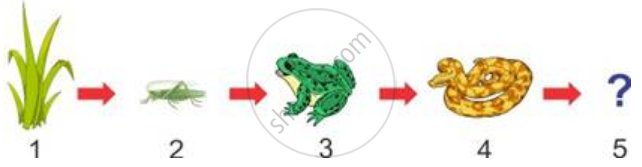
Name one natural element which all the organisms 2-4 and even 5 are getting from No. 1 for their survival.
Name the following:
The green colouring matter of the plants.
Complete the following sentence with appropriate word:
________ are regarded as complete photosynthetic units of plants.
Complete the following sentence with appropriate word:
Carbon dioxide enters the leaf through _______.
Name two plants having variegated leaves.
Match the terms given in column A with column B:
| Column A | Column B | ||
| (a) | Chlorophyll | (i) | Removes/absorbs CO2 |
| (b) | Methylated spirit | (ii) | Tests presence of starch |
| (c) | Potassium hydroxide | (iii) | Traps solar energy |
| (d) | Iodine solution | (iv) | Produces oxygen |
| (e) | Water | (v) | Bleaches chlorophyll |
