Advertisements
Online Mock Tests
Chapters
1: Cell: The structural and functional unit of life
2: Structure of chromosome, cell cycle and cell division
3: Genetics: Some Basic Fundamentals
Unit-2 : Plant Physiology
4: Absorption by roots: The Processes Involved
5: Transpiration
6: Photosynthesis
7: Chemical Coordination in Plants
Unit-3 : Human Anatomy and Physiology
8: The Circulatory System
9: The Excretory System
10: The Nervous System
11: Sense Organs
▶ 12: The Endocrine System
13: The Reproductive System
Unit-4 : Human Evolution
14: Human Evolution
Unit-5 : Population
15: Population: The increasing numbers and rising problems
Unit-6 : Pollution
16: Pollution: A Rising Environmental Problem
![Selina solutions for कन्साइस बायोलॉजी [अंग्रेजी] कक्षा १० आईसीएसई chapter 12 - The Endocrine System - Shaalaa.com](/images/concise-biology-english-class-10-icse_6:930ad8471f2d4b8b8e0d2fbdad788b1f.jpg "Selina solutions for कन्साइस बायोलॉजी [अंग्रेजी] कक्षा १० आईसीएसई chapter 12 - The Endocrine System")
Advertisements
Solutions for Chapter 12: The Endocrine System
Below listed, you can find solutions for Chapter 12 of CISCE Selina for कन्साइस बायोलॉजी [अंग्रेजी] कक्षा १० आईसीएसई.
Selina solutions for कन्साइस बायोलॉजी [अंग्रेजी] कक्षा १० आईसीएसई 12 The Endocrine System Intext Question [Pages 163 - 169]
Progress Check Fill in the blanks by selecting the appropriate alternative from those given in brackets.
Regulation of activities inside the body are brought about by ______ and ______ systems.
nervous
digestive
endocrine
Hormones are secreted directly into the ______.
organs
lymph
blood
Chemically, some hormones are ______ some steroids, some ______.
proteins
amines
carbohydrates
Both ______ or deficiency of hormones lead to serious consequences.
excess
absence
Hormones produced in one species usually show ______ influence in other species.
similar
different
Give the characteristics of hormones pertaining to site of action.
Give the characteristics of hormones pertaining to chemical nature.
Give the characteristics of hormones pertaining to manner of transportation.
Write a note on the four different kinds of cell in Pancreas.
Mention the two principal ways in which insulin acts.
Name the following condition:
Passage of much glucose in urine.
Name the following condition:
Overdose of insulin makes the diabetic patient unconscious.
List any three symptoms of diabetes mellitus.
List the hormones secreted by the following:
Adrenal
List any two effects of adrenaline.
Progress Check Fill in the blanks with the correct alternative:
Thyroid is located close to ______.
larynx
kidney
Cretinism is caused due to ______ of thyroxin.
undersecretion
oversecretion
Oversecretion of thyroxin causes ______ goitre.
simple
exophthalmic
The condition showing swelling in face and hands and sluggishness due to hypothyroidism is called ______.
cretinism
myxoedema
The hormone concerned with facing dangers is ______.
thyroxine
cortisone
adrenalin
Cortex and medulla are the two regions of ______.
thyroid
adrenal
One of the effects of increased secretion of adrenaline is ______.
Dry mouth
slowing of heart beat
arterioles of the digestive system dilate
Progress Check
Mention if the following statement is true (T) or false (F). If false, rewrite the correct word (not words) striking out the single wrong one.
Pituitary is of the size of a lemon.
True
False
Mention if the following statement is true (T) or false (F). If false, rewrite the correct word (not words) striking out the single wrong one.
Pituitary has three lobes - anterior, posterior and intermediate.
True
False
Mention if the following statement is true (T) or false (F). If false, rewrite the correct word (not words) striking out the single wrong one.
Oversecretion of growth hormone in adult causes gigantism.
True
False
Mention if the following statement is true (T) or false (F). If false, rewrite the correct word (not words) striking out the single wrong one.
Vasopressin secreted by anterior lobe controls reabsorption of water form kidney tubules.
True
False
Expand the following biological abbreviation:
TSH
Write the full form of LH.
Write the full for of ACTH.
Expand the abbreviation ADH.
What causes the following?
Acromegaly
What causes the following?
Diabetes insipidus
Selina solutions for कन्साइस बायोलॉजी [अंग्रेजी] कक्षा १० आईसीएसई 12 The Endocrine System Review Questions [Pages 172 - 176]
MULTIPLE CHOICE TYPE (Select the most appropriate option in each case).
Which of the following is not an endocrine gland?
Adrenal gland
Pituitary gland
Thyroid gland
Sebaceous gland
Which of the following hormones stimulates milk secretion?
Prolactin
Oxytocin
Progesterone
Calcitonin
Oxytocin stimulates the contraction of ______.
Ovary
Ureter
Uterus
Breast
Hypersecretion of growth hormone causes ______.
Gigantism and Dwarfism
Acromegaly and Dwarfism
Gigantism and Acromegaly
Dwarfism and Virilism
A gland which secretes enzymes and hormones both is ______.
Adrenal
Pancreas
Thyroid
Pituitary
Insulin is secreted by ______.
beta cells of pancreas
alpha cells of pancreas
delta cells of pancreas
none of the above
y-cells of pancreas
Islets of Langerhans are located in the ______.
Kidneys
Liver
Throat
Pancreas
Exophthalmic goitre is caused due to the overactivity of ______.
thymus
thyroid
parathyroid
adrenal cortex
The hormone which causes stimulation of sympathetic nervous system is ______.
Thyroxine
Insulin
Prolactin
Adrenaline
The hormone which stimulates the breakdown of glycogen in the liver to glucose is ______.
Glucagon
Somatostatin
Insulin
None of these
John tried to match the hormones with the disorders caused due to their hyposecretion. He tabulated the pairs as follows:
| Hormones | Disorders caused due to hyposecretion |
| P | Diabetes mellitus |
| Q | Diabetes insipidus |
Identify the correct pairs of hormones.
P - Insulin, Q - Vasopressin
P - Prolactin, Q - Insulin
P - Insulin, Q - Glucagon
P - Thyroxine, Q - Adrenaline
The following questions are Assertion-Reason based questions. Choose the answer from the options given below.
Assertion (A): Hormones are the secretions from some glandular parts of the body which regulate certain physiological processes by chemical means.
Reason (R): Hormones are directly poured into the target organs which are usually very close to the source/ gland secreting the hormones.
- A is True and R is False.
- A is False and R is True.
- Both A and R are True.
- Both A and R are False.
(1)
(2)
(3)
(4)
Assertion (A): Adrenal medulla secretes glucocorticoids which regulate glucose levels of the blood.
Reason (R): Glucocorticoids, a kind of cortisone, stimulate the deposition of extra glucose in blood as glycogen in the liver and muscles. The roles of insulin and glucocorticoids are the same.
- A is True and R is False.
- A is False and R is True.
- Both A and R are True.
- Both A and R are False.
(1)
(2)
(3)
(4)
Assertion (A): Oversecretion of insulin causes hyperglycemia or diabetes mellitus.
Reason (R): Oversecretion of insulin can lead to hypoglycemia by casuing excessive uptake of glucose from the blood into the cells, which in turn can lead to increased insulin resistance and ultimately result in hyperglycemia or diabetes mellitus.
- A is True and R is False.
- A is False and R is True.
- Both A and R are True.
- Both A and R are False.
(1)
(2)
(3)
(4)
Assertion (A): Cretinism is a condition which affects adults causing dwarfism and mental retardation.
Reason (R): Cretinism is a kind of hypothyroidism. This disease occurs due to the defective development, or early atrophy (degeneration), of the thyroid.
- A is True and R is False.
- A is False and R is True.
- Both A and R are True.
- Both A and R are False.
(1)
(2)
(3)
(4)
VERY SHORT ANSWER TYPE
Name the following:
The hormone produced by adrenal medulla.
Name the following:
The condition caused by the oversecretion of insulin.
Name the following:
The hormone secreted by β (beta) cells of the islets of Langerhans.
Name the following:
The interconnection between the two lobes of thyroid gland (technical term).
Name the following:
The hormone whose undersecretion causes more urine formation.
Name the following:
The hormone which stimulates the entire sympathetic nervous system.
What would a child suffer from if there was hyposecretion from his thyroid?
Choose the odd one out from series and write the category of the remaining terms:
Simple goitre
Cretinism
Pellagra
Myxoedema
Choose the odd one out from series and write the category of the remaining terms:
Alpha cells
Beta cells
Gamma cells
Delta cells
Choose the odd one out from series and write the category of the remaining terms:
Somatotropin
Prolactin
Oxytocin
Luteinizing hormone
Choose the Odd One Out.
Thyroid gland
Adrenal gland
Pituitary gland
Prostate gland
Choose the odd one out from series and write the category of the remaining terms:
Thyroxine
Insulin
Thiamine
Glucagon
Write the full for of ACTH.
Expand the following biological abbreviation:
TSH
Expand the abbreviation ADH.
Write the full form of LH.
Write full form of the following abbreviation:
FSH
Identify the odd one in the following and mention what the rest is:
Larynx
glucagon
testosterone
prolactin
Identify the odd one in the following and mention what the rest is:
Adrenaline
penicillin
insulin
thyroxin
Identify the odd one in the following and mention what the rest is:
Stomach
ileum
liver
adrenaline
Identify the odd one in the following and mention what the rest is:
TSH
GH
ADH
insulin
Identify the odd one in the following and mention what the rest is:
Iodine
cretinism
goitre
myxoedema
Match the terms given in column A with those in column B.
| Column A | Column B | ||
| (a) | Adrenaline | (i) | Hypoglycemia |
| (b) | Adrenal virilism | (ii) | Hyperglycemia |
| (c) | Addison's disease | (iii) | Mental retardation |
| (d) | Acromegaly | (iv) | Eyes are protruded |
| (e) | Cushing's syndrome | (v) | Excessive growth of bones in face |
| (vi) | Emergency hormone | ||
| (vii) | Masculine characters |
Given below is a group of terms. In the group the first pair indicates the relationship between the two terms. Suggest the suitable word(s) for the fourth place.
Beta cells : Insulin :: Alpha cells : ______.
Given below is a group of terms. In the group the first pair indicates the relationship between the two terms. Suggest the suitable word(s) for the fourth place.
Children: Cretinism :: Adults : ______.
Given below is a group of terms. In the group the first pair indicates the relationship between the two terms. Suggest the suitable word(s) for the fourth place.
Undersecretion: Dwarfism:: Oversecretion : ______.
Given below is a group of terms. In the group the first pair indicates the relationship between the two terms. Suggest the suitable word(s) for the fourth place.
Diabetes mellitus: Insulin:: Diabetes insipidus : ______.
SHORT ANSWER TYPE
Mention the name of disease based on the clue/symptom given below:
Urine is loaded with sugar.
Mention the name of disease based on the clue/symptom given below:
Swelling in the neck.
Mention the name of disease based on the clue/symptom given below:
Dwarfism and mental retardation in children.
Mention the name of disease based on the clue/symptom given below:
Eyes are protruded.
Mention the name of disease based on the clue/symptom given below:
Excessive growth of bones in the face, hands and feet.
Write the exact location of the following gland:
Thyroid
Write the exact location of the following glands:
Adrenal
Write the exact location of the following glands:
Pancreas
Write the exact location of the following glands:
Pituitary
Name the following:
Three hormones secreted from the Islets of Langerhans of pancreas.
Name the following:
Two types of cortical hormones.
Name the following:
Six hormones secreted from anterior pituitary.
Name the following:
Two hormones secreted from posterior pituitary.
Name the following:
The emergency hormone.
Name the following;
Diseases caused due to hypothyroidism.
Name the following:
Symptoms of cretinism.
Name the following:
Abnormalities caused due to hypersecretion of growth hormone.
Write the main function of the following hormone.
Thyroxine
Write the main function of the following hormone.
Adrenaline
Write the main function of the following hormone.
Insulin
Write the main function of the following hormone.
Glucagon
Write the main function of the following hormone.
Vasopressin
Name the hormones responsible for the given functions.
| Functions | Hormones | |
| (a) | Contraction of uterine muscles during child birth | ______ |
| (b) | Maintenance of corpus luteum | ______ |
| (c) | Milk formation and secretion | ______ |
| (d) | Development of external sex characters in males. | ______ |
| (e) | Stimulation of sympathetic nervous system | ______ |
If you stand to make your maiden speech before a large audience, your mouth dries up and heart rate increases. What brings about these changes?
Given below is a table designed to give the names of the glands, the hormones produced, their chief functions, the effects of oversecretion and undersecretion in respect of thyroid, pituitary and pancreas. Fill up the blanks 1–13.
| S.No. | Source Gland cells | Hormone produced | Chief function | Effect of oversecretion | Effect of undersecretion |
| 1 | (1) ______ | Thyroxine | (2) ______ | (3) ______ | (4) ______ |
| 2 | Beta cells of Islets of Langerhans | (5) ______ | Promotes glucose utilisation by the body cells | (6) ______ | (7) ______ |
| 3 | (8) ______ | Growth hormone | (9) ______ | (10) ______ | Dwarfism |
| 4 | (11) ______ | Vasopressin | Increases reabsorption of water from kidney tubule | (12) ______ | (13) ______ |
Complete the following table by filling in the blanks numbered 1 to 7.
| Gland | Hormone secreted | Effect on body |
| (1) ______ | (2) ______ | Regulates basal metabolism |
| Pancreas ("beta" cells) | (3) ______ | Controls blood sugar |
| (4) ______ | (5) ______ | Increases heart beat |
| (6) ______ | Thyroid stimulating hormone | (7) ______ |
Complete the following table by filling in the blank spaces numbered 1 to 8:
| Gland | Secretions | Effect on body |
| (1) ______ | oestrogen | (2) ______ |
| Alpha cells of islets of Langerhans | (3) ______ | (4) ______ |
| (5) ______ | (6) ______ | Protruding eyes |
| (7) ______ | (8) ______ | Gigantism |
DESCRIPTIVE TYPE
Define the following term:
Endocrine system
Define the following term:
Hormones
Define the following term:
Myxoedema
Distinguish between the following pair:
Exocrine and endocrine glands (secretory substance and example)
Distinguish between the following pair:
Enzymes and hormones (mode of transport and target organ)
Distinguish between the following pair:
Nervous control and hormonal control (transmission and effect)
Distinguish between the following pair:
Diabetes mellitus and diabetes insipidus (cause and symptoms)
Distinguish between the following pair:
Addison's disease and cushing's syndrome (cause and sugar level)
Give reason.
Adrenaline is often described as the emergency hormone.
Give a reason.
Pituitary is popularly called as the master gland.
People living in the low Himalayan hilly regions often suffer from goiter. What could be the possible reason for it?
Give reason.
Simple goitre can be prevented by using iodised salt in food.
Identify the gland with the help of following clue:
The gland is like a cap on top of each kidney.
Identify the gland with the help of following clue:
The gland is both a duct gland as well as a ductless gland.
Identify the gland with the help of following clue:
A bilobed (butterfly-shaped) gland.
Identify the gland with the help of following clue:
The gland is located in mid-brain below the hypothalamus.
STRUCTURED/APPLICATION/SKILL TYPE
Study the diagram given below and then answer the questions that follow:
 |
- Name the cells of the pancreas that produce (1) glucagon (2) insulin.
- State the main function of (1) glucagon and (2) insulin.
- Why is the pancreas referred to as an exo-endocrine gland?
- Why is insulin not given orally but is injected into the body?
- What is the technical term for the cells of the pancreas that produce endocrine hormones?
- Where in the body is the pancreas located?
Given ahead is a portion from the human body showing some important structure in ventral (front) view.
 |
- Where is this portion located in the body?
- Name the structures numbered 1-3.
- State one main function of each of the structures named above.
- Is there any duct to carry the secretions from the structure numbered 2? If so, give its name.
Given alongside is an outline diagram of human body showing position of certain organs.
 |
- Name the parts numbered 1 to 4.
- What is common to all these parts in regard to the nature of their functions?
- Name the nutrient element which is essential for the normal working of part 2.
The diagram given alongside shows an endocrine gland in the human body. Study the diagram and answer the following questions:
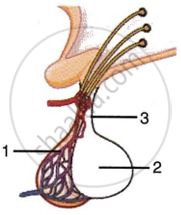 |
- Identify the gland. Write its specific location in the human body.
- Label the guidelines 1, 2 and 3 shown in the figure.
- Name any two secretions from part 1 and two from part 2.
- The deficiency of which hormone causes Diabetes insipidus? How is this condition different from Diabetes mellitus with respect to the abnormal substances present in the of urine.
Human height is mainly controlled by genetic factors but hormonal secretion is also equally important in regulating the height. Study the figures given below and answer the questions that follow:
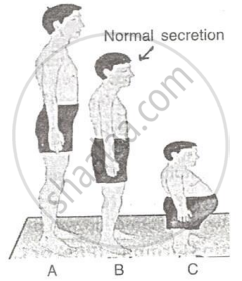
- Which of the above figures (A/B/C) is suffering from hyposecretion of the growth hormone?
- Name the disorder shown in figure A.
- Mention the gland which secretes ‘Growth Hormone’.
Compare the hormonal response with the nervous response with respect to their speed, transmission and the general nature of changes brought about.
Mention three important differences between the action of hormones and that of nerves in the regulatory mechanism of our body.
Solutions for 12: The Endocrine System
Selina solutions for कन्साइस बायोलॉजी [अंग्रेजी] कक्षा १० आईसीएसई chapter 12 - The Endocrine System
Shaalaa.com has the CISCE Mathematics कन्साइस बायोलॉजी [अंग्रेजी] कक्षा १० आईसीएसई CISCE solutions in a manner that help students grasp basic concepts better and faster. The detailed, step-by-step solutions will help you understand the concepts better and clarify any confusion. Selina solutions for Mathematics कन्साइस बायोलॉजी [अंग्रेजी] कक्षा १० आईसीएसई CISCE 12 (The Endocrine System) include all questions with answers and detailed explanations. This will clear students' doubts about questions and improve their application skills while preparing for board exams.
Further, we at Shaalaa.com provide such solutions so students can prepare for written exams. Selina textbook solutions can be a core help for self-study and provide excellent self-help guidance for students.
Concepts covered in कन्साइस बायोलॉजी [अंग्रेजी] कक्षा १० आईसीएसई chapter 12 The Endocrine System are Human Endocrine System, Adrenal Gland (Suprarenal Gland), Pancreas (Islets of Langerhans), Thyroid Gland, Pituitary Gland or Hypophysis Gland, Control of Hormonal Secretions, Hormonal Control Vs Nervous Control, Concept of Hormone, General Properties of Hormones, Summary of Hormones and Their Actions, Human Endocrine System, Adrenal Gland (Suprarenal Gland), Pancreas (Islets of Langerhans), Thyroid Gland, Pituitary Gland or Hypophysis Gland, Control of Hormonal Secretions, Hormonal Control Vs Nervous Control, Concept of Hormone, General Properties of Hormones, Summary of Hormones and Their Actions, Human Endocrine System, Adrenal Gland (Suprarenal Gland), Pancreas (Islets of Langerhans), Thyroid Gland, Pituitary Gland or Hypophysis Gland, Control of Hormonal Secretions, Hormonal Control Vs Nervous Control, Concept of Hormone, General Properties of Hormones, Summary of Hormones and Their Actions.
Using Selina कन्साइस बायोलॉजी [अंग्रेजी] कक्षा १० आईसीएसई solutions The Endocrine System exercise by students is an easy way to prepare for the exams, as they involve solutions arranged chapter-wise and also page-wise. The questions involved in Selina Solutions are essential questions that can be asked in the final exam. Maximum CISCE कन्साइस बायोलॉजी [अंग्रेजी] कक्षा १० आईसीएसई students prefer Selina Textbook Solutions to score more in exams.
Get the free view of Chapter 12, The Endocrine System कन्साइस बायोलॉजी [अंग्रेजी] कक्षा १० आईसीएसई additional questions for Mathematics कन्साइस बायोलॉजी [अंग्रेजी] कक्षा १० आईसीएसई CISCE, and you can use Shaalaa.com to keep it handy for your exam preparation.
