Advertisements
Advertisements
प्रश्न
The diagram given alongside shows an endocrine gland in the human body. Study the diagram and answer the following questions:
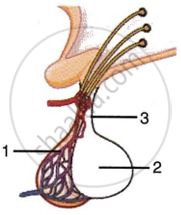 |
- Identify the gland. Write its specific location in the human body.
- Label the guidelines 1, 2 and 3 shown in the figure.
- Name any two secretions from part 1 and two from part 2.
- The deficiency of which hormone causes Diabetes insipidus? How is this condition different from Diabetes mellitus with respect to the abnormal substances present in the of urine.
Advertisements
उत्तर
- The pituitary gland is shown above. A small projection hangs from the base of the midbrain, below the hypothalamus.
-
- Anterior Pituitary
- Posterior Pituitary,
- Hypophyseal stalk
- Hormones produced by the anterior pituitary gland, including TSH. Posterior pituitary hormones include antidiuretic hormone (ADH) and oxytocin.
- Diabetes insipidus is caused by antidiuretic hormone deficiency. In this disease, the urine does not include glucose. However, in Diabetes mellitus, glucose is present in the urine.
APPEARS IN
संबंधित प्रश्न
Briefly mention the mechanism of action of FSH.
Give the special function of the following:
Gonadotrophic hormone
Given below are two diagrams (one is correct, the other one is somewhat incorrect) showing the transport of a hormone from its source gland/cell to the target organ/cell.

What is the error?
Hyper secretion of growth hormone in childhood cause ______.
Which one is not secreted by the pituitary?
You have learnt that a characteristic feature of endocrine system is the presence of feed back loops. By this what is meant if hormone A stimulates gland ‘X’ to secrete hormone B, the production of ‘A’ could be modified when the level of B changes in our blood. An example is the relation between hormones LH and estrogen (E2). An old woman exhibits the following features. High levels of LH in blood but low levels of E2 in the blood. Another woman exhibits high level of LH in blood and also high level of E2 in the blood. Where is the defect in both these women? Provide suitable diagram to support this answer.
Mention if the following statement is true (T) or false (F). If false, rewrite the correct word (not words) striking out the single wrong one.
Pituitary has three lobes - anterior, posterior and intermediate.
Which of the following hormones stimulates milk secretion?
Write full form of the following abbreviation:
FSH
Write the exact location of the following glands:
Pituitary
