Advertisements
Advertisements
Question
Fig. demonstrates a physiological process taking place in green plants. The whole set-up was placed in bright sunlight for several hours. Study the diagram and answer the questions that follow:
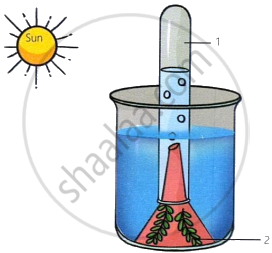
- What aspect of the physiological process is being examined?
- Explain the physiological process mentioned in (a) above.
- Label the parts numbered 1 and 2 in the diagram.
- Write a well-balanced chemical equation for the physiological process explained in (b) above.
- What would happen to the rate of bubbling of the gas if a pinch of sodium bicarbonate is added to the water in the beaker? Explain your answer.
Advertisements
Solution
- The aspect being examined is the release of oxygen during Photosynthesis.
- Photosynthesis is the process by which living plant cells, containing chlorophyll, produce food substances (glucose and starch) from carbon dioxide and water, using light energy. Plants release oxygen as a by-product during photosynthesis.
- 1: Oxygen
2: Hydrilla plant - \[\ce{6CO2 + 12H2O ->[Light energy][Chlorophyll] C6H12O6 + 6H2O + 6O2 \uparrow}\]
- Sodium bicarbonate releases carbon dioxide into the water, which is made available to the plant. This increases the rate of photosynthesis. So more oxygen is released thus more bubbles are released.
APPEARS IN
RELATED QUESTIONS
The diagram below shows two test-tubes A and B. Test-tube A contains a green water plant. Test-tube B contains both a green water plant and a snail. Both testtubes are kept in sunlight. Answer the questions that follow:

(i) Name the physiological process that releases the bubbles of oxygen.
(ii) Explain the physiological process as mentioned above in Q2 (a)(i).
(iii) What is the purpose of keeping a snail in test-tube ‘B’?
(iv) Why does test-tube ‘B’ have more bubbles of oxygen?
(v) Given an example of a water plant that can be used in the above process.
(vi) Write the overall chemical equation for the above process.
The diagram given below represents an experiment to prove the importance of a factor in photosynthesis. Answer the questions that follow:
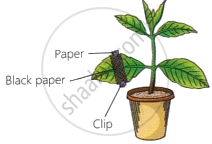
- Name the factor studied in this experiment.
- What will you observe in the experimental leaf after the starch test?
- Explain the process of photosynthesis.
- Give a balanced chemical equation to represent the process of photosynthesis.
- Draw a neat, labelled diagram of an experimental setup to show that oxygen is released during photosynthesis.
Fill in the blank:
Xanthophyll is ______ coloured pigment.
The site of light reaction in the cells of a leaf is ______.
What is meant by the photolysis of water?
Write the functional activity of the following structure:
Chloroplasts
Choose the Correct Answer:
A plant is kept in a dark cupboard for about 48 hours before conducting any experiment on photosynthesis to:
Choose the correct option.
In presence of high concentration of oxygen, RuBP carboxylase converts RuBP to ______.
During photosynthesis, ________ is produced and stored in the leaf.
Sunflowers open the petals in bright light during the daytime but close the petals in dark at night. This response of sunflowers is called ______.
