Advertisements
Advertisements
Question
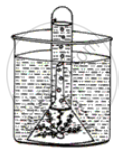
The diagram below shows two test-tubes A and B. Test-tube A contains a green water plant. Test-tube B contains both a green water plant and a snail. Both testtubes are kept in sunlight. Answer the questions that follow:

(i) Name the physiological process that releases the bubbles of oxygen.
(ii) Explain the physiological process as mentioned above in Q2 (a)(i).
(iii) What is the purpose of keeping a snail in test-tube ‘B’?
(iv) Why does test-tube ‘B’ have more bubbles of oxygen?
(v) Given an example of a water plant that can be used in the above process.
(vi) Write the overall chemical equation for the above process.
Advertisements
Solution
(i) Photosynthesis releases the bubbles of oxygen.
(ii) Photosynthesis is a physiological process by which plant cells containing chlorophyll produce food in the form of carbohydrates by using carbon dioxide, water and light energy. Oxygen is released as a by-product.
(iii) Carbon dioxide released by the snail during respiration is used by the plant for photosynthesis. This increases the rate of photosynthesis in the plant placed in test tube B. This also suggests that both respiration and photosynthesis are complementary processes to maintain the concentration of oxygen and carbon dioxide in the atmosphere.
(iv) In test tube B, a plant and a snail are kept. The plant in test tube B has more concentration of CO2 available because the snail releases CO2 during respiration. This increases the rate of photosynthesis in the plant placed in test tube B which leads to the release of more amount of oxygen.
(v) Hydrilla
(vi) Chemical equation for photosynthesis:
6CO2+12H2O`"Light energy"/"Chlorophyll"` C6H12O6+6H2O+6O2↑
APPEARS IN
RELATED QUESTIONS
The individual flattened stacks of membranous structures inside the chloroplasts are known as ______.
An experiment was set up as shown in the figure alongside. Look at the figure and answer the following questions:
( i) What is the objective of this experiment?
( ii ) Which plant is used in this experiment?
( iii ) Which gas is evolved in this process?
( iv ) What will happen to the rate of evolution of this gas if a pinch of sodium
bicarbonate is added?
(v ) What will happen if the apparatus is kept in dark?
Identify the false statements and rewrite them correctly by changing the first or last word only.
Immediate product of photosynthesis is glucose.
"Oxygen is a waste product of photosynthesis." Comment.
A candidate studied the importance of certain factors in photosynthesis. He took a potted plant and kept in the dark for over 24 hours. In the early hours of the next morning, he covered one of the leaves with black paper in the centre only. Then he placed the plant in sunlight for a few hours and tested the leaf which was covered with black paper for starch.
Is there any control in this experiment? If so, state it.
Complete the following food chain by writing the names of appropriate organisms in the blanks:
Grass → __________ → Snake → __________
Complete the following food chain by writing the names of appropriate organisms in the blanks:
→ __________ → __________ → Hen → Man
A plant is kept in a dark room for about 24 hours before conducting any experiment on photosynthesis in order to ______.
Give an example for micronutrients.
Label the diagram with the raw materials and products of photosynthesis.

