Advertisements
Advertisements
Question
Advertisements
Solution
Difference between autotroph and heterotroph:
Autotroph Heterotroph
| Autotroph | Heterotroph |
| (i) They can prepare their own food. | (i) They cannot prepare their own food. |
| (ii) They contain chlorophyll. | (ii) They do not contain chlorophyll. |
| (iii) Examole - Green olants. | (iii) Examole - Animals. |
RELATED QUESTIONS
A potted plant was taken in order to prove a factor necessary for photosynthesis. The potted plant was kept in the dark for 24 hours. One of the leaves was covered with black paper in the centre.The potted plant was then placed in sunlight for a few hours.
- What aspect of photosynthesis was being tested?
- Why was the plant placed in the dark before beginning the experiment?
- During the starch test why was the leaf
- boiled in water
- boiled in methylated spirit
- Write a balanced chemical equation to represent the process of photosynthesis.
- Draw a neat diagram of a chloroplast and label its parts.
Given below is an experiment setup to demonstrate a particualr tropic movement in germinating seeds. Study the diagram and answer the questions that follow : 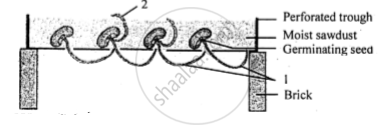
What is Thigmotropism? Give one example.
Mention the exact location of the following :
Thylakoids
Name the following:
The tissue that transports manufactured type of starch from leaves to all parts of the plants.
Identify the false statement and rewrite it correctly by changing the first or last word only.
Green plants perform photosynthesis.
What is meant by the photolysis of water?
Complete the following sentence with appropriate word:
Xanthophyll is ______ coloured pigment.
Mention, if the following statement is True or False. If false rewrite the wrong statement in its correct form:
Leaves are broad and flat to increase the surface area for photosynthesis.
Fill in the blank by rearranging the letter in the bracket.
During photosynthesis plants releases _________ (egxyno).
Define the following term:
Photolysis of water
