Advertisements
Advertisements
प्रश्न
Advertisements
उत्तर
Difference between autotroph and heterotroph:
Autotroph Heterotroph
| Autotroph | Heterotroph |
| (i) They can prepare their own food. | (i) They cannot prepare their own food. |
| (ii) They contain chlorophyll. | (ii) They do not contain chlorophyll. |
| (iii) Examole - Green olants. | (iii) Examole - Animals. |
संबंधित प्रश्न
Given below is an experiment setup to demonstrate a particualr tropic movement in germinating seeds. Study the diagram and answer the questions that follow :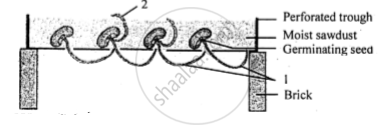
(ii) Name the tropic movement shown by part 1.
Mention any two points in which photosynthesis and respiration in plants are opposite to each other.
Fill in the blank:
______ is the process which replenishes the atmospheric oxygen which the animal life consumes in respiration.
A candidate studied the importance of certain factors in photosynthesis. He took a potted plant and kept in the dark for over 24 hours. In the early hours of the next morning, he covered one of the leaves with black paper in the centre only. Then he placed the plant in sunlight for a few hours and tested the leaf which was covered with black paper for starch.
Describe step by step, how the candidate proceeded to test the leaf for the presence of starch?
Name the molecules which are called assimilatory power? Why are they called so?
The figure given below is for performing an experiment on photosynthesis.

Answer the following:
(i) What is the aim of this experiment?
(ii) Describe an experiment to show that light is necessary for photosynthesis.
(iii) What do you conclude from this experiment?
(iv) What is the role of light in photosynthesis?
Give technical term:
In photosynthesis radiant energy is converted into which from?
Give technical term:
What does ATP abbreviate for?
Choose the correct option.
The net result of photo-oxidation of water is release of ______.
Autotrophs use _____,______ and chlorophyll to prepare their own food.
