Advertisements
Advertisements
प्रश्न
Name the molecules which are called assimilatory power? Why are they called so?
Advertisements
उत्तर
ATP and NADPH2 are called assimilatory power. They are called so because they provide the energy requirement for CO2 assimilation during the dark reaction of photosynthesis.
संबंधित प्रश्न
Fig. demonstrates a physiological process taking place in green plants. The whole set-up was placed in bright sunlight for several hours. Study the diagram and answer the questions that follow:
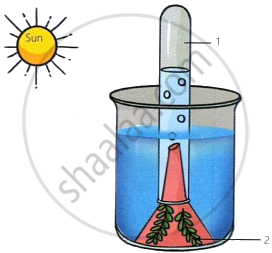
- What aspect of the physiological process is being examined?
- Explain the physiological process mentioned in (a) above.
- Label the parts numbered 1 and 2 in the diagram.
- Write a well-balanced chemical equation for the physiological process explained in (b) above.
- What would happen to the rate of bubbling of the gas if a pinch of sodium bicarbonate is added to the water in the beaker? Explain your answer.
A potted plant was taken in order to prove a factor necessary for photosynthesis. The potted plant was kept in the dark for 24 hours. One of the leaves was covered with black paper in the centre.The potted plant was then placed in sunlight for a few hours.
- What aspect of photosynthesis was being tested?
- Why was the plant placed in the dark before beginning the experiment?
- During the starch test why was the leaf
- boiled in water
- boiled in methylated spirit
- Write a balanced chemical equation to represent the process of photosynthesis.
- Draw a neat diagram of a chloroplast and label its parts.
Which one chemical reaction occurs during photosynthesis?
Are the following statement true or false? Give a reason in support of your answer.
If you immerse a leaf intact on the plant in ice cold water, it will continue to photosynthesise in bright sunshine.
A candidate studied the importance of certain factors in photosynthesis. He took a potted plant and kept in the dark for over 24 hours. In the early hours of the next morning, he covered one of the leaves with black paper in the centre only. Then he placed the plant in sunlight for a few hours and tested the leaf which was covered with black paper for starch.
Describe step by step, how the candidate proceeded to test the leaf for the presence of starch?
Photosynthesis in green plants is directly and indirectly dependent on so many plant structures.
Explain briefly the role of the following structures in this process is Phloem tissue in the leaf veins.
What is the importance of photosynthesis in the life of the following:
Non-green plants
Complete the following food chain by writing the names of appropriate organisms in the blank:
Grass → __________ → Lion
Name the following:
The immediate product of photosynthesis.
The minerals like nitrogen, potassium, and phosphorus, which are required in substantial quantity by the plants are called ______.
