Advertisements
Advertisements
प्रश्न
A candidate studied the importance of certain factors in photosynthesis. He took a potted plant and kept in the dark for over 24 hours. In the early hours of the next morning, he covered one of the leaves with black paper in the centre only. Then he placed the plant in sunlight for a few hours and tested the leaf which was covered with black paper for starch.
Describe step by step, how the candidate proceeded to test the leaf for the presence of starch?
Advertisements
उत्तर
- The student dipped the leaf in boiling water for a minute to kill the cells.
- Then he boiled the leaf in alcohol/methylated spirit over a water bath to remove chlorophyll. The leaf becomes hard and brittle.
- He then places the leaf in hot water to soften it.
- Next the student spreads the leaf in a dish and pours iodine solution on it. The presence of starch is indicated by a blue-black colour.
- The uncovered portion (exposed to sunlight) turned blue-black colour and the covered portion showed brown colour. The difference in the colours of covered and uncovered part of leaves indicates the importance of sunlight in photosynthesis.
संबंधित प्रश्न
Give one example of An aquatic plant used in the laboratory to demonstrate O2 liberation during photosynthesis
The following statement is about photosynthesis in a green plant. Write whether it is True or False.
Photosynthesis occurs in underground organs as well as in aerial ones.
The following statement is about photosynthesis in a green plant. Write whether it is True or False.
A variegated leaf (one that has white as well as green patches) will only photosynthesize in the green areas.
During photosynthesis, the oxygen in glucose comes from
Are the following statement true or false? Give a reason in support of your answer.
The rate of photosynthesis continues to rise as long as the intensity of light rises.
Mention, if the following statement is True or False. If false rewrite the wrong statement in its correct form:
Photosynthesis can also occur n artificial light such as that of a 100-watt electric lamp.
Choose the Correct Answer:
NADP is expanded as
Oxygen is produced at what point during photosynthesis?
What are primary producers?
A potted plant with variegated leafes was kept in dark for 24 hours and then placed in bright sunlight. Answer the following questions.
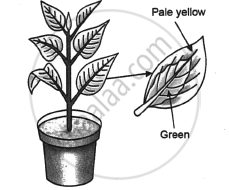
- Which aspect of photosynthesis is being tested in the above diagram?
- Why was the plant kept in the dark for 24 hours?
- After the starch test, what will be the colour of the yellow and green parts of the leaf? Give reasons to support your answer.
