Advertisements
Advertisements
प्रश्न
Give one example of An aquatic plant used in the laboratory to demonstrate O2 liberation during photosynthesis
Advertisements
उत्तर
An aquatic plant used in the laboratory to demonstrate the liberation of oxygen during photosynthesis – Hydrilla
APPEARS IN
संबंधित प्रश्न
Given below is an experiment setup to demonstrate a particualr tropic movement in germinating seeds. Study the diagram and answer the questions that follow : 
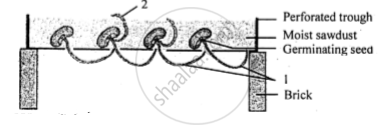
What is Thigmotropism? Give one example.
The diagram given below represents an experiment to prove the importance of a factor in photosynthesis. Answer the questions that follow :
What will you observe in the experimental leaf after the starch test?
Distinguish between the following:
Photosynthesis and photophosphorylation.
How does carbon dioxide return to the atmosphere? Explain.
A student in order to study the importance of certain factors of photosynthesis took a potted plant and kept it in the dark for over 24 hours. Then in the early hours of the morning the student covered one of the leaves with black paper in the centre only. Student placed the potted plant in the sunlight for a few hours, and then tested the leaf which was covered with black paper for starch.
(i) What aspect of photosynthesis was being investigated?
(ii) Is there any control in this experiment? If so, state the name.
(iii) Why was the plant kept in the dark before the experiment?
(iv) Describe step by step how the candidate proceeded to test the leaf for the presence of starch.
A plant is kept in a dark cupboard for 48 hours before conducting any experiment on photosynthesis in order to
Complete the following sentence with appropriate word:
AIIP stands for ____________.
Mention, if the following statement is True or False. If false rewrite the wrong statement in its correct form:
The raw materials for photosynthesis include water and CO2.
Column ‘II’ is a list of items related to ideas in Column ‘I’. Match the term in Column ‘II’ with the suitable idea given in Column ‘I’.
| Column I | Column II | ||
| (i) | Grana | (a) | Decomposers |
| (ii) | Autotrophs | (b) | Light reaction |
| (iii) | By-products of photosynthesis | (c) | Animals |
| (iv) | Photolysis | (d) | Oxygen |
| (v) | Bacteria and fungi | (e) | Stimulated by light |
| (vi) | Chloroplast | (f) | Power |
| (vii) | Oxygen and water | (g) | Raw material |
| (viii) | Sunlight | (h) | Machinery |
| (ix) | CO2 and water | (i) | End products |
| (x) | Glucose (sugar) | (j) | Workrooms |
| (xi) | Cells in the leaf | (k) | By-products. |
The green pigment present in the plant is ______.
The minerals like nitrogen, potassium, and phosphorus, which are required in substantial quantity by the plants are called ______.
