Advertisements
Advertisements
प्रश्न
The diagram below shows two test-tubes A and B. Test-tube A contains a green water plant. Test-tube B contains both a green water plant and a snail. Both testtubes are kept in sunlight. Answer the questions that follow:

(i) Name the physiological process that releases the bubbles of oxygen.
(ii) Explain the physiological process as mentioned above in Q2 (a)(i).
(iii) What is the purpose of keeping a snail in test-tube ‘B’?
(iv) Why does test-tube ‘B’ have more bubbles of oxygen?
(v) Given an example of a water plant that can be used in the above process.
(vi) Write the overall chemical equation for the above process.
Advertisements
उत्तर
(i) Photosynthesis releases the bubbles of oxygen.
(ii) Photosynthesis is a physiological process by which plant cells containing chlorophyll produce food in the form of carbohydrates by using carbon dioxide, water and light energy. Oxygen is released as a by-product.
(iii) Carbon dioxide released by the snail during respiration is used by the plant for photosynthesis. This increases the rate of photosynthesis in the plant placed in test tube B. This also suggests that both respiration and photosynthesis are complementary processes to maintain the concentration of oxygen and carbon dioxide in the atmosphere.
(iv) In test tube B, a plant and a snail are kept. The plant in test tube B has more concentration of CO2 available because the snail releases CO2 during respiration. This increases the rate of photosynthesis in the plant placed in test tube B which leads to the release of more amount of oxygen.
(v) Hydrilla
(vi) Chemical equation for photosynthesis:
6CO2+12H2O`"Light energy"/"Chlorophyll"` C6H12O6+6H2O+6O2↑
APPEARS IN
संबंधित प्रश्न
the exact location of the Thylakoids
Given below is an experiment setup to demonstrate a particualr tropic movement in germinating seeds. Study the diagram and answer the questions that follow :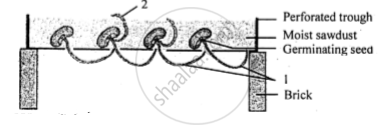
(ii) Name the tropic movement shown by part 1.
The following statement is about photosynthesis in a green plant. Write whether it is True or False.
Photosynthesis occurs in all the cells of the plant.
Fill in the blank:
______ is the process which replenishes the atmospheric oxygen which the animal life consumes in respiration.
Complete the following food chain by writing the names of appropriate organisms in the blanks:
→ __________ → __________ → Hen → Man
Give technical term:
The main reaction which means the breaking up of water molecules through light.
Complete the following sentence with appropriate word:
Xanthophyll is ______ coloured pigment.
Complete the following sentence with appropriate word:
A light reaction is a ___________ reaction.
Complete the following sentence with appropriate word:
4OH ——> _____ + O2
Choose the Odd One Out
