Advertisements
Advertisements
Question
Match the Column:
| no | Column A | Column B |
| 1 | Allele | Control of automobile exhaust |
| 2 | Leydig cells | Tourniquet |
| 3 | Utriculus | Alternate forms of genes |
| 4 | Snake bite | Dynamic equilibrium |
| 5 | Euro IV norms | Testosterone |
| Sudden change in genes | ||
| Static equilibrium |
Advertisements
Solution
| no | Column A | Column B |
| 1 | Allele | Alternate forms of genes |
| 2 | Leydig cells | Testosterone |
| 3 | Utriculus | Dynamic equilibrium |
| 4 | Snake bite | Tourniquet |
| 5 | Euro IV norms | Control of automobile exhaust |
shaalaa.com
Is there an error in this question or solution?
APPEARS IN
RELATED QUESTIONS
Mention two functions of human ovaries.
What is the scientific name of womb?
Given below is a diagram of two systems together in the human body.
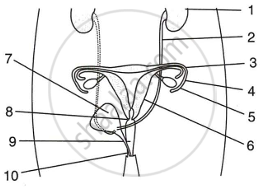 |
- Name the systems.
- Name the parts numbered 1-10.
- Describe the functions of the parts 3, 4, 5 & 6.
- What will happen if the part 3 on both sides gets blocked?
Draw a diagram to display the vertical view of human female reproductive system and label the following parts in the diagram:
(1) Ureter
(2) Ovary
(3) Funnel of fallopian tube
(4) Urethra.
Give the functions of the following:
Vagina
Define the following:
Gestation
Explain the term Parturition or birth.
Name the Following
What does this abbreviation stand for LH?
Distinguish between Vasa efferentia and Vasa deferentia.
A zygote is formed by the fusion of a male gamete and a female gamete. The number of chromosomes in the zygote of a human is ______.
