Advertisements
Advertisements
Question
Given below is a diagram of two systems together in the human body.
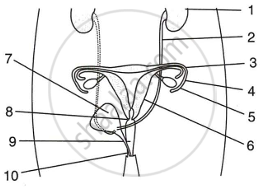 |
- Name the systems.
- Name the parts numbered 1-10.
- Describe the functions of the parts 3, 4, 5 & 6.
- What will happen if the part 3 on both sides gets blocked?
Advertisements
Solution
- The given system is the Urinogenital System of the human female body.
-
- Kidney
- Ureter
- Oviduct or fallopian tube
- Oviducal funnel
- Ovary
- Lining of uterus
- Urinary bladder
- Cervix
- Vagina
- Vulva
- Oviduct: Transport the ovum into the uterus; fertilisation occurs here, and the zygote travels down the uterus via the oviduct.
Oviducal funnel: The released egg is picked up by the fimbriae (cilia) of the oviducal funnel of the oviduct.
Ovary: It produces gg and the female hormones progesterone and oestrogen.
Lining of uterus: It provides a surface for the implantation of a fertilised egg. - If both Fallopian tubes are blocked, the ovary's ovum will not reach the oviduct, preventing fertilization.
APPEARS IN
RELATED QUESTIONS
Where is the male gamete formed in humans?
Which part of the human body produces sperms?
Draw a labelled diagram of the human female reproductive system. With the help of this diagram, explain the working of human female reproductive system.
In a flower, the parts that produce male and female gametes are respectively :
(a) sepal and anther
(b) filament and stigma
(c) anther and ovary
(d) stamen and style
Describe in brief the role of seminal vesicle in human male reproductive system.
List two changes observed in girls at the time of puberty.
List and explain in brief three methods of contraception.
Explain the term Parturition or birth.
State the location:
Prostate gland
Given below are the events in human reproduction. Write them in correct sequential order.
Insemination, gametogenesis, fertilisation, parturition, gestation, implantation
