Advertisements
Advertisements
प्रश्न
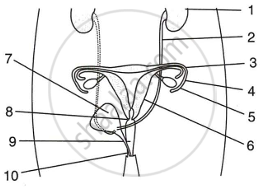
Given below is a diagram of two systems together in the human body.
![]() |
- Name the systems.
- Name the parts numbered 1-10.
- Describe the functions of the parts 3, 4, 5 & 6.
- What will happen if the part 3 on both sides gets blocked?
Advertisements
उत्तर
- The given system is the Urinogenital System of the human female body.
-
- Kidney
- Ureter
- Oviduct or fallopian tube
- Oviducal funnel
- Ovary
- Lining of uterus
- Urinary bladder
- Cervix
- Vagina
- Vulva
- Oviduct: Transport the ovum into the uterus; fertilisation occurs here, and the zygote travels down the uterus via the oviduct.
Oviducal funnel: The released egg is picked up by the fimbriae (cilia) of the oviducal funnel of the oviduct.
Ovary: It produces gg and the female hormones progesterone and oestrogen.
Lining of uterus: It provides a surface for the implantation of a fertilised egg. - If both Fallopian tubes are blocked, the ovary's ovum will not reach the oviduct, preventing fertilization.
संबंधित प्रश्न
Describe placenta structure.
Give biological explanations for The placenta is an important structure for the development of a foetus
When a human female reaches a certain age then vaginal bleeding occurs for a few days after regular time intervals.
(a) What is this process known as (i) in scientific terms, and (ii) in everyday language?
(b) At what approximate age this process starts in human females? When is the human female said to have attained at this stage?
(c) After how much time is this process repeated? For how many days does this process usually last?
(d) What does the onset of this process in human females signify?
(e) At which particular event in the life of a human female does this process stop temporarily but start again?
(f) At which approximate age of human female does this process stop permanently?
When a fertilised egg E formed in the oviduct of a human female divides repeatedly to form an embryo, the embryo gets implanted in the thick and soft lining of the uterus. After this a disc-like special tissue T develops between the uterus wall and embryo through which all the requirements of the developing embryo (and foetus) are met from the mother's body, The embryo is connected to the tissue T through a string like structure S.
(a) What is the other name of fertilised egg cell E?
(b) What is the name of tissue T?
(c) Name the string-like structure S.
(d) Name two substances which pass from mother's blood to embryo through tissue T and, one type of substance which passes from embryo to mother's blood.
(e) What happens to S when the baby is born? Why?
Diagram shows the reproductive system of female human beings:
(i) Name the parts numbered 1 to 14.
(ii) Normally, after how many days does an ovary release an egg?
(iii) Where are the sperms released during coitus?
(iv) What is the role of sperms after their ejaculation in vagina?
(v) What is the function of the organ numbered 5?
(vi) What is the gestation period in human?

The male homologue of the female clitoris is ____________.
The following is the illustration of the sequence of ovarian events (a-i) in a human female.

Write the difference between C and H.
If for some reason, the vasa efferentia in the human reproductive system get blocked, the gametes will NOT be transported form ______
Mention any two changes that are common to both boys and girls in early teenage years.
Consider the following:
- The reductive division for the human female gametogenesis starts earlier than that of the male gametogenesis.
- The gap between the first meiotic division and the second meiotic division is much shorter for males compared to females.
- The first polar body is associated with the formation of the primary oocyte.
- Luteinising Hormone (LH) surge leads to disintegration of the endometrium and onset of menstrual bleeding.
Choose the correct answer from the options given below:

