Advertisements
Advertisements
प्रश्न
Given below is a diagram of two systems together in the human body.
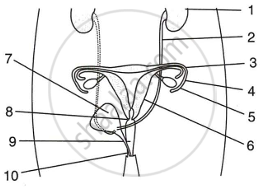 |
- Name the systems.
- Name the parts numbered 1-10.
- Describe the functions of the parts 3, 4, 5 & 6.
- What will happen if the part 3 on both sides gets blocked?
Advertisements
उत्तर
- The given system is the Urinogenital System of the human female body.
-
- Kidney
- Ureter
- Oviduct or fallopian tube
- Oviducal funnel
- Ovary
- Lining of uterus
- Urinary bladder
- Cervix
- Vagina
- Vulva
- Oviduct: Transport the ovum into the uterus; fertilisation occurs here, and the zygote travels down the uterus via the oviduct.
Oviducal funnel: The released egg is picked up by the fimbriae (cilia) of the oviducal funnel of the oviduct.
Ovary: It produces gg and the female hormones progesterone and oestrogen.
Lining of uterus: It provides a surface for the implantation of a fertilised egg. - If both Fallopian tubes are blocked, the ovary's ovum will not reach the oviduct, preventing fertilization.
APPEARS IN
संबंधित प्रश्न
Explain the process of birth in human beings.
What are the functions of testes in the human male reproductive system?
What could be the reasons for adopting contraceptive methods?
Write the function of the following part in a human female reproductive system:
Fallopian tube
Give technical terms for Thin walled sac of skin which covers the testes
What is the function of the placenta?
When a female child is born, her ovaries already contain thousands of immature eggs (or ova) contained in immature structures A. On maturing, A bursts open and an egg shoots out of the ovary in a process called B. The process B starts in the females at puberty and occurs again and again after a time period x. Before every occurrence of process B, the inner lining of uterus becomes thick and soft with lots of blood vessels in it. When the egg cell gets fertilised by a sperm, then an event C occurs in the life of mature human female which lasts for time period y leading to the birth of baby. If, however, the egg cell released by the ovary does not get a sperm to fuse with, then the thick and soft inner lining of uterus breaks down and comes out of the female's body in an event called D. The occurrence of event D is controlled by chemical substances E.
(a) What are A?
(b) What is process B?
(c) What is the time period x?
(d) Name the event C.
(e) How much is the time period y?
(f) What is the name of process D?
(g) Name the chemical substances E.
Pollen grains are formed by ______ division in locules of anthers.
Draw a labeled diagram of the human female reproductive system.
