Advertisements
Online Mock Tests
Chapters
1: Cell: The structural and functional unit of life
2: Structure of chromosome, cell cycle and cell division
3: Genetics: Some Basic Fundamentals
Unit-2 : Plant Physiology
4: Absorption by roots: The Processes Involved
5: Transpiration
6: Photosynthesis
7: Chemical Coordination in Plants
Unit-3 : Human Anatomy and Physiology
8: The Circulatory System
9: The Excretory System
10: The Nervous System
11: Sense Organs
12: The Endocrine System
▶ 13: The Reproductive System
Unit-4 : Human Evolution
14: Human Evolution
Unit-5 : Population
15: Population: The increasing numbers and rising problems
Unit-6 : Pollution
16: Pollution: A Rising Environmental Problem
![Selina solutions for कन्साइस बायोलॉजी [इंग्रजी] इयत्ता १० आयसीएसई chapter 13 - The Reproductive System - Shaalaa.com](/images/concise-biology-english-class-10-icse_6:930ad8471f2d4b8b8e0d2fbdad788b1f.jpg "Selina solutions for कन्साइस बायोलॉजी [इंग्रजी] इयत्ता १० आयसीएसई chapter 13 - The Reproductive System")
Advertisements
Solutions for Chapter 13: The Reproductive System
Below listed, you can find solutions for Chapter 13 of CISCE Selina for कन्साइस बायोलॉजी [इंग्रजी] इयत्ता १० आयसीएसई.
Selina solutions for कन्साइस बायोलॉजी [इंग्रजी] इयत्ता १० आयसीएसई 13 The Reproductive System Intext Question [Pages 181 - 190]
Progress Check
Choose the correct meaning of reproduction.
Increase in population
Increase in the number of parents
Production of new individuals of the same kind.
production of identical individuals
State very briefly the chief function of the following:
Seminal vesicles
State very briefly the chief function of the following:
Prostate gland
State very briefly the chief function of the following:
Cowper's gland
State very briefly the chief function of the following:
Sperm duct (vas deferens)
Progress Check State whether the following statements are True (T) or False (F):
One egg is released from each of the two ovaries every month.
True
False
The enlarged mature follicle bursts to release the egg.
True
False
The egg is passed down through the oviduct by muscular contractions.
True
False
Clitoris is equivalent to the male penis.
True
False
The vagina is a muscular tube.
True
False
Name the three main regions of the human sperm, and briefly mention the function of each.
Name the following:
Three accessory glands of human male reproductive system.
Name the following:
Two hormones secreted from placenta.
Name the two types of twins.
Name the following:
Two layers of the wall of uterus.
List the substances which the foetus receives from the mother through placenta.
How are carbon dioxide and urea, excreted by the foetus, removed?
Write one sentence using the following term pertaining to reproduction in humans.
Gestation
Write one sentence using the following term pertaining to reproduction in humans.
280 days
Write one sentence using the following term pertaining to reproduction in humans.
Head first
Write one sentence using the following term pertaining to reproduction in humans.
Placenta
Write one sentence using the following term pertaining to reproduction in humans.
After-birth
Write one sentence using the following term pertaining to reproduction in humans.
Tied and cut
Does the foetus inside the mother's uterus breathe?
Yes
No
Mention if the following statements are True (T) or False (F):
Placenta produces certain hormones.
True
False
Amniotic fluid serves to provide oxygen to the foetus.
True
False
Heart and blood vessels have been formed by the end of five weeks of pregnancy.
True
False
Mother's blood flows into the foetus through placenta.
True
False
Complete the following by filling in the blanks 1 to 5 with appropriate words:
The human female gonads are ovaries. A maturing egg in the ovary is present in a sac of cells called ______ (1). As the egg grows larger, the follicle enlarges and gets filled with a fluid and is now called the ______ (2) follicle. The process of releasing the egg from the ovary is called ______ (3). The ovum is picked up by the oviducal funnel and fertilization takes place in the ______ (4). In about a weak the blastocyst gets fixed in the endometrium of the uterus and this process is called ______ (5).
Selina solutions for कन्साइस बायोलॉजी [इंग्रजी] इयत्ता १० आयसीएसई 13 The Reproductive System Review Questions [Pages 192 - 194]
MULTIPLE CHOICE TYPE (Select the most appropriate option in each case)
The male accessory gland whose secretion neutralizes the acidity of the urethra and vagina is ______.
Seminal vesicle
Prostate gland
Seminiferous tubule
Bulbo-urethral gland
The onset of menstruation in women is called ______.
Parturition
Menopause
Ovulation
Menarche
In the human menstrual cycle, the ovulation occurs around ______.
7 days
21 days
28 days
14 days
Fertilization takes place in ______.
Fallopian tube
Uterus
Vas deferens
Vagina
The packing tissues between the coils of the seminiferous tubules are called as ______.
Leydig cells
Hymen
Graafian follicle
Clitoris
Which of the following cannot pass readily through the placenta to the foetus?
Antibodies
Amino acids
Alcohol
Haemoglobin
The thin-walled sac of skin in which testis descends is ______.
Seminal vesicle
Vas deferens
Scrotal sac
Epididymis
The outermost layer of uterine wall around the foetus is ______.
Choroid
Allantois
Chorion
Amnion
The period of pregnancy is called ______.
Parturition
Implantation
Copulation
Gestation
The canal through which each testis descends into the scrotum just before the birth of a male baby is ______.
Acrosome
Epididymis
Efferent duct
Inguinal canal
The following questions are Assertion-Reason based questions. Choose the answer from the options given below.
Assertion (A): The placenta is a vital organ during pregnancy, responsible for providing nutrients and oxygen to the developing foetus.
Reason (R): The placenta develops from the fusion of the zygote and the endometrial lining, forming a specilized tissue structure that facilitates the exchange of substances between the maternal and foetal bloodstreams.
- A is True and R is False.
- A is False and R is True.
- Both A and R are True.
- Both A and R are False.
(1)
(2)
(3)
(4)
Assertion (A): Leydig cells produce oestrogen and progesterone.
Reason (R): Leydig cells are also called as interstitial cells which are located as packing tissues between the coils of seminiferous tubules.
- A is True and R is False.
- A is False and R is True.
- Both A and R are True.
- Both A and R are False.
(1)
(2)
(3)
(4)
Assertion (A): Prostate gland pours an alkaline secretion which neutralizes the acidic pH of the vagina.
Reason (R): Prostate gland is a lobulated gland located between the posterior surface of the urinary bladder and the rectum.
- A is True and R is False.
- A is False and R is True.
- Both A and R are True.
- Both A and R are False.
(1)
(2)
(3)
(4)
Assertion (A): Fertilization of the ovum and sperm occurs in the sperm duct of the female reproductive system.
Reason (R): Vas deferens carries sperms from the epididymis to the urethra of the male reproductive system.
- A is True and R is False.
- A is False and R is True.
- Both A and R are True.
- Both A and R are False.
(1)
(2)
(3)
(4)
VERY SHORT ANSWER TYPE
Name these:
3 male accessory glands in humans.
Name these:
2 hormones secreted from the corpus luteum.
Name these:
4 phases of the menstrual cycle.
Name the two types of twins.
Name these:
3 membranous, protective layers around the foetus.
Rewrite the terms in the correct order so as to be in a logical sequence.
Implantation, ovulation, child birth, gestation, fertilisation.
Rewrite the terms in the correct order so as to be in a logical sequence.
Sperm duct, coitus, sperm, vagina, urethra.
Rewrite the terms in the correct order so as to be in a logical sequence.
Sperm duct, penis, testes, sperms, semen.
Rewrite the terms in the correct order so as to be in a logical sequence.
Puberty, menopause, menstruals, menarche, reproductive age.
Rewrite the terms in the correct order so as to be in a logical sequence.
Graafian follicle, ostium, uterus, fallopian tube, ovum.
Give appropriate term for the following:
The onset of reproductive phase in a female.
Give appropriate terms for the following:
Rupture of follicle and release of ovum from the ovary.
Give the appropriate term for the following:
Monthly discharge of blood and disintegrated tissues in the human female
Give the appropriate term for the following:
Process of fusion of ovum and sperm.
Give appropriate terms for each of the following process:
Fixing of developing zygote (blastocyst) on the uterine wall.
Match the items in column I with those in column II and write down the matching pairs (some may not match).
| Column I | Column II | ||
| (a) | Acrosome | (i) | An embryo which looks like human baby. |
| (b) | Gestation | (ii) | Luteinizing hormone |
| (c) | Menopause | (iii) | Ovum producing cells. |
| (d) | Foetus | (iv) | Semen |
| (e) | Oogenesis | (v) | Spermatozoa |
| (f) | Ovulation | (vi) | Complete stoppage of menstrual cycle. |
| (vii) | Time taken by a fertilised egg till the delivery of baby. |
Given below is a group of terms. In the group, one pair indicates the relationship between the two terms. Rewrite and complete the second pair on a similar basis.
Sperm : Spermatogenesis :: Ovum : ______.
Given below is a group of terms. In the group, one pair indicates the relationship between the two terms. Rewrite and complete the second pair on a similar basis.
Female gonad : Ovaries :: Male gonad : ______.
Given below is a group of terms. In the group, one pair indicates the relationship between the two terms. Rewrite and complete the second pair on a similar basis.
Follicle cells : Ova :: ______ : Sperms.
Given below is a group of terms. In the group, one pair indicates the relationship between the two terms. Rewrite and complete the second pair on a similar basis.
Leydig cells : Testosterone : ______ : Oestrogen.
Given below is a group of terms. In the group, one pair indicates the relationship between the two terms. Rewrite and complete the second pair on a similar basis.
Follicular phase: 5-12 days:: Luteal phase : ______ days.
Choose the odd one out from the group of terms given below and write the category for the remaining terms:
Testis
Epididymis
Uterine tube
Sperm duct
Choose the odd one out from the group of terms given below and write the category for the remaining terms:
Seminal vesicle
Seminiferous tubule
Prostate gland
Cowper's gland
Choose the odd one out from the group of terms given below and write the category for the remaining terms:
Uterus
Ureter
Oviduct
Ovaries
Choose the odd one out from the group of terms given below and write the category for the remaining terms:
Choroid
Chorion
Amnion
Allantois
Choose the odd one out from the group of terms given below and write the category for the remaining terms:
Zona pellucida
Acrosome
Axial filament
Middle piece
SHORT ANSWER TYPE
State whether the following statements are TRUE (T) or FALSE (F):
Rewrite the wrong statement by correcting only one word either at the beginning or at the end of the sentence.
Fertilisation occurs in vagina.
True
False
State whether the following statements are TRUE (T) or FALSE (F):
Rewrite the wrong statement by correcting only one word either at the beginning or at the end of the sentence.
Uterus is also known as birth canal.
True
False
State whether the following statements are TRUE (T) or FALSE (F):
Rewrite the wrong statement by correcting only one word either at the beginning or at the end of the sentence.
Nutrition and oxygen diffuse from the mother’s blood into the foetus’s blood through amnion.
True
False
Complete the following table by writing the name of the structure or the function of the given structure:
| Structure | Function | ||
| 1. | Corpus luteum | 1. | ______ |
| 2. | ______ | 2. | Produces male gametes in mass |
| 3. | Leydig cells | 3. | ______ |
| 4. | ______ | 4. | Stores the sperms until they mature and become mobile |
| 5. | Umbilical cord | 5. | ______ |
| 6. | Fallopian tube | 6. | ______ |
Given below is the name of certain stage/substance related to reproduction and found in human body. Answer the questions related to it.
Foetus.
- Where is it contained?
- How does it differ from embryo?
Given below is the name of certain stage/substance related to reproduction and found in human body. Answer the questions related to it.
Hyaluronidase.
- Is it an enzyme or simply a protein?
- What is its function?
Given below is the name of certain stage/substance related to reproduction and found in human body. Answer the questions related to it.
Morula.
- What is this stage?
- Name the stage which comes next to it?
Given below is the name of certain stage/substance related to reproduction and found in human body. Answer the questions related to it.
Amniotic fluid.
- Where is it found?
- What are its functions?
Given below is the name of certain stage/substance related to reproduction and found in human body. Answer the questions related to it.
Placenta
- What are the two sources that form placenta?
- Name any two main substances which pass from foetus to mother through placenta.
- Name any two hormones it produces.
Given below is the name of certain stage/substance related to reproduction and found in human body. Answer the questions related to it.
Implantation.
- The development stage that undergoes this process.
- The approximate time after fertilisation, when it occurs.
Write important function of the following:
Inguinal canal
Write important function of the following:
Testis
Mention the functions of Ovary.
Mention the functions of Oviduct.
Give the function of the following:
Uterus
The exact location of the seminal vesicle
Write the specific location of the following:
Uterus
Write the specific location of the following:
Placenta
Write the specific location of the following:
Acrosome
Write the specific location of the following:
Vagina
Define the following term:
Reproduction
Define the following term:
Hernia
Define ovulation.
Define the following term:
Puberty
Define.
Fertilization
Define the following term:
Hymen
Distinguish between the following pair:
Spermatogenesis and oogenesis
Distinguish between the following pair:
Implantation and gestation
Distinguish between the following pair:
Pregnancy and parturition
Distinguish between the following pair:
Placenta and umbilical cord
Differentiate between Identical twins and fraternal twins.
Differentiate between the following pair:
Menarche and menopause
What is the significance of the testes being located in scrotal sacs outside the abdomen?
Can there be any abnormal situation regarding testes location? If so, what is that and what is the harm caused due to it?
What are the secondary sexual characters in the human male?
What are the secondary sexual characteristics in the human female respectively?
What are the accessory reproductive organs?
Differentiate between primary and accessory reproductive organs.
Name and describe very briefly, the stages in the development of human embryo.
Is it correct to say that the testes produce testosterone. Discuss?
STRUCTURED/APPLICATION/SKILL TYPE
Given below is a diagram of two systems together in the human body.
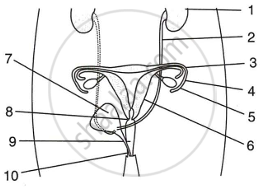 |
- Name the systems.
- Name the parts numbered 1-10.
- Describe the functions of the parts 3, 4, 5 & 6.
- What will happen if the part 3 on both sides gets blocked?
The figure given ahead is an organ system of humans. Study the same and answer the following questions.
 |
- Identify the organ system.
- Label the guidelines 1 to 7.
- Write one important role of parts 3 and 6.
- Name the cells of part 1 that produce testosterone.
- What is the significance of the part 1 being located in a separate sac suspended outside the body?
The figure given below is an important gonad of humans. Study the figure and answer the following questions.
 |
- Identify the organ. Write its specific location in the body.
- Label the parts shown in the figure as 1 to 4.
- Write important functions of parts 2 and 4.
- Name one cellular structure and one hormone which are produced in part 3.
- Draw a neat and labelled diagram of the cellular structure mentioned by you in (d).
Given below is the outline of the male reproductive system. Name the parts labelled 1 to 8. Also name the corresponding structure of part (4) in female reproductive system.
 |
The diagram given below is that of a developing human foetus in the womb. Study the same and then answer the questions that follow:
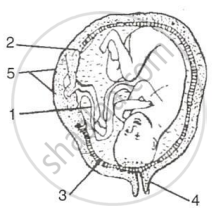
- Name the parts ‘l’ to ‘5’ indicated by guidelines.
- What term is given to the period of development of the foetus in the womb?
- How many days does the foetus take to be fully developed?
- Mention two functions of the parts labelled ‘2’ other than its endocrine function.
- Name any one hormone produced by the part labelled ‘2’.
The figure given below is the human female reproductive system. Study the same and answer the following questions.
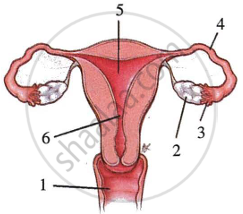
- Label the guidelines 1 to 6 shown in the figure.
- What is the normal gestation period in human?
- Where are the sperms released during coitus?
- Write two important functions of part 2.
- Mention the technical term for the fixing of developing zygote to the uterine wall.
The diagram below represents two reproductive cells A and B. Study the same and then answer the questions that follow:
 |
- Identify the reproductive cells A and B.
- Name the specific part of the reproductive system where the above cells are produced.
- Where in the female reproductive system do these cells unite?
- Name the main hormones secreted by the (1) ovary (2) testes.
- Name an accessory gland found in the male reproductive system and state the function of its secretion.
Solutions for 13: The Reproductive System
Selina solutions for कन्साइस बायोलॉजी [इंग्रजी] इयत्ता १० आयसीएसई chapter 13 - The Reproductive System
Shaalaa.com has the CISCE Mathematics कन्साइस बायोलॉजी [इंग्रजी] इयत्ता १० आयसीएसई CISCE solutions in a manner that help students grasp basic concepts better and faster. The detailed, step-by-step solutions will help you understand the concepts better and clarify any confusion. Selina solutions for Mathematics कन्साइस बायोलॉजी [इंग्रजी] इयत्ता १० आयसीएसई CISCE 13 (The Reproductive System) include all questions with answers and detailed explanations. This will clear students' doubts about questions and improve their application skills while preparing for board exams.
Further, we at Shaalaa.com provide such solutions so students can prepare for written exams. Selina textbook solutions can be a core help for self-study and provide excellent self-help guidance for students.
Concepts covered in कन्साइस बायोलॉजी [इंग्रजी] इयत्ता १० आयसीएसई chapter 13 The Reproductive System are Reproduction, The Female Reproductive System, Menstrual Cycle (Ovarian Cycle), Role of Hormones in Reproduction, Parturition (Birth) in Human, Human Reproduction, The Male Reproductive System, Placenta (Growth) in Human, Twins - Fraternal & Identical, Multiple Births: Triplets, Quadruplets, etc., Reproduction, The Female Reproductive System, Menstrual Cycle (Ovarian Cycle), Role of Hormones in Reproduction, Parturition (Birth) in Human, Human Reproduction, The Male Reproductive System, Placenta (Growth) in Human, Twins - Fraternal & Identical, Multiple Births: Triplets, Quadruplets, etc., Reproduction, The Female Reproductive System, Menstrual Cycle (Ovarian Cycle), Role of Hormones in Reproduction, Parturition (Birth) in Human, Human Reproduction, The Male Reproductive System, Placenta (Growth) in Human, Twins - Fraternal & Identical, Multiple Births: Triplets, Quadruplets, etc..
Using Selina कन्साइस बायोलॉजी [इंग्रजी] इयत्ता १० आयसीएसई solutions The Reproductive System exercise by students is an easy way to prepare for the exams, as they involve solutions arranged chapter-wise and also page-wise. The questions involved in Selina Solutions are essential questions that can be asked in the final exam. Maximum CISCE कन्साइस बायोलॉजी [इंग्रजी] इयत्ता १० आयसीएसई students prefer Selina Textbook Solutions to score more in exams.
Get the free view of Chapter 13, The Reproductive System कन्साइस बायोलॉजी [इंग्रजी] इयत्ता १० आयसीएसई additional questions for Mathematics कन्साइस बायोलॉजी [इंग्रजी] इयत्ता १० आयसीएसई CISCE, and you can use Shaalaa.com to keep it handy for your exam preparation.
