Advertisements
Advertisements
प्रश्न
The figure given below is the human female reproductive system. Study the same and answer the following questions.
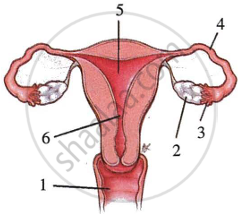
- Label the guidelines 1 to 6 shown in the figure.
- What is the normal gestation period in human?
- Where are the sperms released during coitus?
- Write two important functions of part 2.
- Mention the technical term for the fixing of developing zygote to the uterine wall.
Advertisements
उत्तर
-
- Vagina
- Ovary
- Fimbriae
- Fallopian tube/Oviduct
- Uterus
- Uterine lining/Endometrium
- The normal gestation period in humans is about 280 days or 40 weeks (approximately 9 months).
- Vagina
- Functions of the Ovary: The ovaries produce and release ova (eggs) and secrete female sex hormones such as oestrogen and progesterone.
- Implantation
APPEARS IN
संबंधित प्रश्न
Draw a diagrammatic sectional view of the female reproductive system of human and label the parts
(i) where the secondary oocytes develop
(ii) which helps in collection of ovum after ovulation
(iii) where fertilization occurs
(iv) where implantation of embryo occurs.
Name the function of the following:
Endometrium
What happens in a girl’s body under the influence of hormones?
Differentiate between the following pair:
Uterus and vegina
Differentiate between:
Prostate gland and cowper’s gland (the nature of secretion)
Write the functions of ovary
The implantation of the embryo occurs at about ______ days of fertilization.
Fertilization occurs in human females when the sperms and ovum reach simultaneously at ______
Read the following and answer from given below:
During copulation, semen is released by the penis into the vegina. The motile sperms swim rapidly, fuse with the ovum in the ampullary region, resulting in fertilization. The haploid nucleus of sperm fuses with that of the ovum to form a diploid zygote.
What is the signifacance of fertilisation?
Which among the following diseases is not sexually transmitted?
