Advertisements
Advertisements
प्रश्न
Name the function of the following:
Endometrium
Advertisements
उत्तर
It is the uterine mucous membrane, which thickens and becomes more glandular as the menstrual cycle progresses and has an enhanced blood supply. If embryo implantation does not occur, the endometrium undergoes a decline and loses most of its tissue during menstruation. If a pregnancy is confirmed, the endometrium develops into the decidua, which is shed after birth.
APPEARS IN
संबंधित प्रश्न
Draw a labelled diagram of the female reproductive system.
How many eggs are released by a human ovary in a month? How many eggs do you think would have been released if the mother gave birth to identical twins? Would your answer change if the twins born were fraternal?
Give the appropriate term for the following:
Monthly discharge of blood and disintegrated tissues in the human female
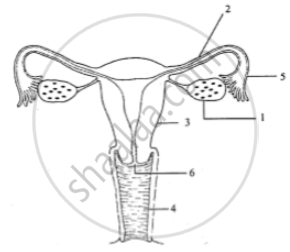
The diagram given below represents a system in the human body. Study the diagram and answer the following questions:
- Identify the system.
- Label the parts marked 5 and 6.
- Name the two hormones secreted by 1.
- Mention the number and the name of the part involved in fertilization and implantation from the above diagram.
- Mention the surgical methods of contraception in:
- Human males.
- Human females.
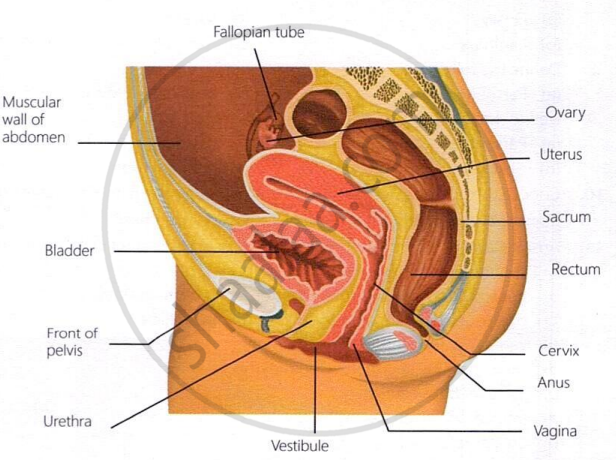
The diagram alongside is the vertical section of female reproductive organs. Study the diagram and answer the questions that follow:
- Name the fully developed part of ovary containing the ovum.
- Name the organ of the female body in which the foetus develops.
- What is ovulation?
- Which two hormones are secreted by ovary?
Name the following:
The separation of the foetus from the mother's body.
Name the following:
Organ producing ovum.
Name the Following
The term used for the mature follicles.
Give Technical Term:
What term is used for the production and maturation of eggs in the ovaries?
Which of the following is not a part of female reproductive system?
Name the part of the human female reproductive system where the following occurs.
Implantation
Which part of the fallopian tube collects to ovum after ovulation?
Identify the layer that makes up the corona radiate.
Which one the following is a part of external genitalia of a female human being?
A sac shaped like an upside down pear with a thick lining and muscles in the pelvic area where a fertilized egg or zygote comes to grow into a baby is called ______.
Bartholin’s glands are situated ______.
The external genitalia of the human female is called ______.
Read the following and answer from given below:
Oogenesis is the process of the formation of an ovum in the ovaries. It consists of three phases: multiplication, growth, and maturation. Oogenesis is controlled by hormones GnRH, LH, FSH. GnRH secreted by the hypothalamus stimulates the anterior lobe of the pituitary gland to secrete LH and FSH.
what is the function of hormones FSH?
What changes are observed in the uterus subsequent to the implantation of a young embryo?
What are the functions of the ovaries and uterus in the female reproductive system?
What is the role of cervix in the human female reproductive system?
Explain how the uterus and placenta provide necessary conditions for proper growth and development of the embryo after implantation?
Clitoris is equivalent to the male penis.
Statement I: The presence or absence of hymen is not a reliable indicator of virginity.
Statement II: The hymen is torn during the first coitus only.
In the light of the above statements, choose the correct answer from the options given below:
Median vertical depression of external genitalia in females, enclosing the urethral and vaginal opening is ______.
Which steroid/ovarian hormones are produced by the ovaries?
Which part of the fallopian tube is closest to the ovary and has finger-like fimbriae at its edges?
What pushes the egg towards the uterus in the fallopian tube?
Which sequence correctly traces the milk pathway from alveoli to nipple?
At what age does puberty begin in females?
