Advertisements
Advertisements
प्रश्न
How many eggs are released by a human ovary in a month? How many eggs do you think would have been released if the mother gave birth to identical twins? Would your answer change if the twins born were fraternal?
Advertisements
उत्तर
Each ovary produces several immature eggs, which are connected with groups of other cells known as follicles. In humans, only one egg is usually removed at a time; however, two or more may emerge during the menstrual cycle. The egg emerges from the ovary between the 14th and 16th days of the typically 28-day menstrual cycle. Fertilisation of a single egg results in one zygote (monozygotic) that divides into two embryos, forming identical twins. If the twins were born fraternal, two eggs would be released. Fraternal twins (also known as non-identical twins) are typically formed when two fertilised eggs are implanted in the uterine wall at the same time. The two eggs produce two zygotes; hence, these twins are also known as dizygotic or binovular twins.
APPEARS IN
संबंधित प्रश्न
Mention the exact location of the following :
Corpus callosum
Given below is a diagram of the female reproductive system of a human being

(i) Name the parts numbered 1 to 6.
(ii) Normally after how many days does an ovary release an egg?
(iii) Where are the sperms released during coitus?
(iv) What do the sperms do after being released?
(v) What is the function of the organ numbered 5?
(vi) How many days does it normally take from the fertilization of the egg up to the birth of the baby?
Explain the term Tubectomy.
Mention, if the following statement is True or False. If false rewrite the wrong statement in its correct form:
The cilia lining the oviduct funnel, push the released ovum into the uterus.
Generally, every month, __________ ovum is released in the abdominal cavity alternately from each ovary.
Estrogen is secreted by ______
______ pollen mother cells should undergo meiotic division to produce 64 pollen grains.
Identify the distal narrow part of the duct opening into the uterus.
Penis is homologous to ____________.
Egg is liberated from ovary in ______.
Bartholin’s glands are situated ______.
The finger-like projections, called fimbriae, help in the collection of ovum into the fallopian tube following ovulation.
To produce 400 seeds, the number of meiotic divisions required will be ______
The period during adolescence when the reproductive tissues begin to mature is called ______
How does fertilisation take place? Fertilisation occurs once in a month. Comment.
In human beings, the correct sequence of events during reproduction is
Mother gives birth to a baby but the baby has characters of both parents. How is this possible?
______ acts as a birth canal.
The vaginal orifice is covered by a fold of membrane called hymen ______.
The______ is also called the womb.
The diagram given below shows a section of the human ovary.
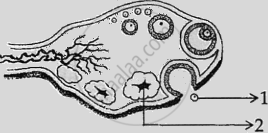
- Name the process for the release of the part labelled 1.
- Write the name of the structure marked 2.
Which hormone facilitates contraction of fallopian tube and uterus to assist movement of sperms towards ampulla?
How many ovaries are present in the female reproductive system?
Which part of the fallopian tube is closest to the ovary and has finger-like fimbriae at its edges?
Which uterine layer is the external thin membranous protective outer covering?
Which structure is a thin membrane partially covering the vaginal opening and has variable presence?
What is formed when tubules of each mammary lobe join?
At what age does puberty begin in females?
