Advertisements
Chapters
1: Sexual Reproduction in Flowering Plants
▶ 2: Human Reproduction
3: Reproductive Health
UNIT 2: GENETICS AND EVOLUTION
4: Principles of Inheritance and Variation
5: Molecular Basis of Inheritance
6: Origin of Life
7: Evidences and Theories of Biological Evolution
8: Human Evolution
UNIT 3: BIOLOGY AND HUMAN WELFARE
9: Human Health and Diseases
10: Microbes in Human Welfare
UNIT 4: BIOTECHNOLOGY AND ITS APPLICATIONS
11: Principles and Processes of Biotechnology
12: Biotechnology and Its Applications
UNIT 5: ECOLOGY AND ENVIRONMENT
13: Organisms and Populations
14: Ecosystem
15: Biodiversity and Its Conservation
![Nootan solutions for बायोलॉजी [इंग्रजी] इयत्ता १२ आईएससी chapter 2 - Human Reproduction - Shaalaa.com](/images/biology-english-class-12-isc_6:27951a2dacd84a79893ea93197c886ef.jpg "Nootan solutions for बायोलॉजी [इंग्रजी] इयत्ता १२ आईएससी chapter 2 - Human Reproduction")
Advertisements
Solutions for Chapter 2: Human Reproduction
Below listed, you can find solutions for Chapter 2 of CISCE Nootan for बायोलॉजी [इंग्रजी] इयत्ता १२ आईएससी.
Nootan solutions for बायोलॉजी [इंग्रजी] इयत्ता १२ आईएससी 2 Human Reproduction TEST YOUR PROGRESS [Pages 105 - 114]
OBJECTIVE TYPE QUESTIONS: Choose the correct answer from the alternatives given.
The limited period of sexual receptivity that occurs around the time of ovulation in all female mammals, except human, is called ______.
oogenesis
menstruation
estrus
puberty
The female equivalent of the glans of the penis is ______.
clitoris
hymen
vestibule
vas deferens
Sperms are produced in ______.
seminiferous tubules
vas deferens
prostate glands
interstitial cells
How many mature eggs are typically produced by each ovary of a non-pregnant woman in a year?
6
24
12
48
Fertilization takes place in ______.
fallopian tube
follicle
uterus
vagina
During oogenesis, each diploid cell produces ______.
four functional eggs
two functional eggs and two polar bodies
one functional egg and three polar bodies
four functional polar bodies
The female hormone that causes deposition of fat in the breast, and hips and the growth of pubic hairs during puberty is ______.
estrogen
progesterone
luteinizing hormone
follicle-stimulating hormone
Menstruation is triggered by an abrupt decline in the amount of ______.
estrogen
progesterone
luteinizing hormone
follicle-stimulating hormone
The acrosome of a sperm contains ______.
hydrolytic enzymes
mitochondria
DNA
RNA
After ovulation, in a female mammal, the structure which is formed by the ruptured follicle is ______.
corpus luteum
graafian follicle
placenta
epididymis
The spermiogenesis is the process by which spermatozoa are formed from ______.
spermatid
spermatogonia
primary spermatocyte
secondary oocyte
In most of the mammals, the testes remain enclosed in an extra-abdominal sac, the scrotum, where the temperature is lower than that in the abdomen. What will happen if the temperature of the scrotum is artificially maintained to the level of abdominal temperature?
no effect; germinal epithelium will carry out normal spermatogenesis.
germinal epithelium will produce a large quantity of androgen secretion.
germinal epithelium will produce more sperms.
germinal epithelium will degenerate, resulting in sterility.
Which of the following hormones is more directly associated with the maintenance of pregnancy?
Progesterone
Testosterone
Cortisone
Vasopressin
Proliferation of endometrium occurs under the influence of increasing amount of ______.
estrogen
progesterone
LH
FSH
In the 28 day human ovarian cycle, ovulation takes place typically on ______.
first day of the cycle
day 5 of the cycle
day 14 of the cycle
last day of the cycle
Development of an egg without fertilization is called ______.
gametogenesis
parthenogenesis
abiogenesis
sporogenesis
Animal eggs with rich yolk content are called ______.
microlecithal
homolecithal
telolecithal
alecithal
The Graafian follicle is characteristic of ______.
reptiles
amphibians
mammals
all of these
Spermatogenesis in mammalian testes is controlled by ______.
follicle stimulating hormones
growth hormones
luteinizing hormones
estrogens
A hormone secreted by the posterior lobe of pituitary is concerned with ______.
contraction of uterine muscles
secondary sexual characters
stimulation of thyroids
metabolism of carbohydrates
Gonadotropic hormone is secreted by ______.
adenohypophysis of the pituitary gland
parathyroids
interstitial cells of the testes
adrenal medulla
Which one of the following is formed during the process of spermatogenesis?
Sperm
Ova
Estrogen
Corpus luteum
At the time of puberty, the hormone that triggers changes is ______.
testosterone
estrogen
adrenaline
thyroxine
Leydig cells in adult mammals produce ______.
estrogen
testosterone
progesterone
follicle stimulating hormone
Ovulation is brought about by the hormone of pituitary gland which is called ______.
follicle stimulating hormone
luteinizing hormone (LH)
luteotropic hormone (LTH)
estrogen
Which of the following is an unpaired gland in human body?
Prostate gland
Seminal vesicle
Cowper’s gland
Bartholin’s gland
Reproduction may be defined as a phenomenon by which organisms ______.
increase in size
produce progeny of their own kind
are produced from single fertilized eggs
form new tissues and organs
The mammalian ovum was discovered by ______.
Hertwig
Von Baer
Schwann
Sertoli
The immediate predecessors of spermatids are ______.
spermatogonia
sperm mother cells
primary spermatocytes
secondary spermatocytes
From germinal cell to the formation of ovum, meiotic division takes place in ______.
oogonium
primordial germ cell
primary oocyte
secondary oocyte
Which one from the following is a requirement for sexual reproduction?
Male and female parents
Production of gametes
Optimal environmental conditions
Aquatic habitat
Internal fertilization ______.
prevents the drying out of gametes and zygotes
must take place on land
is practiced by humans
both prevents the drying out of gametes and zygotes and is practiced by humans
Which one of the following is mismatched?
Interstitial cells - testosterone
Seminiferous tubules - sperm production
Vasa deferentia - seminal fluid production
Urethra - conducts sperm
In tracing the path of sperm, you would mention vasa deferentia before ______.
testes
epididymis
urethra
uterus
An oocyte is fertilized in the ______.
vagina
uterus
oviduct
ovary
During pregnancy ______.
the ovarian and uterine cycles occur more quickly than before
GnRH is produced at a higher level than before
the ovarian and uterine cycles do not occur
female secondary sex characteristics are not maintained
Follicle-stimulating hormone (FSH) ______.
is secreted by females but not by males
stimulates the seminiferous tubules to produce sperm
secretion is controlled by gonadotropin releasing hormone (GnRH)
both stimulates the seminiferous tubules to produce sperm and secretion is controlled by gonadotropin releasing hormone (GnRH)
Which of the following combinations is most likely to be present before ovulation occurs?
FSH, corpus luteum, estrogen, secretory uterine lining
Luteinizing hormone (LH), follicle, progesterone, thick uterine lining
FSH, follicle, estrogen, uterine lining becoming thick
LH, corpus luteum, progesterone, secretory uterine lining
A human cell containing 22 autosomes and a ‘Y’ chromosome is probably a ______.
somatic cell of a male
sperm cell
somatic cell of a female
unfertilized egg cell
All of the following are sexual sources of genetic variation except:
crossing-over
mutation
production of offspring from two parents
random fertilization
Which one of the following secretions govern reproductive function in males?
FSH
LH
Testosterone
All of these
During a menstrual cycle, a mid-cycle surge of ______ triggers ovulation.
estrogen
progesterone
LH
FSH
During a menstrual cycle ______ and ______ secreted by the corpus luteum prepare the uterus for pregnancy.
FSH; LH
FSH; testosterone
estrogen; progesterone
estrogens only
Which of the following characterizes parthenogenesis?
An individual may change its sex during its lifetime.
Specialized groups of cells may be released and grow into new individuals.
An egg develops without being fertilized.
Both members of a mating pair have male and female reproductive organs.
Which of the following structures is incorrectly paired with its function?
Gonads - gamete producing organs
Spermatheca - sperm-transferring organ found in male insects
Cloaca - common opening for reproductive, excretory, and digestive systems
Endometrium - lining of the uterus, forms maternal part of placenta
Which of the following male and female structures are least alike in function?
Seminiferous tubule - vagina
Testes - ovaries
Spermatogonia - oogonia
Vas deferens - oviduct
A difference between oestrus and menstrual cycles is that ______.
non-mammalian vertebrates have oestrus cycles, whereas mammals have menstrual cycles.
the endometrial lining is shed in menstrual cycles but reabsorbed in oestrus cycles.
oestrus cycles occur more frequently than menstrual cycles do.
ovulation occurs before the endometrium thickens in oestrus cycles.
Peaks of LH and FSH production occur during ______.
flow phase of the menstrual cycle
follicular phase of the ovarian cycle
period surrounding ovulation
end of the luteal phase of the ovarian cycle
The direct function of GnRH is to ______.
stimulate production of estrogen and progesterone
initiate ovulation
inhibit secretion of pituitary hormones
stimulate secretion of LH and FSH
In mammalian males, the excretory and reproductive systems share the ______.
testes
urethra
ureter
vas deferens
Which of the following is not a difference between spermatogenesis and oogenesis in humans?
Spermatogenesis Oogenesis Occurs in males Occurs in females Spermatogenesis Oogenesis Produces four sperms per meiosis Produces one egg per meiosis Spermatogenesis Oogenesis Produces haploid cells Produces diploid cells Spermatogenesis Oogenesis Always goes to completion Does not always go to completion
Meiosis leads to all of the following except:
gametogenesis
oogenesis
pangenesis
spermatogenesis
The polar body is ______.
another name for an egg cell
a precursor cell that becomes an egg cell
non-functional cell rudiment made at the same time as an egg cell
the cell produced when fertilization occurs
Polar bodies ______.
nurse the egg as it leaves the follicle
are extra chromosomal material representing the X chromosome in each female cell
orient the sperm towards the egg
allow a reduction in chromosomes while preserving all the food for one egg
In human females, meiosis II occurs ______.
at ovulation
immediately after the sperm penetration of the secondary oocyte
immediately after the sperm penetrates the primary oocyte
none of the above
Where does in the human male spermatogenesis occur?
Ovaries
Testes
Epididymis
Prostate gland
Infertility in human males is sometimes due to the failure of the spermatids to develop into mature sperm. This failure to mature is due to:
blocked seminiferous tubules
lowered testosterone levels
inflammation of the epididymis
all of the above
Although the sperm and egg are both produced by the process of meiosis, they differ:
from a genetic point of view: each gene stands an equal chance of ending up in a sperm but has only 50% chance of being discarded in the polar body in egg production
in the allocation of cellular food supply
in motility
all of the above
The hollow ball of cells formed from cleavage is called ______.
blastomere
morula
blastula
blastocoel
Which of the following organs develop first?
Liver
Heart
Kidneys
Notochord
Which of the following structures serves as a lung, digestive tract and kidney for the developing embryo?
Placenta
Endometrium
Amnion
Liver
How old is the embryo when it becomes a foetus?
2 weeks
2 months
5 months
28 days
The fluid released from the vagina just prior to childbirth is ______.
baby’s accumulated urine
amniotic fluid
mother’s plasma from the umbilical cord
baby’s plasma from its fetal circulation
A cell formed from cleavage is called a ______.
blastomere
morula
blastula
blastopore
The solid ball of cells formed from cleavage is called ______.
blastomere
morula
blastula
gastrula
Cleavage is a unique form of mitotic cell division in that ______.
the nucleus does not participate
no spindle develops to guide the chromosomes
the plasma membranes of daughter cells do not separate
there is no growth of cells
The main role of placenta in embryonic development is to ______.
act as storage organ
convey nerve impulses
provide essential requirements for growth of embryo
protect embryo from shocks
Amnion protects the embryo from ______.
shocks
toxic effects
desiccation
humidity
Which of the following stages is the first one out of sequence?
Cleavage
Blastula
Morula
Gastrula
Which of the following stages is mismatched?
Cleavage - cell division
Blastula - gut formation
Gastrula - three germ layers
Neurula - nervous system
Which of the germ layers is best associated with development of the heart?
Ectoderm
Mesoderm
Endoderm
All of these
In humans, the placenta develops from the chorion. This indicates that human development ______.
resembles that of the chick
is dependent upon extraembryonic membranes
cannot be compared to lower animals
begins only upon implantation
In humans, the foetus ______.
is surrounded by four extraembryonic membranes
has developed organs and is recognizably human
is dependent upon the placenta for excretion of wastes and acquisition of nutrients
has developed organs and is recognizably human and is dependent upon the placenta for excretion of wastes and acquisition of nutrients
In many embryos, differentiation begins at the following stage:
cleavage
blastula
gastrula
neurula
Morphogenesis is best associated with ______.
overall growth
induction of one tissue by another
genetic mutations
all of the above
Development cannot proceed properly unless each stage is successfully completed before the next begins, starting with ______.
gamete formation
gastrulation
fertilization
cleavage
Primary tissue layers first appear ______.
in the egg cortex
in the gastrula
during cleavage
in primary organs
The astonishing internal complexity characteristic of most animals became possible following the evolution of ______.
ectoderm
myoderm
mesoderm
endoderm
As an embryo develops, tissues and organs change in size, shape and proportions. This process is called ______.
gastrulation
morphogenesis
pattern formation
metamorphosis
In implantation, which of the following burrows into the endometrium?
Zygote
Blastocyst
Gastrula
Morula
The ______ a fluid-filled sac, surrounds and protects the embryo from mechanical shocks and keeps it from drying out.
yolk sac
allantois
amnion
chorion
Which of the following is mismatched?
Brain - ectoderm
Lens - endoderm
Gut - endoderm
Bone - mesoderm
During development, spermatozoa are nourished by ______.
fructose
cells of leydig
mitochondria
sertoli cells
Which of the following is not true regarding the uterus?
It is the site of implantation of a fertilized ovum.
It is the site of menstruation.
It is the site of ovulation.
It is the site of development of the foetus.
Place the following in the correct order concerning the passage of sperm from the testes to the outside of the body:
- ductus (vas) deferens
- rete testes
- seminiferous tubules
- epididymis
- urethra
- straight tubules
3, 4, 6, 2, 1, 5
2, 4, 6, 1, 3, 5
3, 6, 2, 4, 1, 5
3, 6, 2, 4, 5, 1
During the postovulatory phase, the hormone that is most dominant is ______.
progesterone
estrogens
luteinizing hormone (LH)
follicle-stimulating hormone (FSH)
Foetal circulation differs from that of an adult because ______.
foetal liver is not developed
blood does not circulate through the gastrointestinal tract, kidneys and lungs
foetus utilizes CO2 and the adult utilizes O2
heart is not functional
The principal embryonic membranes are ______.
chorion and umbilicus
amnion and placenta
amnion and chorion
placenta and umbilicus
The placenta:
is formed by the inner portion of the chorion
contacts a portion of the mother’s endometrium
allows the foetus and the mother to exchange nutrients and waste products
all of the above
The period of time from conception of the zygote to delivery of the foetus is called ______.
implantation
gastrulation
fertilization
gestation
During human gestation, organogenesis occurs ______.
in the first trimester
in the second trimester
in the third trimester
during the blastocyst stage
Which of the following is common to both avian and mammalian development?
Holoblastic cleavage
Primitive streak
Trophoblast
Yolk plug
The archenteron develops into ______.
blastocoel
endoderm
lumen of the digestive tract
placenta
Which of the following is associated with maternal physiological changes during pregnancy?
Frequency and urgency of urination
Decreased gastrointestinal tract motility
Increased cardiac output
all of the above
The cell formed through fertilization is called a ______.
gamete
sperm cell
zygote
ovum
The act of expelling the full term foetus from the uterus is termed as ______.
gestation
implantation
parturition
capacitation
Identify the odd one from the following:
Fimbriae
Isthmus
lnfundibulum
Labia minora
The membranous cover of the ovum at ovulation is ______.
Corona radiata
Zona radiata
Zona pellucida
Chorion
Which one of the following is not a male accessory gland?
Seminal vesicle
Ampulla
Prostate
Bulbourethral gland
Spermiation is the process of the release of sperm from ______.
Seminiferous tubules
Vas deferens
Epididymis
Prostate gland
Choose the correct statement from the following:
High levels of estrogen triggers the ovulatory surge.
Oogonial cells give rise to functional ova in regular cycles from puberty onwards.
Progesterone level is high during the post-ovulatory phase of menstrual cycle.
Colostrum contains antibodies and nutrients.
Spot the odd one out from the following structures with reference to the male reproductive system.
Isthmus
Vasa efferentia
Rete testis
Epididymis
In humans, the following structure has 23 chromosomes:
spermatogonia
secondary oocyte
oogonia
zygote
Which of the following hormones is not secreted by human placenta?
LH
Progesterone
Estrogens
hCG
Fill in the blanks with appropriate words.
The male gonads are the ______ which are suspended from the body wall within the ______.
The female gonads are the ______, located within the ______.
A sperm consists of three sections: a head, which carries the ______ and is capped with an egg-penetrating ______; a middle piece, which is rich in ______; and a tail, which is really a single ______ used for locomotion.
The females of many primates, including humans, have cycles, in which the ______ is shed, whereas other mammals have ______ cycles, in which it is reabsorbed.
During the first 14 days of the menstrual cycle, growth of the follicle is promoted by ______, which is released from the anterior pituitary.
Corpus luteum secretes ______ whereas Leydig cells ______.
In mammals spermatozoa must ascend to the ______ to fertilize the ovum.
First meiotic division during oogenesis occurs in ______.
Development of an egg without fertilization is called ______.
The endometrium is the lining of ______.
The abdominal passage which connects the abdominal cavity with the scrotal sac in mammals is known as ______.
A series of cyclic changes in the female reproductive system of non-primate mammals is called ______ cycle.
If ovum is not fertilized then the corpus luteum degenerates into a white mass called ______.
Change in the female secondary sex organs are controlled by ______ of the ovary in the proliferative phase of the menstrual cycle whereas the changes in the secretory phase are controlled by the hormone ______.
A secondary oocyte has a ______ chromosome number while a fertilized ovum has a ______ chromosome number.
Testes in human male are located in ______.
During oogenesis, an oogonium produces ______ ovum and three ______.
Transformation of a young follicle into Graafian follicle is controlled by ______.
______ is process whereby the spermatid is transformed into spermatozoa.
Primitive germ cells (or spermatogonia) are located in the ______.
The human eggs are ______.
The process by which an organism produces young individuals of its own species is called ______.
A mating organ present in the male reproductive system is ______.
A developmental defect whereby the testes do not descend into the scrotal sac is known as ______.
Corpus luteum persists and secretes progesterone and estrogen during ______ period.
The onset of menstruation is called ______.
A placenta is made of ______ tissues and connects the embryo’s blood vessels to the mother’s ______.
Development of a fertilized ovum starts with ______.
Development of young one in humans occurs in the ______.
Gestation period for human baby is about ______ days.
Intimate connection established between foetal membrane and uterine wall is known as ______.
The process of giving birth to a young one is called ______.
Brain and in fact, the whole nervous system in mammals are derived from embryonic ______.
The process of release of the ovum from a mature follicle is called ______.
The structure which provides vascular connection between the foetus and uterus is called ______.
Zygote divides to form ______ which is implanted in the uterus.
The stage in embryonic development which consists of a solid ball of cells called ______.
State whether the following statement is true or false.
The number of ova produced after a primary oocyte that has undergone two maturation divisions is four.
State whether the following statement is true or false.
Gametes are usually produced in specialized structures known as gonads.
State whether the following statement is true or false.
Accessory glands like seminal vesicles contribute to the fluid substance of the seminal fluid.
State whether the following statement is true or false.
High levels of progesterone result in a diminution of the trophic hormone LH. This is called negative feedback.
State whether the following statement is true or false.
Endometrium is highly vascular and rich in glands.
State whether the following statement is true or false.
In primates, the condition of the failure of testes to descend in the scrotal sac is known as cryptorchidism.
State whether the following statement is true or false.
Leydig cells are found in ovary.
State whether the following statement is true or false.
In human ovaries all oogonia mature at the same time.
State whether the following statement is true or false.
During oogenesis, one primary oocyte gives rise to four ova.
State whether the following statement is true or false.
The nerve tube arises from the ectoderm.
State whether the following statement is true or false.
The alecithal eggs show meroblastic type of cleavage.
State whether the following statement is true or false.
The placenta in humans is the true placenta in which foetal and maternal parts can be easily separated without any bleeding.
State whether the following statement is true or false.
Archenteron is a cavity lined by endodermal cells and is produced during gastrulation.
State whether the following statement is true or false.
When trophoblastic villi degenerate in addition to the walls of the uterine vessels so that the foetal capillaries lie bathed in uterine blood, the placenta is known as haemoendothelial type.
State whether the following statement is true or false.
The placenta formed from the yolk sac is called allantoic.
State whether the following statement is true or false.
There is no appreciable increase in the size of the embryo during the formation of morula.
State whether the following statement is true or false.
In mammals, yolk sac regresses in size and function as soon as allantois is well developed.
VERY SHORT ANSWER TYPE QUESTIONS
At what age normally menopause occurs in females.
Where fertilization of ovum occurs in a human female?
What is the function of acrosome in a sperm?
Where do you find Leydig cells?
How many sperms will be produced from 100 primary spermatocytes and how many eggs will be produced from 100 primary oocytes?
Mention the most significant function of interstitial cells of testis.
Which epithelium lines the fallopian tube?
Choose the odd item in the series.
Spermatocyte, spermatid, spermatogonium, polar body
Choose the odd item in the series.
Fallopian tubes, vagina, uterus, ovaries
Choose the odd item in the series.
Cowper’s glands, prostate, testes, seminal vesicles
Choose the odd item in the series.
Cowper’s glands, fallopian tube, epididymis, vas deferens
Choose the odd item in the series.
Graafian follicle, endometrium, corpus luteum, acrosome
What is secreted by corpus luteum?
Name the process of the rupture of Graafian follicle and the subsequent release of the egg from the ovary.
What is the proliferative phase in the menstrual cycle? For how many days does it last?
How many chromosomes are present in a normal human ovum?
Define spermiogenesis.
Name the tube which carries spermatozoa out from the testis.
Name the two phases covering the first half and second half of the menstrual cycle respectively.
How many autosomes are found in a single mature human sperm?
How many polar bodies are given out in the production of one egg during oogenesis?
A spermatogonial cell has 30 chromosomes. How many chromosomes will occur in (i) the primary spermatocyte and (ii) a spermatid derived from this cell?
Name the organelles contained in the neck of a mammalian sperm.
In which organ is the corpus luteum formed?
What is the function of Leydig cells?
Define the term castration.
What is the special structural feature of the epithelial cells that line the fallopian tubes?
Name the tissue layers that cover and protect the testes.
Name the cells that produce the hormone testosterone.
Which accessory sex gland contributes to the most of the liquid portion of semen?
Name the male structures that are homologous to the ovaries and the clitoris.
To which structures do the mesovarium, ovarian ligament and suspensory ligament anchor the ovary?
What happens to most ovarian follicles?
Which spermatogenic cells in a seminiferous tubule are most mature and least mature?
Name the ligaments that hold the ovaries in position.
Which hormones stimulate proliferation of the endometrium, ovulation, growth of the corpus luteum and the surge of LH at mid-cycle?
In which phase of the uterine cycle does implantation occur?
Name the foetal membranes in a mammal.
Name the term used for the period between fertilization of ovum and birth of young one.
What makes the uterus contract during child birth?
Name the enzyme present in the sperm’s acrosome for its easy penetration into the egg.
Which particular part of the mammalian sperm secretes enzymes to facilitate penetration into the ovum?
Name the hormone and its corresponding gland associated with the following event:
Uterine contraction during parturition.
Name the hormone and its corresponding gland associated with the following event:
Progesterone secretion by the corpus luteum.
At what stage is the mammalian embryo implanted in the uterus?
Give two functions of the amniotic fluid.
Name the germ layer from which gonads develop.
What is capacitation with reference to mammalian sperm?
Name the sperm lysin. Which organelle secretes it? What is its function?
Name the enzyme which a sperm releases to penetrate the layer of corona radiata of an ovum.
What is the name of the cavity formed in the gastrula?
Which event marks the animal pole of the human ovum?
Name the part of an ovum for the entry of the sperm.
Name the chemical substance released by the sperm that helps its entry into the ovum.
Name the layer of cells forming the outer wall of the blastocyst.
What is corona radiata?
Name the enzyme that the sperm releases at the time of fertilization.
From which germ layers do the following organ differentiate?
Kidney
From which germ layers do the following organ differentiate?
Urinary bladder
Why is the cleavage in mammals referred as simple holoblastic?
Name the first germ layer that gets differentiated from the inner mass of cells of the mammalian blastula. Name any one organ developed from this germ layer.
What is the trophoectoderm?
Which muscle assists in parturition (childbirth)?
Which muscles assist in the erection of penis in males and clitoris in females?
The structural differences between female and male pelvises are related to which functions?
What is the histological difference between a morula and a blastocyst?
How does the blastocyst merge with and burrow into the endometrium?
What types of cells compose the mucosa of the fallopian tubes?
Name the structure through which exchange of materials between mother and foetus occurs.
Which cells of the blastocyst give rise to the embryonic disc?
How do the amnion and chorion differ in function?
Name the hormone that causes morning sickness.
Name the hormone that increases the flexibility of the pubic symphysis and helps dilate the cervix of the uterus to ease delivery of the baby.
Give the scientific term for the animals which gave birth to young ones.
Mention the most significant function/role of the acrosome.
Name the extra embryonic membranes formed during mammalian development.
List any two events taking place in an ovum just when sperm gains entry into it.
Mention the most significant role of sertoli cells.
Name the foetal membrane that provides a fluid medium to the developing embryo. Mention its two functions.
Where are fimbriae present in human female reproductive system? Give their function.
Study the figure given below and answer the questions that follow:
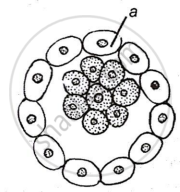
- Name the stage of human embryo the figure represents.
- Identify ‘a’ in the figure and mention its function.
- Mention the fate of the inner cell mass after implantation in the uterus.
- Where are the stem cells located in this embryo?
Mention the function of trophoblast in human embryo.
When and where does spermatogenesis occur in a human male?
What stimulates pituitary to release the hormone responsible for parturition? Name the hormone.
State the difference between meiocyte and gamete with respect to chromosome number.
When do the oogenesis and the spermatogenesis initiate in human females and males respectively?
Write the function of the following:
Middle piece in human sperm.
Write the function of the following:
Luteinizing hormone in human males.
Write the function of seminal vesicles.
Give reasons for the following:
Testes descend into the scrotum before birth.
Write the physiological reason why a woman generally cannot conceive a child after 50 years of age?
Name the cells that nourish the germ cells in the testes. Where are these cells located in the testis?
Name the hormones which are produced in women only during pregnancy.
Write the effect of the high concentration of LH on a mature Graafian follicle.
List the different parts of the human oviduct through which the ovum travels till it meets the sperm for fertilization.
Give one example of an animal which exhibits oestrus cycle.
Write the effect of the high concentration of LH on a mature Graafian follicle.
Given below are the events in human reproduction. Write them in correct sequential order.
Insemination, gametogenesis, fertilisation, parturition, gestation, implantation
What is the role of cervix in the human female reproductive system?
Why are menstrual cycles absent during pregnancy?
During reproduction, the chromosome number (2n) reduces to half (n) in the gametes and again the original number (2n) is restored in the offspring. What are the processes through which these events take place?
Placenta has endocrine function. Does it have other functions?
Give a scientific term for the following:
An act of expelling the full-term foetus from mother’s uterus at the end of gestation.
Which accessory sex gland contributes to the most of the liquid portion of semen?
Arrange the following hormones in sequence of their secretion in a pregnant woman.
hCG, LH, FSH, Relaxin
SHORT/LONG ANSWER TYPE QUESTIONS
What does each accessory sex gland contribute to semen?
How does the age of a primary oocyte in a female compare with the age of a primary spermatocyte in a male?
What is corpus luteum?
Under what condition does corpus luteum undergo degeneration?
Draw labelled diagram of T.S. testis of a male human.
Describe the human male reproductive system.
Describe the events that occur during the ovulatory phase of the menstrual cycle.
Describe the events that occur during secretory phases of the menstrual cycle.
Describe various phases of menstrual cycle emphasizing the role of hormones.
What is the period when there is maximum chance of conception?
A human female experiences two major changes, menarche and menopause during her life. Mention the significance of both the events.
Nootan solutions for बायोलॉजी [इंग्रजी] इयत्ता १२ आईएससी 2 Human Reproduction BOARD EXAMINATION QUESTIONS [Pages 114 - 115]
Regulation of the menstrual and estrous cycles provides an excellent example of the integration of hormonal action seen in mammals. Briefly discuss the hormonal interactions involved.
Explain the role of hormones during the menstrual cycle.
Describe the events that occur during the ovulatory phase of the menstrual cycle.
Briefly describe the events that occur during the luteal phase of menstrual cycle.
Describe briefly the internal structure of a mammalian ovary.
State three functions of the placenta.
Write a short note on capacitation.
Write a short note on ‘Menarche’.
Describe the events that take place from the time of entry of human sperm into the ovum till fertilization is complete.
Draw an electron microscopic view of a mammalian sperm. Label any six internal structures of the sperm.
Briefly describe the events that occur during the proliferative phase of the menstrual cycle.
Describe the process of oogenesis in human female.
Briefly describe the process of spermatogenesis.
Draw a well labelled diagram of L.S. human testis.
The transparent non-cellular layer of the ovum is called ______.
Zona pellucida
Theca externa
Corona radiata
Granulosa layer
What is the difference between spermiogenesis and spermiation?
In spermiogenesis, spermatids are formed; while in spermiation, spermatozoa are formed.
In spermiogenesis, spermatozoa are formed; while in spermiation, spermatids are formed.
In spermiogenesis, spermatozoa are released from sertoli cells; while in spermiation, spermatozoa are formed.
In spermiogenesis, spermatozoa are formed; while in spermiation, spermatozoa are released from the sertoli cells.
If the fallopian tube in the human reproductive system get blocked, the gametes will not be transported from ______.
Ovary to uterus
Epididymis to vas deferens
Uterus to ovary
Vas deferens to penis
Morulla is a solid ball of ______ blastomeres.
100
16
90
64
Assertion: Testes and ovaries are primary sex organs.
Reason: Facial hair, development of chest, deepening of voice and secondary sexual organs in female.
Both assertion and reason are true, and reason is the correct explanation of assertion.
Both assertion and reason are true, but reason is not the correct explanation of assertion.
Assertion is true but reason is false.
Both assertion and reason are false.
Study the diagram given below and answer the questions that follow:
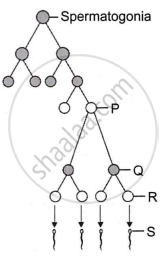
- During multiplication phase the sperm mother cells divide mitotically and form:
- Spermatogonia
- Secondary spermatocytes
- Spermatids
- Spermatozoa
- The role of gonadotropin releasing hormones is to stimulate the production of:
- Progesterone
- Inhibin
- FSH and LH
- Oestrogen
- Choose the correct labels for the structure marked P and R from the options given below:
- P-primary spermatocytes, R-secondary spermatocytes
- P-primary spermatocytes, R-spermatids
- P-secondary spermatocytes, R-primary spermatocytes
- P-spermatids, R-spermatozoa
- The energy for the movement of sperm tail come from the:
- Mitochondria
- Acrosone
- Centriole
- Nucleus
- When does spermatogenesis starts in human beings?
- At birth
- At onset of puberty
- During embryonic development
- Between 10-12 years
Nootan solutions for बायोलॉजी [इंग्रजी] इयत्ता १२ आईएससी 2 Human Reproduction HIGHER ORDER THINKING SKILLS QUESTIONS (HOTS) [Pages 115 - 116]
Identify A, B, C and D with reference to gametogenesis in humans, in the flow chart given below:

Study the following flow chart. Name the hormones involved at each stage. Explain their functions.
| Flow chart |
| Hypothalamus |
| ↓ |
| Pituitary |
| ↓ |
| Testes |
| ↓ |
| Sperm |
Study the following flow chart. Name the hormones involved at each stage. Explain their functions.
| Flow chart |
| Hypothalamus |
| ↓ |
| Pituitary |
| ↓ |
| Ovary |
| ↓ |
| Pregnancy |
Could you guess a remarkable difference between the reproductive events in the male and in the female?
In humans, the testes are situated outside the abdominal cavity. Why? Name the pouch in which they are present.
The presence or absence of hymen is not reliable indicator of virginity or sexual experience.
Lack of menstruation is an indication of pregnancy.
Why not all copulations lead to fertilization and pregnancy?
What does each accessory sex gland contribute to semen?
How does the age of a primary oocyte in a female compare with the age of a primary spermatocyte in a male?
What structural features of the endometrium and myometrium contribute to their functions?
When declining levels of estrogens and progesterone stimulate secretion of GnRH, is this a positive or negative feedback effect and why?
Nootan solutions for बायोलॉजी [इंग्रजी] इयत्ता १२ आईएससी 2 Human Reproduction NCERT EXERCISES [Pages 116 - 117]
Fill in the blanks:
Humans reproduce ______.
asexually
sexually
Humans are ______.
oviparous
viviparous
ovoviviparous
Fertilization is ______ in humans.
external
internal
Male and female gametes are ______.
diploid
haploid
Zygote is ______.
diploid
haploid
The process of release of the ovum from a mature follicle is called ______.
Ovulation is induced by a hormone called ______.
The fusion of the male and the female gametes is called ______.
Fertilization takes place in ______.
Zygote divides to form ______ which is implanted in the uterus.
The structure which provides vascular connection between the foetus and uterus is called ______.
Draw a labelled diagram of the male reproductive system.
Draw a labelled diagram of the female reproductive system.
Write two major functions of testis.
Write two major functions of ovary.
Describe the structure of a seminiferous tubule.
What is spermatogenesis?
Briefly describe the process of spermatogenesis.
Name the hormones involved in regulation of spermatogenesis.
Define spermiogenesis.
Define spermiation.
Draw a labelled diagram of sperm.
What are the major components of seminal plasma?
What are the major functions of female accessory ducts?
What are the major functions of female accessory glands?
What is oogenesis?
Give a brief account of oogenesis.
Draw a labelled diagram of a section through the ovary.
Draw a labelled diagram of a Graafian Follicle.
Name the function of the following:
Corpus luteum
Name the function of the following:
Endometrium
Name the functions - Acrosome of sperm.
Name the function of the following:
Sperm tail
Name the function of the following:
Fimbriae
Identify True/False statement. Correct false statement to make it true.
Androgens are produced by Sertoli cells.
Identify True/False statement. Correct false statement to make it true.
Spermatozoa get nutrition from Sertoli cells.
Identify True/False statement. Correct the false statement to make it true.
Leydig cells are found in the ovary.
Identify True/False statement. Correct false statement to make it true.
Leydig cells synthesise androgens.
Identify True/False statement. Correct false statement to make it true.
Oogenesis occurs in corpus luteum.
Identify True/False statement. Correct false statement to make it true.
Menstrual cycle ceases during pregnancy.
Identify True/False statement. Correct false statement to make it true.
Presence or absence of hymen is not a reliable indicator of virginity or sexual experience.
What is menstrual cycle?
Which hormones regulate menstrual cycle?
What is parturition?
Which hormones are involved in the induction of parturition?
In our society the women are often blamed for giving birth to daughters. Can you explain why this is not correct?
How many eggs are released by a human ovary in a month? How many eggs do you think would have been released if the mother gave birth to identical twins? Would your answer change if the twins born were fraternal?
How many eggs do you think were released by the ovary of a female dog which gave birth to 6 puppies?
Nootan solutions for बायोलॉजी [इंग्रजी] इयत्ता १२ आईएससी 2 Human Reproduction VALUE BASED QUESTIONS [Page 117]
What do you think the doctors inject to induce delivery?
Why colostrum is necessary for the new-born babies?
Breast-feeding during the initial period of infant growth is recommended by doctors for bringing up a healthy baby. Can you assign any reason for this recommendation?
What symptom will be common to a person whose leydig cells have been destroyed and a person whose sertoli cells have been destroyed? What symptom will not be common?
Nootan solutions for बायोलॉजी [इंग्रजी] इयत्ता १२ आईएससी 2 Human Reproduction DIFFERENTIATE BETWEEN [Page 118]
Difference between animal pole and vegetal pole.
Answer in one sentence.
Give two differences between blastula and gastrula.
Difference between fertilization and insemination.
Differentiate between the graafian follicle and corpus luteum.
Difference between hormones of ovulatory phase and hormones of luteal phase.
Differentiate between implantation and parturition.
Differentiate between the following pair:
Menarche and menopause
Difference between morula and blastula.
Differentiate between seminiferous tubules and leydig cells.
Differentiate between sertoli cells and spermatogonial cells.
Differentiate between sertoli cells and spermatids.
Differentiate between the following:
Spermatogenesis and oogenesis
Differentiate between spermatogenesis and spermiogenesis.
Differentiate between vas deferens and vasa efferentia.
Differentiate between zona pellucida and corona radiata.
Solutions for 2: Human Reproduction
Nootan solutions for बायोलॉजी [इंग्रजी] इयत्ता १२ आईएससी chapter 2 - Human Reproduction
Shaalaa.com has the CISCE Mathematics बायोलॉजी [इंग्रजी] इयत्ता १२ आईएससी CISCE solutions in a manner that help students grasp basic concepts better and faster. The detailed, step-by-step solutions will help you understand the concepts better and clarify any confusion. Nootan solutions for Mathematics बायोलॉजी [इंग्रजी] इयत्ता १२ आईएससी CISCE 2 (Human Reproduction) include all questions with answers and detailed explanations. This will clear students' doubts about questions and improve their application skills while preparing for board exams.
Further, we at Shaalaa.com provide such solutions so students can prepare for written exams. Nootan textbook solutions can be a core help for self-study and provide excellent self-help guidance for students.
Concepts covered in बायोलॉजी [इंग्रजी] इयत्ता १२ आईएससी chapter 2 Human Reproduction are The Male Reproductive System, Mammary Glands, Disorders of Female Reproductive System, Male Urethra Vs Female Urethra, Graafian Follicle Vs Corpus Luteum, Sperm Vs Ovum, Gametogenesis, Spermatogenesis, Ovarian Follicle Development and Function, Spermiogenesis, Human Reproduction, Secondary Sexual Characteristics in Humans, Human Reproductive Organs, Testes, Location and Temperature Regulation of Testes, Structure of Testis, Duct system of Male Reproductive Tract, Accessory Glands of Male Reproductive System, The Female Reproductive System, External Genitalia: Penis, Semen (Seminal fluid), Disorders of Male Reproductive System, External Genitalia: Vulva, Female Reproductive Duct System, Female Internal Reproductive Organ > Ovary, Structure of Sperm, Spermatogenesis Vs Oogenesis, Puberty, Hormonal Control of Puberty, Menstrual Cycle (Ovarian Cycle), Major Events of Menstrual Cycle, Hormonal Control of Menstrual Cycle, Menarche and Menopause, Embryonic Development in Human, Fate of Germ Layers in Embryonic Development, Major Features of Embryonic Development, Placenta (Growth) in Human, Parturition (Birth) in Human, Lactation in Human, Fertilization in Human, Factors affecting Spermatogenesis, Oogenesis, The Male Reproductive System, Mammary Glands, Disorders of Female Reproductive System, Male Urethra Vs Female Urethra, Graafian Follicle Vs Corpus Luteum, Sperm Vs Ovum, Gametogenesis, Spermatogenesis, Ovarian Follicle Development and Function, Spermiogenesis, Human Reproduction, Secondary Sexual Characteristics in Humans, Human Reproductive Organs, Testes, Location and Temperature Regulation of Testes, Structure of Testis, Duct system of Male Reproductive Tract, Accessory Glands of Male Reproductive System, The Female Reproductive System, External Genitalia: Penis, Semen (Seminal fluid), Disorders of Male Reproductive System, External Genitalia: Vulva, Female Reproductive Duct System, Female Internal Reproductive Organ > Ovary, Structure of Sperm, Spermatogenesis Vs Oogenesis, Puberty, Hormonal Control of Puberty, Menstrual Cycle (Ovarian Cycle), Major Events of Menstrual Cycle, Hormonal Control of Menstrual Cycle, Menarche and Menopause, Embryonic Development in Human, Fate of Germ Layers in Embryonic Development, Major Features of Embryonic Development, Placenta (Growth) in Human, Parturition (Birth) in Human, Lactation in Human, Fertilization in Human, Factors affecting Spermatogenesis, Oogenesis.
Using Nootan बायोलॉजी [इंग्रजी] इयत्ता १२ आईएससी solutions Human Reproduction exercise by students is an easy way to prepare for the exams, as they involve solutions arranged chapter-wise and also page-wise. The questions involved in Nootan Solutions are essential questions that can be asked in the final exam. Maximum CISCE बायोलॉजी [इंग्रजी] इयत्ता १२ आईएससी students prefer Nootan Textbook Solutions to score more in exams.
Get the free view of Chapter 2, Human Reproduction बायोलॉजी [इंग्रजी] इयत्ता १२ आईएससी additional questions for Mathematics बायोलॉजी [इंग्रजी] इयत्ता १२ आईएससी CISCE, and you can use Shaalaa.com to keep it handy for your exam preparation.
