Advertisements
Advertisements
प्रश्न
The membranous cover of the ovum at ovulation is ______.
पर्याय
Corona radiata
Zona radiata
Zona pellucida
Chorion
Advertisements
उत्तर
The membranous cover of the ovum at ovulation is corona radiata.
Explanation:
The corona radiata is the membranous cover of the ovum at ovulation, formed by the layers of follicular cells surrounding the ovum. It provides nutrients and protection to the ovum during ovulation.
APPEARS IN
संबंधित प्रश्न
Write the functions of the following organs of reproduction:
a. Ovaries
b. Seminal vesicle and prostate glands
Draw a sectional view of human female reproductive system and label the part where
(i) eggs develop.
(ii) fertilisation takes place.
(iii) fertilised egg gets implanted.
Describe placenta structure.
What are the functions of testes in the human male reproductive system?
If a woman is using copper-T for contraception, will it protect her from sexually transmitted diseases?
State the main function of the Leydig cells
Match the Column:
| no | Column A | Column B |
| 1 | Allele | Control of automobile exhaust |
| 2 | Leydig cells | Tourniquet |
| 3 | Utriculus | Alternate forms of genes |
| 4 | Snake bite | Dynamic equilibrium |
| 5 | Euro IV norms | Testosterone |
| Sudden change in genes | ||
| Static equilibrium |
State the main function of the Sperm duct.
The site of maturation of human sperms is the
Give a biological explanation for the following.
The placenta is an important structure for the development of a foetus.
Do all organisms give birth to individuals like humans?
What do the ovaries in a woman produce?
Name the liquid that contains sperms.
What is the frequency of menstrual cycle in human females (or women)?
Mention two functions of human ovaries.
Which structures in human female are equivalent to the following structures in the male?
- testes
- vas deferens
- penis
In each case say in what respect the structures are equivalent?
Where does fertilisation take place in human females?
Which of the following is not a sexually transmitted disease?
(a) gonorrhoea
(b) hepatitis
(c) syphilis
(d) AIDS
In a flower, the parts that produce male and female gametes are respectively :
(a) sepal and anther
(b) filament and stigma
(c) anther and ovary
(d) stamen and style
Given below is a diagram of two systems together in the human body.
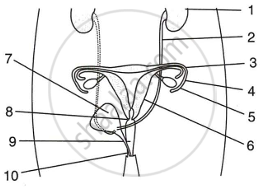 |
- Name the systems.
- Name the parts numbered 1-10.
- Describe the functions of the parts 3, 4, 5 & 6.
- What will happen if the part 3 on both sides gets blocked?
Write two examples of sexually transmitted diseases caused by virus.
Choose the correct answer:
The aim of sexual reproduction _________
Choose the correct answer:
Binary fission is a method of __________
Choose the correct answer:
When pregnancy does not occur, the life of corpus luteum is about _____________
Give the functions of the following:
Vagina
Label the folowing diagram
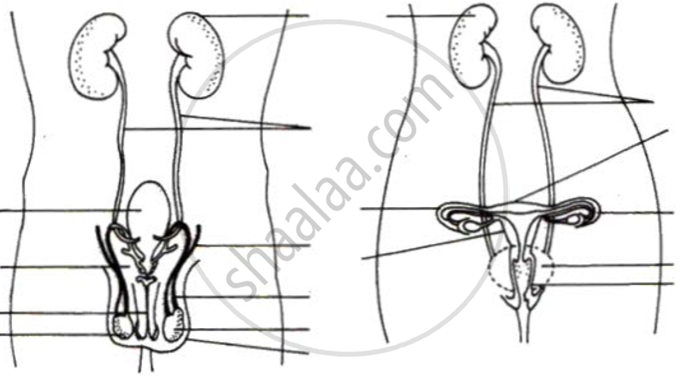
Rewrite the following terms in a correct and logical sequence:
The luteal phase, follicular phase, menstrual phase, ovulatory phase.
Choose the Odd One Out:
Freshly released human egg has ______.
