Advertisements
Online Mock Tests
Chapters
2: Sexual Reproduction in Flowering Plants
▶ 3: Human Reproduction
4: Reproductive Health
5: Principle of Inheritance and Variation
6: Molecular Basis of Inheritance
7: Evolution
8: Human Health and Diseases
9: Strategies for Enhancement in Food Production
10: Microbes in Human Welfare
11: Biotechnology : Principles and Processes
12: Biotechnology and Its Applications
13: Organisms and Populations
14: Ecosystem
15: Biodiversity and Conservation
16: Environmental Issues
![NCERT Exemplar solutions for बायोलॉजी एक्सेम्पलार [इंग्रजी] इयत्ता १२ chapter 3 - Human Reproduction - Shaalaa.com](/images/biology-exemplar-english-class-12_6:436861273171423eb97769e06742bf93.png "NCERT Exemplar solutions for बायोलॉजी एक्सेम्पलार [इंग्रजी] इयत्ता १२ chapter 3 - Human Reproduction")
Advertisements
Solutions for Chapter 3: Human Reproduction
Below listed, you can find solutions for Chapter 3 of CBSE, Karnataka Board PUC NCERT Exemplar for बायोलॉजी एक्सेम्पलार [इंग्रजी] इयत्ता १२.
NCERT Exemplar solutions for बायोलॉजी एक्सेम्पलार [इंग्रजी] इयत्ता १२ 3 Human Reproduction MULTIPLE CHOICE QUESTIONS [Pages 17 - 20]
Choose the incorrect statement from the following.
Polyspermy is prevented by the chemical changes in the egg surface
In the human female implantation occurs almost seven days after fertilisation
Colostrum contains antibodies and nutrients
In birds and mammals internal fertilisation takes place
Identify the correct statement from the following:
High levels of estrogen triggers the ovulatory surge.
Oogonial cells start to proliferate and give rise to functional ova in regular cycles from puberty onwards.
Sperms released from seminiferous tubules are highly motile.
Progesterone level is high during the post ovulatory phase of menstrual cycle.
Spot the odd one out from the following structures with reference to the male reproductive system.
Isthmus
Vasa efferentia
Rete testis
Epididymis
Seminal plasma, the fluid part of semen, is contributed by.
- Seminal vesicle
- Prostate
- Urethra
- Bulbourethral gland
i, ii, and iv
ii, iii and iv
i and iv
i and ii
Spermiation is the process of the release of sperm from ______.
Seminiferous tubules
Vas deferens
Epididymis
Prostate gland
Mature Graafian follicle is generally present in the ovary of a healthy human female around stet ______.
11 - 17 days of menstrual cycle
18 - 23 days of menstrual cycle
24 - 28 days of menstrual cycle
5 - 8 days of menstrual cycle
Acrosomal reaction of the sperm occurs due to ______.
Its contact with zona pellucida of the ova
Reactions within the uterine environment of the female
Reactions within the epididymal environment of the male
Androgens produced in the uterus
Which one of the following is not a male accessory gland?
Seminal vesicle
Ampulla
Prostate
Bulbourethral gland
The spermatogonia undergo division to produce sperms by the process of spermatogenesis. Choose the correct one with reference to above.
Spermatogonia have 46 chromosomes and always undergo meiotic cell division
Primary spermatocytes divide by mitotic cell division
Secondary spermatocytes have 23 chromosomes and undergo second meiotic division
Spermatozoa are transformed into spermatids
Match between the following representing parts of the sperm and their functions and choose the correct option.
| Column A | Column B | ||
| A. | Head | i. | Enzymes |
| B. | Middle piece | ii. | Sperm motility |
| C. | Acrosome | iii. | Energy |
| D. | Tail | iv. | Genetic material |
A-iv, B-iii, C-i, D-ii
A-iv, B-i, C-ii, D-iii
A-ii, B-i, C-iii, D-iv
A-ii, B-iv, C-i, D-iii
Which among the following has 23 chromosomes?
Secondary oocyte
Oogonia
Zygote
Spermatogonia
Match the following and choose the correct options:
| A. | Trophoblast | i. | Embedding of blastocyst in the endome |
| B. | Cleavage | ii. | Group of cells that would differentiate as embryo |
| C. | Inner cell mass | iii. | Outer layer of blastocyst attached to the endometrium |
| D. | Implantation | iv. | Mitonic division of zygote |
A-iii, B-iv, C-ii, D-i
A-iii, B-i, C-ii, D-iv
A-ii, B-iv, C-iii, D-i
A-ii, B-i, C-iii, D-iv
Which of the following hormones is not secreted by human placenta?
LH
Progesterone
Estrogens
hCG
The vas deferens receives duct from the seminal vesicle and opens into urethra as ______.
Ejaculatory duct
Efferent ductule
Ureter
Epididymis
Urethral meatus refers to the ______.
External opening of the urinogenital duct
Muscles surrounding the urinogenial duct
Opening of vas deferens into urethra
Urinogenital duct
Morula is a developmental stage ______.
Between the zygote and blastocyst
Between the blastocyst and gastrula
After the implantation
Between implantation and parturition
The membranous cover of the ovum at ovulation is ______.
Corona radiata
Zona radiata
Zona pellucida
Chorion
Identify the odd one from the following.
Labia minora
Fimbriae
Infundibulum
Isthmus
NCERT Exemplar solutions for बायोलॉजी एक्सेम्पलार [इंग्रजी] इयत्ता १२ 3 Human Reproduction VERY SHORT ANSWER [Pages 20 - 21]
Given below are the events in human reproduction. Write them in correct sequential order.
Insemination, gametogenesis, fertilisation, parturition, gestation, implantation
The path of sperm transport is given below. Provide the missing steps in blank boxes.
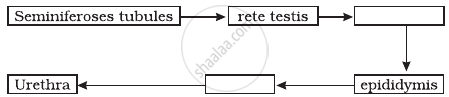
What is the role of cervix in the human female reproductive system?
Why are menstrual cycles absent during pregnancy?
Female reproductive organs and associated functions are given below in column A and B. Fill the blank boxes.
| Column A | Column B |
| Ovaries | Ovulation |
| Oviduct | a |
| b | Pregnancy |
| Vagina | Birth |
From where the parturition signals arise-mother or foetus? Mention the main hormone involved in parturition.
What is the significance of epididymis in male fertility?
Give the names and functions of the hormones involved in the process of spermatogenesis. Write the names of the endocrine glands from where they are released.
The mother germ cells are transformed into a mature follicle through series of steps. Provide the missing steps in the blank boxes.

During reproduction, the chromosome number (2n) reduces to half (n) in the gametes and again the original number (2n) is restored in the offspring. What are the processes through which these events take place?
What is the difference between a primary oocyte and a secondary oocyte?
What is the significance of ampullary–isthmic junction in the female reproductive tract?
How does zona pellucida of ovum help in preventing polyspermy?
Mention the importance of LH surge during menstrual cycle.
Which type of cell division forms spermatids from the secondary spermatocytes?
NCERT Exemplar solutions for बायोलॉजी एक्सेम्पलार [इंग्रजी] इयत्ता १२ 3 Human Reproduction SHORT ANSWER [Page 22]
A human female experiences two major changes, menarche and menopause during her life. Mention the significance of both the events.
How many spermatozoa are formed from one secondary spermatocyte?
Where does the first cleavage division of zygote take place?
Corpus luteum in pregnancy has a long life. However, if fertilisation does not take place, it remains active only for 10 - 12 days. Explain.
What is foetal ejection reflex? Explain how it leads to parturition?
Except endocrine function, what are the other functions of placenta.
Why doctors recommend breast feeding during initial period of infant growth?
What are the events taking place in the ovary and uterus during follicular phase of the menstrual cycle.
Given below is a flow chart showing ovarian changes during menstrual cycle. Fill in the spaces giving the name of the hormones responsible for the events shown.

Give a schematic labelled diagram to represent oögenesis (without descriptions)
What are the changes in the oogonia during the transition of a primary follicle to Graafian follicle?
NCERT Exemplar solutions for बायोलॉजी एक्सेम्पलार [इंग्रजी] इयत्ता १२ 3 Human Reproduction LONG ANSWER [Pages 22 - 23]
What role does pituitary gonadotropins play during follicular and ovulatory phases of menstrual cycle? Explain the shifts in steroidal secretions.
Meiotic division during oogenesis is different from that in spermatogenesis. Explain how and why?
The zygote passes through several developmental stages till implantation, Describe each stage briefly with suitable diagrams.
Draw a neat diagram of the female reproductive system and label the parts associated with the following:
(a) production of gamete
(b) site of fertilisation
(c) site of implantation
(d) birth canal
With a suitable diagram, describe the organisation of mammary gland.
Solutions for 3: Human Reproduction
NCERT Exemplar solutions for बायोलॉजी एक्सेम्पलार [इंग्रजी] इयत्ता १२ chapter 3 - Human Reproduction
Shaalaa.com has the CBSE, Karnataka Board PUC Mathematics बायोलॉजी एक्सेम्पलार [इंग्रजी] इयत्ता १२ CBSE, Karnataka Board PUC solutions in a manner that help students grasp basic concepts better and faster. The detailed, step-by-step solutions will help you understand the concepts better and clarify any confusion. NCERT Exemplar solutions for Mathematics बायोलॉजी एक्सेम्पलार [इंग्रजी] इयत्ता १२ CBSE, Karnataka Board PUC 3 (Human Reproduction) include all questions with answers and detailed explanations. This will clear students' doubts about questions and improve their application skills while preparing for board exams.
Further, we at Shaalaa.com provide such solutions so students can prepare for written exams. NCERT Exemplar textbook solutions can be a core help for self-study and provide excellent self-help guidance for students.
Concepts covered in बायोलॉजी एक्सेम्पलार [इंग्रजी] इयत्ता १२ chapter 3 Human Reproduction are Structure of Sperm, Human Reproduction, Gametogenesis, The Male Reproductive System, The Female Reproductive System, Implantation in Human, Lactation in Human, Spermatogenesis, Oogenesis, Menstrual Cycle (Ovarian Cycle), Major Events of Menstrual Cycle, Menstrual Hygiene, Fertilization in Human, Pregnancy and Embryonic Development, Parturition (Birth) in Human, Spermiogenesis.
Using NCERT Exemplar बायोलॉजी एक्सेम्पलार [इंग्रजी] इयत्ता १२ solutions Human Reproduction exercise by students is an easy way to prepare for the exams, as they involve solutions arranged chapter-wise and also page-wise. The questions involved in NCERT Exemplar Solutions are essential questions that can be asked in the final exam. Maximum CBSE, Karnataka Board PUC बायोलॉजी एक्सेम्पलार [इंग्रजी] इयत्ता १२ students prefer NCERT Exemplar Textbook Solutions to score more in exams.
Get the free view of Chapter 3, Human Reproduction बायोलॉजी एक्सेम्पलार [इंग्रजी] इयत्ता १२ additional questions for Mathematics बायोलॉजी एक्सेम्पलार [इंग्रजी] इयत्ता १२ CBSE, Karnataka Board PUC, and you can use Shaalaa.com to keep it handy for your exam preparation.
