Advertisements
Advertisements
प्रश्न
Given below are the events in human reproduction. Write them in correct sequential order.
Insemination, gametogenesis, fertilisation, parturition, gestation, implantation
Given below are the stages in human reproduction . Write them in correct sequential order.
Implantation, Gametogenesis, Gestation, Parturition, Fertilization, Insemination.
Advertisements
उत्तर
Gametogenesis, Insemination, Fertilisation, Implantation, Gestation, Parturition.
APPEARS IN
संबंधित प्रश्न
Explain the process of development in human beings.
List any four methods of contraception used by humans. State in brief two advantages of adopting such preventive methods.
List two functions ovary of human female reproductive system.
State its functions in case of a pregnant human female.
Explain how the embryo gets nourishment inside the mother’s body.
What are sexually transmitted diseases?
Give biological explanations for All the food chains begin with green plants.
What do the testes in a man produce?
Write the names of male sex hormone?
What is the scientific name of birth canal?
What is the life support system of a fetus?
Describe the process of fertilisation in humans and development of embryo briefly.
One of the following is not a part of the human male reproductive system. This is
(a) testis
(b) oviduct
(c) seminal vesicle
(d) prostrate gland
During adolescence, several changes occur in the human body. Mark one change from the following associated with sexual maturation in boys.
The normal body cell of an organism contains 28 pairs of chromosomes. The number of chromosomes present in its germ cell will be:
When a female child is born, her ovaries already contain thousands of immature eggs (or ova) contained in immature structures A. On maturing, A bursts open and an egg shoots out of the ovary in a process called B. The process B starts in the females at puberty and occurs again and again after a time period x. Before every occurrence of process B, the inner lining of uterus becomes thick and soft with lots of blood vessels in it. When the egg cell gets fertilised by a sperm, then an event C occurs in the life of mature human female which lasts for time period y leading to the birth of baby. If, however, the egg cell released by the ovary does not get a sperm to fuse with, then the thick and soft inner lining of uterus breaks down and comes out of the female's body in an event called D. The occurrence of event D is controlled by chemical substances E.
(a) What are A?
(b) What is process B?
(c) What is the time period x?
(d) Name the event C.
(e) How much is the time period y?
(f) What is the name of process D?
(g) Name the chemical substances E.
Given below is a diagram of two systems together in the human body.
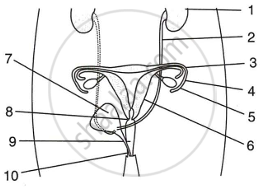 |
- Name the systems.
- Name the parts numbered 1-10.
- Describe the functions of the parts 3, 4, 5 & 6.
- What will happen if the part 3 on both sides gets blocked?
Define the term puberty.
Give the names:
Any two sexual diseases.
Give the names:
Methods of family planning.
Diagram shows the reproductive system of female human beings:
(i) Name the parts numbered 1 to 14.
(ii) Normally, after how many days does an ovary release an egg?
(iii) Where are the sperms released during coitus?
(iv) What is the role of sperms after their ejaculation in vagina?
(v) What is the function of the organ numbered 5?
(vi) What is the gestation period in human?

Name the following:
Male and Female organs on specific individuals.
Define the following:
Asexual reproduction
Define the following:
Gestation
Which one of the following statements about human sperm is correct?
Consider the following:
- The reductive division for the human female gametogenesis starts earlier than that of the male gametogenesis.
- The gap between the first meiotic division and the second meiotic division is much shorter for males compared to females.
- The first polar body is associated with the formation of the primary oocyte.
- Luteinising Hormone (LH) surge leads to disintegration of the endometrium and onset of menstrual bleeding.
Choose the correct answer from the options given below:
Which of the following correctly pairs a reproductive function with its description?
Which of the following is an example of a secondary sexual characteristic in humans?
