Advertisements
Advertisements
प्रश्न
Name the following:
Male and Female organs on specific individuals.
Advertisements
उत्तर
Testes and ovaries
संबंधित प्रश्न
What are sexually transmitted diseases?
What could be the reasons for adopting contraceptive methods?
fill in the blanks with suitable functions: Seminiferous Tubule and _____
Why is it an advantage for the testes to be situated in the scrotal sac outside the main body cavity? Can you think of one disadvantage?
What changes are seen in boys at the time of puberty?
Draw a labelled diagram of the human female reproductive system. With the help of this diagram, explain the working of human female reproductive system.
Explain why, fertilisation is possible if mating takes place during the middle of menstrual cycle.
Write the functions of secretions of prostate gland and seminal vesicles in humans.
The below diagram is of a developing embryo is a mother’s womb:
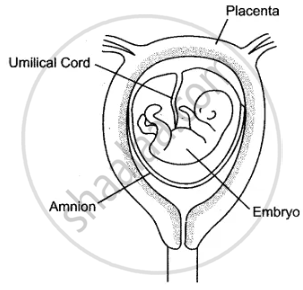
(i) Write the functions of the placenta, amnion, and umbilical cord.
(ii) How are the waste products of a fetus removed?
(iii) What is the gestation period?
Consider the following:
- The reductive division for the human female gametogenesis starts earlier than that of the male gametogenesis.
- The gap between the first meiotic division and the second meiotic division is much shorter for males compared to females.
- The first polar body is associated with the formation of the primary oocyte.
- Luteinising Hormone (LH) surge leads to disintegration of the endometrium and onset of menstrual bleeding.
Choose the correct answer from the options given below:
