Advertisements
Advertisements
प्रश्न
Match between the following representing parts of the sperm and their functions and choose the correct option.
| Column A | Column B | ||
| A. | Head | i. | Enzymes |
| B. | Middle piece | ii. | Sperm motility |
| C. | Acrosome | iii. | Energy |
| D. | Tail | iv. | Genetic material |
पर्याय
A-iv, B-iii, C-i, D-ii
A-iv, B-i, C-ii, D-iii
A-ii, B-i, C-iii, D-iv
A-ii, B-iv, C-i, D-iii
Advertisements
उत्तर
A-iv, B-iii, C-i, D-ii
APPEARS IN
संबंधित प्रश्न
Identify True/False statement. Correct false statement to make it true.
Leydig cells synthesise androgens.
Expand the following biological abbreviations: TSH
Differentiate between the following pair:
Bulbo-urethral gland and prostate gland
Differentiate
Urinogenital duct and Ureter.
State the Location:
Cowper’s glands
Multiple Choice Question:
Which one of the following Is the route that a sperm follows when it leaves the testes of a mammal?
In humans, sperm production occurs in the organ ______.
Name the secondary sex organs in males.
The increased level of estrogen and progesterone is responsible for menstruation.
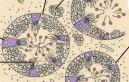
The given diagram represents T. S of
The ________ secrete testosterone after puberty.
ln the reproductive system of a male human being, the ejaculatory ducts open into ________.
Seminal plasma in humans is rich in ______.
Which of the following hormone maintains the function of male sex accessory gland and ducts?
During adolescence, several changes occur in the human body. Mark one change associated with sexual maturation in boys
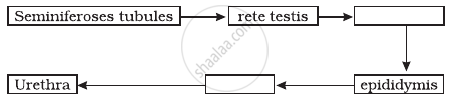
The path of sperm transport is given below. Provide the missing steps in blank boxes.
The canal through which each testis descends into the scrotum just before the birth of a male baby is ______.
Name these:
3 male accessory glands in humans.
Write important function of the following:
Testis
The figure given below is an important gonad of humans. Study the figure and answer the following questions.
 |
- Identify the organ. Write its specific location in the body.
- Label the parts shown in the figure as 1 to 4.
- Write important functions of parts 2 and 4.
- Name one cellular structure and one hormone which are produced in part 3.
- Draw a neat and labelled diagram of the cellular structure mentioned by you in (d).
