Advertisements
Advertisements
प्रश्न
Match between the following representing parts of the sperm and their functions and choose the correct option.
| Column A | Column B | ||
| A. | Head | i. | Enzymes |
| B. | Middle piece | ii. | Sperm motility |
| C. | Acrosome | iii. | Energy |
| D. | Tail | iv. | Genetic material |
विकल्प
A-iv, B-iii, C-i, D-ii
A-iv, B-i, C-ii, D-iii
A-ii, B-i, C-iii, D-iv
A-ii, B-iv, C-i, D-iii
Advertisements
उत्तर
A-iv, B-iii, C-i, D-ii
APPEARS IN
संबंधित प्रश्न
Describe the human male reproductive system.
____________ contribute about 60% of the total volume of the semen.
Give the functions of the following:
Testes
What differences are there in number, structure, and activity of the male and female gametes in a man?
Explain the term Scrotum.
Which hormone controls the secondary sexual characters in males?
Identify the labels (a, b, c, and d) in the given diagram of the male reproductive system.
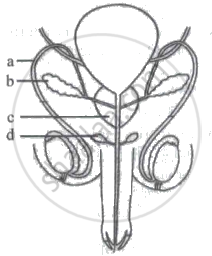
Semen is secreted by ______.
How many spermatozoa will be produced from 10 million spermatids?
Ejaculation of human male contains about 200 - 300 million sperms, of which for normal fertility ______% sperms must have normal shape and size and at least ______% must show energetic motility.
The primary sex organ of a human male is ______.
In human males, the testes lie in the scrotum, because it helps in the
Mature sperms in humans are stored in ______.
Vasa efferentia exist in between:
Describe the function of Bulbourethral glands.
In humans, sperm production occurs in the organ ______.
State very briefly the chief function of the following:
Cowper's gland
Can there be any abnormal situation regarding testes location? If so, what is that and what is the harm caused due to it?
What is the primary role of the testes?
The bulbourethral glands (Cowper's glands) are paired glands located at which anatomical position?
