Advertisements
Advertisements
प्रश्न
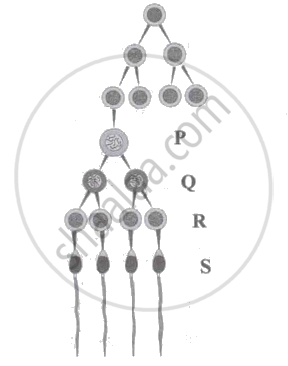
The spermatogonia undergo division to produce sperms by the process of spermatogenesis. Choose the correct one with reference to above.
पर्याय
Spermatogonia have 46 chromosomes and always undergo meiotic cell division
Primary spermatocytes divide by mitotic cell division
Secondary spermatocytes have 23 chromosomes and undergo second meiotic division
Spermatozoa are transformed into spermatids
Advertisements
उत्तर
Secondary spermatocytes have 23 chromosomes and undergo second meiotic division
APPEARS IN
संबंधित प्रश्न
The process of release of the ovum from a mature follicle is called ______.
Name the hormones involved in regulation of spermatogenesis.
Body breaks up into several fragments and each fragment starts to live as a new individual. This is ______ type of reproduction.
At the time of birth, there are _______________ oocytes in the ovary of a female foetus.
At what stage of development are the gametes formed in newborn male and female?
Identify the diploid cell.
Identify the correct stages (P - S) in the given diagram of spermatogenesis.
How many autosomes does a human primary spermatocyte have?
How many sperms are formed from a secondary spermatocyte?
Connective tissue around seminiferous tubules possess endocrine cells called ______.
Identify the wrong statement from the following.
At what stage of life is oogenesis initiated in a human female?
Which of the following is a primary sex organ of female?
Which of the following are called dual gland?
Penetration of the sperm in the ovum is followed by ______
Aquatic animals in which fertilisation occurs in water are said to be
In the process of fertilization, this is true:
If for a species 2n = 16, then during Ist prophase and IInd prophase of the meiotic division of a cell, how many tetrads and diads will be formed:
In human females, meiosis II is not completed until:
The process of gametogenesis is initiated by ______ and ______ hormones respectively.
