Advertisements
Advertisements
प्रश्न
Body breaks up into several fragments and each fragment starts to live as a new individual. This is ______ type of reproduction.
पर्याय
Budding
Fragmentation
Regeneration
Binary fission
Advertisements
उत्तर
Body breaks up into several fragments and each fragment starts to live as a new individual. This is fragmentation type of reproduction.
Explanation:
This type of asexual reproduction occurs in multicellular organisms. In this type of reproduction, the body of parent organism breaks up into many fragments and each fragment starts to live as an independent new organism.
संबंधित प्रश्न
Define spermiation.
Name the functions - Acrosome of sperm.
Explain the structure of secondary oocyte.
The glandular accessory organ which produces the largest proportion of semen is ____________.
The Androgen Binding Protein (ABP) is produced by ____________.
Which of the following are known as the nourishing cells present in the seminiferous tubules?
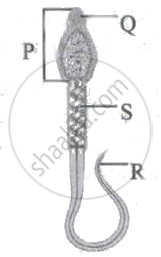
The part labelled as ______ contains the energy source that facilitates sperm motility.
Which of the following occurs during maturation phase of spermatogenesis?
The immature male germ cells differentiates into ______ at the end of meiosis I.
Extrusion of second polar body from egg nucleus occurs ______.
How many functional sperms and how many ova will be formed by a primary spermatocyte and a primary oocyte.
At what stage of life is oogenesis initiated in a human female?
During oogenesis, each diploid cell produces ______.
Head of epididymis is called as ______.
Mark the odd one.
Human milk differs from cow's milk because human milk contains:
Germ cells present in the seminiferous tubules undergo ______
How many primary oocytes produce one oogonia?
What are the two main types of gametogenesis based on the organ in which they occur?
