Advertisements
Advertisements
प्रश्न
The process of release of the ovum from a mature follicle is called ______.
Advertisements
उत्तर
The process of release of the ovum from a mature follicle is called ovulation.
Explanation:
The secondary oocyte forms a new membrane called the zona pellucida surrounding it. The Graafian follicle now ruptures to release the secondary oocyte (ovum) from the ovary, a process called ovulation.
संबंधित प्रश्न
Give the name and function for ‘A’ and ‘B’ from the diagram given below

The fusion of the male and the female gametes is called ______.
Draw a labelled diagram of sperm.
What is oogenesis?
Identify True/False statement. Correct the false statement to make it true.
Oogenesis takes place in the corpus luteum.
Describe the process of budding in hydra.
Explain the structure of secondary oocyte.
Describe the process of oogenesis in human female.
Expand the acronym.
LH
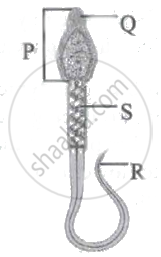
The part labelled as ______ contains the energy source that facilitates sperm motility.
Formation of ____________ is an indication of the termination of oogenesis.
Identify the proper order of spermatogenesis and choose the correct option.
Identify the longest period of menstrual cycle.
The immature male germ cells differentiates into ______ at the end of meiosis I.
The human male gamete is usually about ______ in length.
Conversion of spermatid into sperm is called as _______.
By which process sperms released from the seminiferous tubules?
Cavity of graafian follicle is ______.
Cells of corona radiata remain grouped together by ______.
Besides activating the egg another role of a sperm is to carry ______ to egg.
Which of the following groups of cells in the male gonad, represent haploid cells?
Which of the following are called dual gland?
The number of chromosome groups at the equatorial plate in metaphase-I of meiosis in a plant with 2n = 50 shall be:
Growth hormone of pituitary is more effective in ______.
How many spermatozoa are formed from one secondary spermatocyte?
Given below are two statements.
- Statement I: The spermatids are non-motile and non-functional which get transformed into functional spermatozoa by the process of spermiogenesis.
- Statement II: During the process of this change, the spermatids remain held to each other and to Leydig's cells by cytoplasmic bridges.
In light of the above statements, select the correct answer from the option given below.
During spermatogenesis meiosis occurs in ______.
Meiotic division of the secondary oocyte completed ______.
What is spermatogenesis?
Which gamete is produced through oogenesis?
