Advertisements
Advertisements
Question
The process of release of the ovum from a mature follicle is called ______.
Advertisements
Solution
The process of release of the ovum from a mature follicle is called ovulation.
Explanation:
The secondary oocyte forms a new membrane called the zona pellucida surrounding it. The Graafian follicle now ruptures to release the secondary oocyte (ovum) from the ovary, a process called ovulation.
RELATED QUESTIONS
Draw a diagram of the microscopic structure of human sperm. Label the following parts in it and write their functions:
- Acrosome
- Nucleus
- Middle piece
Male and female gametes are ______.
What is oogenesis?
______ type of reproduction occurs without fusion of gametes.
Body breaks up into several fragments and each fragment starts to live as a new individual. This is ______ type of reproduction.
Which precautions will you follow to maintain the reproductive health?
In angiosperms, the pollen germinates to produce a pollen tube that carries two gametes. What is the purpose of carrying two gametes when a single gamete can fertilize the egg?
At what stage of development are the gametes formed in newborn male and female?
Expand the acronym.
LH
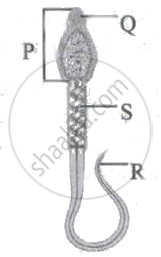
The part labelled as ______ contains the energy source that facilitates sperm motility.
Identify the diploid cell.
500 spermatozoa are formed from ____________ secondary spermatocytes.
Which of the following is diploid?
Draw a labelled diagram of a Graafian Follicle.
The human male gamete is usually about ______ in length.
By which process sperms released from the seminiferous tubules?
Corona radia is made up of ______.
How many functional sperms and how many ova will be formed by a primary spermatocyte and a primary oocyte.
Cells of corona radiata remain grouped together by ______.
The head of the epididymis at the head of the testis is called ______.
At what stage of life is oogenesis initiated in a human female?
Mark the odd one.
In human females, meiosis II is not completed until:
The spermatogonia undergo division to produce sperms by the process of spermatogenesis. Choose the correct one with reference to above.
What is the difference between a primary oocyte and a secondary oocyte?
Meiotic division of the secondary oocyte completed ______.
In our society the women are often blamed for giving birth to daughters. Can you explain why this is not correct?
Match List - I with List - IІ.
| List - I | List - II |
| A. Head | I. Enzymes |
| B. Middle piece | II. Sperm motility |
| C. Acrosome | ΙII. Energy |
| D. Tail | IV. Genetic material |
Choose the correct answer from the options given below:
