Advertisements
Advertisements
Questions
Describe the process of oogenesis in human female.
Explain the process of oogenesis in humans.
Advertisements
Solution
Oogenesis is a process of formation of the haploid female gamete i.e. egg or ovum from the diploid germinal epithelium. Oogenesis takes place in the ovaries and is initiated prior to birth of the female baby. It involves the process of mitosis and meiosis. This process can be divided into three stages:
- Multiplication phase: In this stage, the primary germinal cells - PGCs (2n) of ovary undergo repeated mitotic division to form millions of gamete mother cells or oogonial cells (2n). This process is completed in the embryonic stage of human females.
- Growth phase: Some of the oogonia stop division and begin to increase in size and form the primary oocytes (2n). Cellular organelles like ER, Golgi apparatus and mitochondria increase in number.
- Maturation phase:
- The primary oocytes (2n) enter the maturation phase, which includes meiotic division (Meiosis I and Meiosis II). The diploid primary oocytes undergo meiosis I (reduction division) to form two haploid daughter cells having 23 chromosomes. However, due to unequal division of cytoplasm, of the two daughter cells, one is a large cell, called secondary oocyte (n) and another is a small cell, called 1st polar body (n). Generally, the 1st polar body does not enter meiosis II.
- The secondary oocyte (n) proceeds only upto metaphase II of meiosis II and its division is further stopped or arrested at this stage. The secondary oocyte is shed from the Graafian follicle and ovary during ovulation. Meiosis II is completed only if fertilization occurs. This last phase is usually completed in the ampulla of the fallopian tube at the time of fertilization. In this division also, the two unequal daughter cells are formed i.e. the large cell is ovum (n) and the small cell is 2nd polar body (n). The ovum (n) so formed functions as the female gamete and is ready for fertilization. If the secondary oocyte is not fertilized by a sperm/spermatozoa, it is shed off along with menstruum.
APPEARS IN
RELATED QUESTIONS
Briefly describe the process of spermatogenesis.
Answer the following type of question Assertion (A) and Reason (R).
(A) - Head of the sperm consists of acrosome and mitochondria.
(R) - Acrosome contains spiral rows of mitochondria.
Give a schematic representation of spermatogenesis and oogenesis in humans.
The secondary oocyte enter into the fallopian tube through the ______.
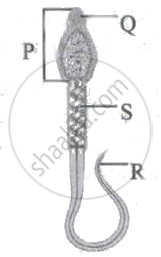
The part labelled as ______ contains the energy source that facilitates sperm motility.
500 spermatozoa are formed from ____________ secondary spermatocytes.
The immature male germ cells differentiates into ______ at the end of meiosis I.
Four primary spermatocytes give rise to ______.
The human male gamete is usually about ______ in length.
In human beings, the largest cell formed during Oogenesis is ______
Acrosome reaction in sperm is triggered by ______.
It The cell division in secondary oocyte is suspended at ______.
Corona radia is made up of ______.
Spermiation is the process of the release of sperm from ______.
Which of the following groups of cells in the male gonad, represent haploid cells?
After the release of the secondary oocyte, the Graafian follicle develops into ______.
Mark the odd one.
Penetration of the sperm in the ovum is followed by ______
Sketch and label the process of oogenesis.
