Advertisements
Advertisements
Questions
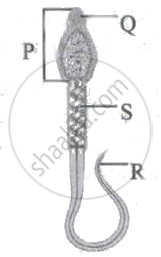
Draw a diagram of the microscopic structure of human sperm. Label the following parts in it and write their functions:
- Acrosome
- Nucleus
- Middle piece
Draw a diagram of a mature human sperm. Label any three parts and write their functions.
Explain the structure of human sperm with labelled diagram.
With the help of a neat labelled diagram, describe the structure of human sperm.
Advertisements
Solution 1
Structure of human sperm

Function of Acrosome: It releases various chemicals like hyaluronidase and acrosin which helps sperm in fusing with egg cell.
Function of Nucleus: It stores the genetic information. It carries 23 chromosomes, out of which one is sex chromosome (either X or Y). Thus, it is responsible for determining the sex of the individual.
Function of Middle piece: The middle piece contains several mitochondria, which produce energy for the motility of the sperm.
Solution 2

- Head: It the flat oval part of the human sperm that contains the nucleus, containing genetic material, and acrosome, a small anterior part which is formed from Golgi complex. It secretes hyaluronidase enzyme which helps in the entry of sperm into the egg.
- Middle Piece: It is the middle, cylindrical portion of the sperm, which contains numerous mitochondria. They provide energy (ATP) to the sperm for its movement.
- Tail: It is the long, tapering structure composed of cytoplasm. It helps in the movement of the sperms inside the uterus.
Solution 3

Sperm is the male gamete. It is a motile, microscopic and elongated cell. The sperm is divisible into three parts: Head, middle piece, and tail.
- Head: The sperm head is oval in shape and contains haploid nucleus. Above the nucleus, there is a cap like structure called acrosome which is formed from the Golgi body. Acrosome contains hydrolytic enzymes like hyaluronidase and proteolytic enzymes like zona lysins and corona penetrating enzymes.
- Neck: It is a very short region having two centrioles, i.e. proximal centriole and distal centriole.
- Middle piece: It has an axial filament surrounded by 10-14 spiral turns of mitochondria (Nebenkern). It produces energy necessary for the movement of sperm.
- Tail: It is a long, slender, and tapering part containing cytoplasm and a fine thread, i.e., an axial filament. The axial filament arises from the distal centriole and travels throughout the length of the tail. It is partly surrounded by the plasma membrane (main piece). The part without plasma membrane is called end piece.
Notes
Students should refer to the answer according to their question and preferred marks.
APPEARS IN
RELATED QUESTIONS
Name the hormones involved in regulation of spermatogenesis.
What is gamete formation?
The glandular accessory organ which produces the largest proportion of semen is ____________.
Define gametogenesis.
Identify the given image and label its parts marked as a, b, c and d
Expand the acronym.
LH
The part labelled as ______ contains the energy source that facilitates sperm motility.
Identify the diploid cell.
Formation of ____________ is an indication of the termination of oogenesis.
The cell which undergoes meiosis I during spermatogenesis is the ______.
How many functional sperms and how many ova will be formed by a primary spermatocyte and a primary oocyte.
A reaction of granules content which harden the zona pellucida and ensures sure block to polyspermy is ______.
Preparation of sperm before penetration of ovum is ______.
Mark the odd one.
What does the figure represent?

In spermatogenesis, at the end of the first meiotic division ______ are formed.
The diagram given below shows the various steps in spermatogenesis.

- Name the parts labelled '1', '2' and '3'.
- Name the process by which part '3' changes to part '4'.
The process of gametogenesis is initiated by ______ and ______ hormones respectively.
Which gamete is produced through oogenesis?
