English
Karnataka Board PUCPUC Science 2nd PUC Class 12

The membranous cover of the ovum at ovulation is ______. - Biology

Advertisements
Advertisements

Question

The membranous cover of the ovum at ovulation is ______.

Options

  • Corona radiata

  • Zona radiata

  • Zona pellucida

  • Chorion

MCQ
Fill in the Blanks
Advertisements

Solution

The membranous cover of the ovum at ovulation is corona radiata.

Explanation:

The corona radiata is the membranous cover of the ovum at ovulation, formed by the layers of follicular cells surrounding the ovum. It provides nutrients and protection to the ovum during ovulation.

shaalaa.com
  Is there an error in this question or solution?
Chapter 3: Human Reproduction - MULTIPLE CHOICE QUESTIONS [Page 20]

APPEARS IN

NCERT Exemplar Biology [English] Class 12
Chapter 3 Human Reproduction
MULTIPLE CHOICE QUESTIONS | Q 17. | Page 20
Nootan Biology [English] Class 12 ISC
Chapter 3 Human Reproduction
TEST YOUR PROGRESS | Q 1. 98. | Page 109

RELATED QUESTIONS

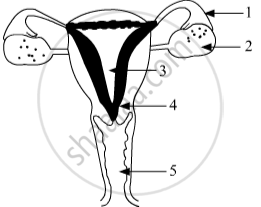
Draw a sectional view of human female reproductive system and label the part where

(i) eggs develop.

(ii) fertilisation takes place.

(iii) fertilised egg gets implanted.


State its functions in case of a pregnant human female.


Describe the function of placenta.


Newly formed DNA copies may not be identical at times. Give one reason.


State the main function of the Leydig cells


Differentiate between Sperm duct and fallopian rube (function)


The site of maturation of human sperms is the


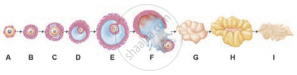
Given below are diagrams showing the different stages in the process of fertilisation of an egg. in the human female reproductive tract.

Study the diagrams and answer the questions:

1) Arrange the letters given below each diagram in a logical sequence to show the correct order in the process of fertilisation.

2) Where does fertilisation normally take place? and What is ‘Implantation’ that follows fertilisation?

3) Mention the chromosome number of the egg and zygote in humans.

4) Explain the term ‘Gestation’. How long does Gestation last in humans?

5) Draw a neat, labelled diagram of a mature human sperm.


Where is the male gamete formed  in humans?


Where in the human body does an ovum get fertilised?


Name the organs which produce ova (or egg cells) in human females.


What is ovulation? How often does it happen in human females?


Which among the following are not the functions of testes at puberty?

(i) formation of germ cells
(ii) secretion of testosterone
(iii) development of the placenta
(iv) secretion of estrogen


The normal body cell of an organism contains 28 pairs of chromosomes. The number of chromosomes present in its germ cell will be
(a) 28
(b) 14
(c) 56
(d) 42


When a fertilised egg E formed in the oviduct of a human female divides repeatedly to form an embryo, the embryo gets implanted in the thick and soft lining of the uterus. After this a disc-like special tissue T develops between the uterus wall and embryo through which all the requirements of the developing embryo (and foetus) are met from the mother's body, The embryo is connected to the tissue T through a string like structure S.
(a) What is the other name of fertilised egg cell E?
(b) What is the name of tissue T?
(c) Name the string-like structure S.
(d) Name two substances which pass from mother's blood to embryo through tissue T and, one type of substance which passes from embryo to mother's blood.
(e) What happens to S when the baby is born? Why?


When a female child is born, her ovaries already contain thousands of immature eggs (or ova) contained in immature structures A. On maturing, A bursts open and an egg shoots out of the ovary in a process called B. The process B starts in the females at puberty and occurs again and again after a time period x. Before every occurrence of process B, the inner lining of uterus becomes thick and soft with lots of blood vessels in it. When the egg cell gets fertilised by a sperm, then an event C occurs in the life of mature human female which lasts for time period leading to the birth of baby. If, however, the egg cell released by the ovary does not get a sperm to fuse with, then the thick and soft inner lining of uterus breaks down and comes out of the female's body in an event called D. The occurrence of event D is controlled by chemical substances E.
(a) What are A?
(b) What is process B?
(c) What is the time period x?
(d) Name the event C.
(e) How much is the time period y?
(f) What is the name of process D?
(g) Name the chemical substances E.


Given below is a diagram of two systems together in the human body.

  1. Name the systems.
  2. Name the parts numbered 1-10.
  3. Describe the functions of the parts 3, 4, 5 & 6.
  4. What will happen if the part 3 on both sides gets blocked?

What is fertilisation?


Mention the two functions of human testis.


Describe in brief the role of testis in human male reproductive system.


List and explain in brief three methods of contraception.


Draw a diagram of human female reproductive system and label the part.

(i) That produces eggs.

(ii) Where fusion of egg and sperm take place.

(iii) Where zygote is implanted.

What happens to human egg when it is not fertilized?


Name the following:
Male and Female organs on specific individuals.


Mention, if the following statement is True or False. If false rewrite the wrong statement in its correct form:

A zygote is the product of the fusion of male and female gametes.


Column ‘II’ is a list of items related to ideas in Column ‘I’. Match the term in Column ‘II’ with a suitable idea given in Column ‘I’.

Column I Column II
(i) Acrosome

(ii) Ovulation

(iii) Sperm

(iv) Menopause

(v) Implantation

(vi) Fertilization

(vii) Contraception in males

(a) Male gamete

(b) Oviduct

(c) Uterus

(d) Spermatozoa

(e) Progesterone

(f) Stoppage of the menstrual cycle

(g) Sudden change in genes


Choose the Odd One Out:


The living organisms can be unexceptionally distinguished from the non-living things on the basis of their ability for ______.


Reproductive organs are also considered endocrine glands.


Share
Notifications

Englishहिंदीमराठी


      Forgot password?
Use app×