Advertisements
Advertisements
प्रश्न
The membranous cover of the ovum at ovulation is ______.
विकल्प
Corona radiata
Zona radiata
Zona pellucida
Chorion
Advertisements
उत्तर
The membranous cover of the ovum at ovulation is corona radiata.
Explanation:
The corona radiata is the membranous cover of the ovum at ovulation, formed by the layers of follicular cells surrounding the ovum. It provides nutrients and protection to the ovum during ovulation.
APPEARS IN
संबंधित प्रश्न
Draw a sectional view of human female reproductive system and label the part where
(i) eggs develop.
(ii) fertilisation takes place.
(iii) fertilised egg gets implanted.
If a woman is using copper-T for contraception, will it protect her from sexually transmitted diseases?
State the changes that take place in the uterus when Implantation of embryo has occurred
The diagram shown below is the longitudinal section of a testis of man. Study it carefully and answer the questions that follow

(i) Label the parts numbered 1 to 3 in the diagram.
(ii) In which part of the testis are the sperms produced?
(iii) State the functions of the parts labelled 1 and 3 in the diagram.
State the main function of the corpus luteum.
Differentiate between Sperm duct and fallopian rube (function)
Describe in brief the structure of placenta
Where is the male gamete formed in humans?
What is the scientific name of womb?
Explain why, fertilisation is possible if mating takes place during the middle of menstrual cycle.
Which one of the following best describes the function of the umbilical cord? It :
(a) feeds the embryo with digested substances.
(b) conveys nutrients and wastes to and from the embryo respectively
(c) removes waste matter from the embryo to the mother's blood.
(d) supplies oxygenated blood from the mother to the embryo.
During adolescence, several changes occur in the human body. Mark one change from the following associated with sexual maturation in boys.
The ratio of the number of chromosomes in a human zygote and a human sperm is ______
Write the functions of secretions of prostate gland and seminal vesicles in humans.
Complete the following statement by choosing the correct alternative:
Sterilization in female is due to cutting off of ______.
Give the functions of the following:
Vagina
Define the following:
Asexual reproduction
Identify the given diagram.
Name the parts 1 to 5. 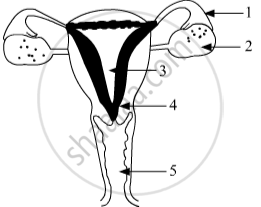
What do you understand by an inguinal hernia?
Name the Following
What does this abbreviation stand for FSH?
Column ‘II’ is a list of items related to ideas in Column ‘I’. Match the term in Column ‘II’ with a suitable idea given in Column ‘I’.
| Column I | Column II |
| (i) Acrosome
(ii) Ovulation (iii) Sperm (iv) Menopause (v) Implantation (vi) Fertilization (vii) Contraception in males |
(a) Male gamete
(b) Oviduct (c) Uterus (d) Spermatozoa (e) Progesterone (f) Stoppage of the menstrual cycle (g) Sudden change in genes |
Choose the Odd One Out:
Choose the Odd One Out:
How does human sperm locomote?
Freshly released human egg has ______.
During adolescence, reproductive phase starts and ______.
Distinguish between Vasa efferentia and Vasa deferentia.
Given below is a group of terms. In the group, one pair indicates the relationship between the two terms. Rewrite and complete the second pair on a similar basis.
Female gonad : Ovaries :: Male gonad : ______.
