Advertisements
Advertisements
प्रश्न
Choose the Odd One Out:
विकल्प
Testis
Penis
Oviduct
Seminiferous tubules
Advertisements
उत्तर
Oviduct
संबंधित प्रश्न
Explain how the embryo gets nourishment inside the mother’s body.
Differentiate between Sperm duct and fallopian rube (function)
State the main function of the Sperm duct.
Choose the ODD one out from the following terms given and name the CATEGORY to which the others belong:
Prostate gland, Cowper’s gland, seminal vesicle, seminiferous tubules.
What do the testes in a man produce?
When a female child is born, her ovaries already contain thousands of immature eggs (or ova) contained in immature structures A. On maturing, A bursts open and an egg shoots out of the ovary in a process called B. The process B starts in the females at puberty and occurs again and again after a time period x. Before every occurrence of process B, the inner lining of uterus becomes thick and soft with lots of blood vessels in it. When the egg cell gets fertilised by a sperm, then an event C occurs in the life of mature human female which lasts for time period y leading to the birth of baby. If, however, the egg cell released by the ovary does not get a sperm to fuse with, then the thick and soft inner lining of uterus breaks down and comes out of the female's body in an event called D. The occurrence of event D is controlled by chemical substances E.
(a) What are A?
(b) What is process B?
(c) What is the time period x?
(d) Name the event C.
(e) How much is the time period y?
(f) What is the name of process D?
(g) Name the chemical substances E.
Describe in brief the role of prostate gland in human male reproductive system.
Choose the correct answer:
When pregnancy does not occur, the life of corpus luteum is about _____________
Give the functions of the following:
Vagina
The following is the illustration of the sequence of ovarian events (a-i) in a human female.
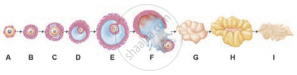
Write the difference between C and H.
