Advertisements
Advertisements
प्रश्न
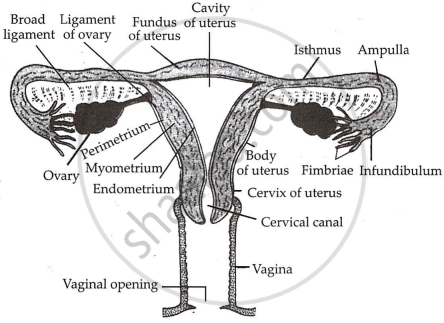
Draw a labelled diagram of the female reproductive system.
Advertisements
उत्तर १

उत्तर २
संबंधित प्रश्न
Draw a diagrammatic sectional view of the female reproductive system of human and label the parts
(i) where the secondary oocytes develop
(ii) which helps in collection of ovum after ovulation
(iii) where fertilization occurs
(iv) where implantation of embryo occurs.
Put a tick mark (✓) against the correct alternative in the following statement:
Internally, the uterus opens into:
Fill in the blank:
The time between fertilisation and birth is called _________.
What happens in a girl’s body under the influence of hormones?
In female, after how much time after fertilization, does the fertilized egg get implanted in the
uterine wall?
Differentiate between:
Implantation and pregnancy
Choose the correct answer:
The onset of menstruation in the female is termed __________
Name the following:
The part of the female reproductive system in which fertilization occurs.
Name the following:
Organ producing ovum.
Explain the term Graffian follicle.
Complete the following sentences with appropriate word:
The female equivalent of the penis is the _______.
State the Location:
Ovary
Which of the following is not a part of female reproductive system?
After fertilization the ovary develops into ______.
Name the part of the human female reproductive system where the following occurs.
Fertilization
Name the part of the human female reproductive system where the following occurs.
Implantation
The pair of thin folds present inner to the labia majora is ____________.
Identify the layer of the uterine wall that undergoes changes during menstrual cycle.
A sac shaped like an upside down pear with a thick lining and muscles in the pelvic area where a fertilized egg or zygote comes to grow into a baby is called ______.
Lower narrow end of uterus is called ______.
Bartholin’s glands are situated ______.
The finger-like projections, called fimbriae, help in the collection of ovum into the fallopian tube following ovulation.
Mark the odd one.
The period during adolescence when the reproductive tissues begin to mature is called ______
Read the following and answer from given below:
During copulation, semen is released by the penis into the vegina. The motile sperms swim rapidly, fuse with the ovum in the ampullary region, resulting in fertilization. The haploid nucleus of sperm fuses with that of the ovum to form a diploid zygote.
In the female genital tract, sperms are made capable of fertilizing the egg. This phenomenon of sperm activation is called ______
In human females, an event that reflects onset of reproductive phase is
Which among the following is not the function of testes at puberty?
- formation of germ cells
- secretion of testosterone
- development of placenta
- secretion of estrogen
What is placenta? Mention its role during pregnancy?
In human beings, the correct sequence of events during reproduction is
Mother gives birth to a baby but the baby has characters of both parents. How is this possible?
In rabbits, humans and other placental mammals, fertilization occurs in ______.
With a suitable diagram, describe the organisation of mammary gland.
______ is not a part of the female reproductive system in human beings.
Give reason.
Placenta is extremely essential for foetal development.
Give reason:
Uterine lining becomes thick and spongy after fertilisation.
Describe the female reproductive systems in humans.
The diagram given below shows a section of the human ovary.
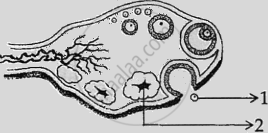
- Name the process for the release of the part labelled 1.
- Write the name of the structure marked 2.
The ______ is also called the womb.
Clitoris is equivalent to the male penis.
Name these:
2 hormones secreted from the corpus luteum.
Choose the odd one out from the group of terms given below and write the category for the remaining terms:
Write the specific location of the following:
Vagina
Define the following term:
Hymen
Female gametes, namely ova/ovum, are produced through which process?
Which sequence correctly traces the milk pathway from alveoli to nipple?
