Advertisements
Advertisements
प्रश्न
Write two major functions of testis.
Advertisements
उत्तर
- They produce male gametes called spermatozoa by the process of spermatogenesis.
- The leydig cells of the seminiferous tubules secrete the male sex hormone called testosterone. Testosterone aids in the development of secondary sex characteristics in males.
संबंधित प्रश्न
What are the major components of seminal plasma?
State the function of Seminal vesicle.
Fill in the blank:
Male gemetes are produced inside _______.
Describe the male reproductive systems in humans.
Name the following :
The body part in which the testes are present in a human male.
Differentiate between the following pair:
Bulbo-urethral gland and prostate gland
Mention, if the following statement is True or False. If false rewrite the wrong statement in its correct form:
Tubectomy involves the cutting and tying of the vas deferens in males.
Find an odd one out.
Write the functions of penis
State names of organs in male reproductive system.
Which of the following correctly describes the gubemaculum?
Which of the following is a secondary sexual character observed in males?
Identify the INCORRECTLY labelled structure in the given diagram of the male reproductive system.
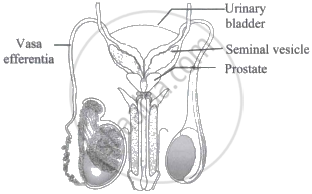
Which of the following correctly describes the rete testis?
How much semen is generally present in seminal fluid?
Which is the duct that carries sperms from testes and opens into the epididymis?
Identify the correct sequence of layers that cover the testis (outside to inside).
The correct sequence of spermatogenetic stages leading to the formation of sperms in a mature human testis is ______.
Seminal plasma in humans is rich in ______.
Seminal plasma, the fluid part of semen is formed by ______.
Temperature of the scrotum which is necessary for the functioning of testis is always ______ around below body temperature.
The primary sex organ of a human male is ______.
The correct sequence of organs in the male reproductive system for transport of sperms is
Give two reasons for the appearance of variations among the progeny formed by sexual reproduction.
What is the length of the sperm?
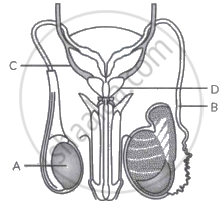
Identify A, B, C, D, in the given diagram of the human reproductive system:
Draw a neat labeled diagram of T.S. of testis.
What is the significance of the testes being located in scrotal sacs outside the abdomen?
In humans, sperm production occurs in the organ ______.
List two roles of the Testis in the human reproductive system.
Match the items given in Column I with the most appropriate ones in Column II and rewrite the correct matching pairs:
| Column I | Column II | ||
| (a) | Leydig Cells | 1. | Lack of thyroxine in children |
| (b) | Stoma | 2. | 12 pairs |
| (c) | Ova | 3. | Testosterone |
| (d) | Cranial nerve | 4. | Diffusion of respiratory gases |
| (e) | Cretinism | 5. | Haploid cells |
| 6. | 31 Pairs | ||
| 7. | Diploid cells |
Statement I: Vas deferens receives a duct from seminal vesicle and opens into urethra as the ejaculatory duct.
Statement II: The cavity of the cervix is called cervical canal which along with vagina forms birth canal.
In the light of the above statements, choose the correct answer from the options given below:
What is the whitish, viscous fluid secreted by glands along with spermatozoa called?
In which anatomical region is the male reproductive system located?
Which accessory ducts are responsible for sperm transport and maturation in their correct sequence?
What is the primary function of Leydig cells (interstitial cells)?
What is formed by the junction of the vas deferens and the seminal vesicle duct?
Which three glands produce secretions that collectively form the seminal plasma?
The prostate gland is a single gland located at which position?
