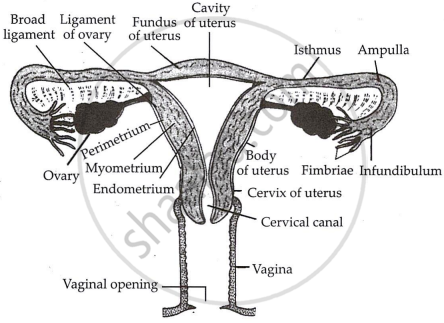
Draw a labelled diagram of the female reproductive system.
Advertisements
Question
Draw a labelled diagram of the female reproductive system.
Advertisements
Solution 1

Solution 2
RELATED QUESTIONS
Draw a diagrammatic sectional view of the female reproductive system of human and label the parts
(i) where the secondary oocytes develop
(ii) which helps in collection of ovum after ovulation
(iii) where fertilization occurs
(iv) where implantation of embryo occurs.
Fill in the blank:
Development of baby (foetus) takes place inside __________.
Choose the odd one in each of the following:
Ovary; fallopian tube; ureter; uterus
The following diagram represents the vertical sectional view of the human female reproductive system.
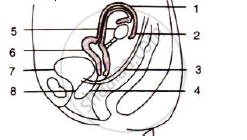
Label the parts indicated by the guidelines 1 to 8.
Explain the concept of IVF.
Name the two types of twins.
Give appropriate term of the following:
The rupture of follicle and release of ovum from the ovary.
Give appropriate term of the following:
The process of fusion of ovum and sperm.
Choose the correct answer:
Cervix is a part of ________________
Given here is a section of the female reproductive system of human beings.
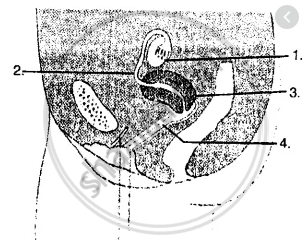
Name the part where fertilisation occurs in human beings.
Why is zona pellucid retained around the egg till it reaches the uterus?
Differentiate between the graafian follicle and corpus luteum.
The below diagram represents the vertical view of the human female reproductive system.
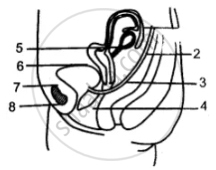
(i) Label the parts indicated by the guidelines 1 to 8.
(ii) How does the uterus prepare for the reception of a zygote?
(iii) What happens to the uterus if fertilization takes place?
(iv) What happens to the uterus if fertilization has failed to take place?
Name the Following
The age or period when the reproductive organs become fully operational.
Hormones secreted by the ovary of the female reproductive system.
Estrogen is secreted by ______
A neat labelled diagram describes the parts of a typical angiospermic ovule.
What is the other term used for fallopian tube?
Which of the following are accessory ducts of female reproductive system?
Development of mammary glands is controlled by ____________.
Contraction of which muscles are responsible for causing labour during parturition?
Which of the following is ectodermal in origin?
| (i) | Heart |
| (ii) | Sweat glands |
| (iii) | Adrenal medulla |
| (iv) | Middle ear |
| (v) | Urinary bladder |
| (vi) | Dermis of skin |
The part of fallopian tube closest to the ovary is ______.
When both ovaries are removed from rat which hormone is decreased in blood?
Which part of ovary in mammals acts as an endocrine gland after ovulation?
The second maturation division of the mammalian ovum occurs ______.
In oocyte secondary maturation occurs in ______.
Read the following and answer from given below:
During copulation, semen is released by the penis into the vegina. The motile sperms swim rapidly, fuse with the ovum in the ampullary region, resulting in fertilization. The haploid nucleus of sperm fuses with that of the ovum to form a diploid zygote.
In the female genital tract, sperms are made capable of fertilizing the egg. This phenomenon of sperm activation is called ______
Read the following and answer from given below:
Oogenesis is the process of the formation of an ovum in the ovaries. It consists of three phases: multiplication, growth, and maturation. Oogenesis is controlled by hormones GnRH, LH, FSH. GnRH secreted by the hypothalamus stimulates the anterior lobe of the pituitary gland to secrete LH and FSH.
Which hormone induces the rupture of the mature Graafian follicle?
Capacitation occurs in:
Which is a pear-shaped muscular organ in females?
Progesterone is secreted by ______.
______ receives the sperms and acts as a birth canal during childbirth.
Female reproductive organs and associated functions are given below in column A and B. Fill the blank boxes.
| Column A | Column B |
| Ovaries | Ovulation |
| Oviduct | a |
| b | Pregnancy |
| Vagina | Birth |
Give reason:
Uterine lining becomes thick and spongy after fertilisation.
The vaginal orifice is covered by a fold of membrane called hymen ______.
Bartholin's glands are homologous to ______.
Given below is a group of terms. In the group, one pair indicates the relationship between the two terms. Rewrite and complete the second pair on a similar basis.
Leydig cells : Testosterone : ______ : Oestrogen.
Choose the odd one out from the group of terms given below and write the category for the remaining terms:
Write the specific location of the following:
Uterus
The figure given below is the human female reproductive system. Study the same and answer the following questions.
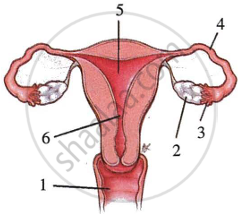
- Label the guidelines 1 to 6 shown in the figure.
- What is the normal gestation period in human?
- Where are the sperms released during coitus?
- Write two important functions of part 2.
- Mention the technical term for the fixing of developing zygote to the uterine wall.
Statement I: The presence or absence of hymen is not a reliable indicator of virginity.
Statement II: The hymen is torn during the first coitus only.
In the light of the above statements, choose the correct answer from the options given below:
Which description correctly identifies the uterus?
Which uterine layer contracts strongly during childbirth delivery?
How many mammary lobes does each breast have?
Which sequence correctly traces the milk pathway from alveoli to nipple?
